

Article
- +1
Toby Dalton, Mark Hibbs, Nicole Grajewski, …
{
  "authors": [
    "Mark Hibbs"
  ],
  "type": "legacyinthemedia",
  "centerAffiliationAll": "dc",
  "centers": [
    "Carnegie Endowment for International Peace"
  ],
  "collections": [],
  "englishNewsletterAll": "ctw",
  "nonEnglishNewsletterAll": "",
  "primaryCenter": "Carnegie Endowment for International Peace",
  "programAffiliation": "NPP",
  "programs": [
    "Nuclear Policy"
  ],
  "projects": [],
  "regions": [],
  "topics": [
    "Security",
    "Nuclear Policy"
  ]
}
Source: Getty
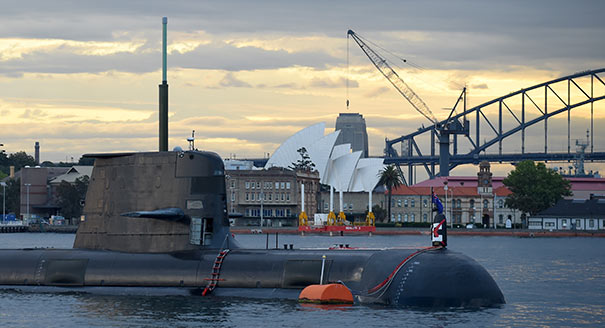
Australia’s discussion about its submarines should remind anyone who has forgotten it that nuclear fission reactors fueled with uranium are “strategic” technology, and that a changing geostrategic environment will put time-honored non-proliferation policies under pressure.
Source: Arms Control Wonk
Australia for many reasons is an exceptional country, including in the nuclear policy area: Nuclear weapons were tested on Australian territory, Australia owns intellectual property for enriching uranium, and uranium mined in the outback today fuels the world’s peaceful nuclear applications, but Australia has no nuclear weapons and it produces no nuclear electricity. And so far, Australia has no nuclear submarines.
This morning in Berlin the Frankfurter Allgemeine Zeitung brought to my breakfast table a tempest in a teapot that was brewed down under last week. Tony Abbott, a member of the Australian Parliament who served as Prime Minister for a Liberal government from 2013 through 2015, on June 29 and thereafter told anyone willing to listen that Australia should think hard about building nuclear-driven submarines in its ongoing effort to upgrade its naval defenses. That probably won’t happen anytime soon, but Australia’s discussion about its submarines including last week should remind anyone who has forgotten it that nuclear fission reactors fueled with uranium are “strategic” technology, and that a changing geostrategic environment will put time-honored non-proliferation policies under pressure.
Germany’s leading serious newspaper today reported on Abbott’s comments because back in April 2016 Thyssen Krupp Marine Services (TKMS) had lost out in a competition to Naval Group a.k.a. DCNS of France; the Australian government picked the French firm to build 12 submarines for the price of 50 billion dollars. Australia chose the French to build conventional submarines. But, according to the FAZ, “the order could be redefined at any time” to specify nuclear-powered craft. When the German firm dropped out of the race to build Australian boats, it asserted darkly, “behind the scenes it was suspected that that had happened because the Germans offer no nuclear option.” (The above-linked article from 15 months ago in fact mentioned the French vendor’s atomic advantage over TKMS.)
Instead, Abbott said in a statement flavored with skepticism, Australia will “take a French nuclear submarine and completely redesign it to work with conventional propulsion.” He urged Australia to reconsider the case for nuclear-propelled vessels in the country’s long-term interest, especially given Australia’s marine security environment and naval technology developments in China, India, Japan, Russia, and the United States.
Discussion of a possible Australian nuclear navy follows upon previous protracted debate in Australia about whether to generate electricity with nuclear reactors. Abbott has elsewhere elaborated on this theme, regretting that Australia, including under his tenure as Prime Minister, has repeatedly brushed off nuclear power, and asserting that “Australia could develop a nuclear servicing industry from scratch within about 15 years,” in time to commission nuclear-propelled submarines that could be built by French or U.S. firms. That of course would beg the hypothetical question whether Australia would finally dust off its nearly half-century-old gas centrifuge blueprints, or instead use laser technology it more recently pioneered, to enrich Australian uranium needed to fuel future fission-powered vessels. It also would raise the (still more-hypothetical) question whether the fuel for such submarines would be under IAEA safeguards 24/7 (it was Australia that in 1978 prompted the IAEA Director General to establish for the record that a state with safeguards obligations couldn’t decide that sensitive matter by itself).
In recent years Australian federal and state governments have carried out very transparent and visible investigations of the country’s various nuclear “options,” including nuclear power generation, commercial uranium enrichment, and disposal of highly-active nuclear waste and spent fuel. Australia has the world’s largest reserves of uranium, and is the world’s third leading uranium producer after Kazakhstan and Canada, but Australians appear to remain profoundly disinclined to use the uranium they produce on their territory–to say nothing about ships patrolling international waters in the Pacific and Indian oceans.
The question raised by Abbott last week re-litigates a debate that got underway over a decade ago even before Australia prepared to upgrade its naval defenses. The above-linked 2006 government report on nuclear energy included a submission from the Submarine Institute of Australia. When Australia began preparing to beef up its naval might, in 2013, predictably, nuclear nonproliferators warned of the governance perils an Australian nuclear navy would unleash, while defense strategists countered that nuclear-propelled submarines would protect Australia best. In fact Abbott’s own government in 2015 was itself not prepared to champion the case for a nuclear navy–a point that Abbott’s critics now raise in the wake of his remarks.
Abbott said on June 29 that while “conventional subs need to surface frequently to recharge their batteries, need to refuel every 70 days, and can only briefly maintain a top speed of about 20 knots, nuclear powered submarines can stay submerged as long as the crew can endure, never have to refuel, and can travel at nearly 40 knots.” Even if Australian military leaders beset with the future consequences of China’s naval buildup were to conclude that these were decisive advantages, Abbott’s previous lack of enthusiasm would suggest that the road toward a nuclear navy might be paved with political risks including for Australia’s strategic community; what’s in print suggests there may be no internal consensus on this issue. Following from Canberra’s firm and longstanding nuclear non-proliferation commitment, as the above-cited 1978 interaction with the IAEA bears witness, Australia today would not welcome the emergence of navies powered by uranium withdrawn from IAEA safeguards. Ultimately, it is hard to believe that Australians who until now have been wary of deploying climate change-mitigating power reactors at home would in the near term favor using the same technology to propel their country’s navy on the high seas.
This article was originally posted in Arms Control Wonk.
Correction: This article originally stated that the Australian government picked a French firm to build 18 submarines for the price of 50 billion dollars. This has been changed to 12 submarines.

Nonresident Senior Fellow, Nuclear Policy Program
Hibbs is a Germany-based nonresident senior fellow in Carnegie’s Nuclear Policy Program. His areas of expertise are nuclear verification and safeguards, multilateral nuclear trade policy, international nuclear cooperation, and nonproliferation arrangements.
Recent Work


Toby Dalton, Mark Hibbs, Nicole Grajewski, …
Mark Hibbs
Carnegie does not take institutional positions on public policy issues; the views represented herein are those of the author(s) and do not necessarily reflect the views of Carnegie, its staff, or its trustees.

With its public finances in shambles, the far right polling at 35 percent ahead of the 2027 presidential election, and a growing protest movement, is France’s crisis a threat to the EU’s geopolitical awakening?

Rym Momtaz, ed.

Europe is facing rising populism internally as well as external pressures from Russia, China, Turkey, and the United States.

Dimitar Bechev

The new U.S.–Denmark–Greenland agreement will help Washington exert political, economic, and financial dominance under the guise of security. Yet, it acknowledged Copenhagen’s and Nuuk’s sovereignty on the island.

Marc Pierini

A summer of escalation in the Black Sea has hurt Ukraine economically and is exacerbating world food security. A truce is needed—as is a broader reframing of Europe’s Ukraine strategy.

Thomas de Waal

Are Germany’s economic, industrial, and political struggles becoming a liability for the EU’s ability to rise to the geopolitical moment?
Rym Momtaz, ed.