

Q&A
Eugene Rumer
{
  "authors": [
    "Eugene Rumer"
  ],
  "type": "other",
  "centerAffiliationAll": "dc",
  "centers": [
    "Carnegie Endowment for International Peace",
    "Carnegie China"
  ],
  "collections": [
    "China’s Foreign Relations"
  ],
  "englishNewsletterAll": "ctw",
  "nonEnglishNewsletterAll": "",
  "primaryCenter": "Carnegie Endowment for International Peace",
  "programAffiliation": "russia",
  "programs": [
    "Russia and Eurasia"
  ],
  "projects": [],
  "regions": [
    "East Asia",
    "China",
    "Russia"
  ],
  "topics": [
    "Foreign Policy"
  ]
}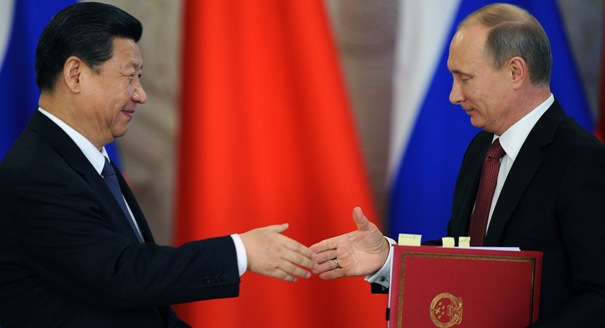
Source: Getty
Russia’s relations with China have undergone a complete transformation in the past quarter century and have developed into a genuine strategic partnership, despite the Kremlin’s junior partner status.
Source: National Bureau of Asian Research
This essay considers Russian-Chinese relations from the perspective of Russia, challenges some of the widely held assumptions about Russian foreign policy and its goals, examines the key drivers of Russian policy toward China, and concludes with implications for U.S. interests.
Russia’s relations with China have undergone a complete transformation in the past quarter century and have developed into a genuine strategic partnership. Although the Kremlin no doubt is aware of its junior partner status vis-à-vis Beijing, this relationship is truly without an alternative for Russia’s leaders. Russian foreign policy is controlled exclusively by a narrow circle of the country’s elite, whose chief preoccupation is with preserving domestic stability and the security of the ruling regime. The West’s insistence on domestic change in Russia makes it an incompatible partner for the Kremlin. Beijing, by contrast, does not confront Moscow with such demands and, moreover, partners with it to oppose the West’s pursuit of democratic change worldwide. These domestic considerations largely offset potential sources of friction in relations with China.
This piece was originally published by the National Bureau of Asian Research.
Director and Senior Fellow, Russia and Eurasia Program
Rumer, a former national intelligence officer for Russia and Eurasia at the U.S. National Intelligence Council, is a senior fellow and the director of Carnegie’s Russia and Eurasia Program.
Recent Work
Eugene Rumer
Eugene Rumer
Carnegie does not take institutional positions on public policy issues; the views represented herein are those of the author(s) and do not necessarily reflect the views of Carnegie, its staff, or its trustees.

The EU can impose sanctions but struggles to enforce them without the United States. With Washington increasingly disinterested in backing European interests, the bloc must now fend for itself.


Nicu Popescu, Tiago Antunes

Russia is testing the waters of NATO’s mutual defense clause. What do strikes in Romanian territorial waters mean for the alliance’s posture toward Moscow?

Dimitar Bechev

With its public finances in shambles, the far right polling at 35 percent ahead of the 2027 presidential election, and a growing protest movement, is France’s crisis a threat to the EU’s geopolitical awakening?

Rym Momtaz, ed.

Ahead of a tough winter for Ukraine, Donald Trump’s swing back toward Russia bodes ill. But instead of panicking, Kyiv’s European allies are focusing on action.
Rym Momtaz

Funding Ukraine remains a priority for European leaders. As Russia’s war of aggression heads into another winter, two feasible options to mobilize support for Kyiv should be fast-tracked.


Vladyslav Rashkovan, Gregory P. Wilson