

In The Media
David Rothkopf
{
  "authors": [
    "David Rothkopf"
  ],
  "type": "legacyinthemedia",
  "centerAffiliationAll": "",
  "centers": [
    "Carnegie Endowment for International Peace"
  ],
  "collections": [],
  "englishNewsletterAll": "",
  "nonEnglishNewsletterAll": "",
  "primaryCenter": "Carnegie Endowment for International Peace",
  "programAffiliation": "",
  "programs": [],
  "projects": [],
  "regions": [
    "North America",
    "United States"
  ],
  "topics": [
    "Political Reform",
    "Foreign Policy"
  ]
}
Source: Getty
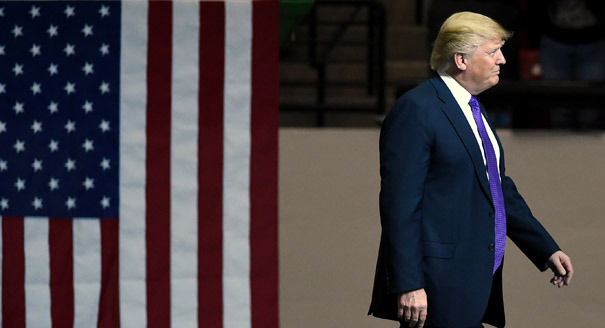
It is not the incivility of modern politics that drives some to question Trump’s fitness for the presidency; it is a respect for the lessons of history and for the national interests his profound deficits put at risk.
Source: Washington Post
Last week, at the Aspen Ideas Festival, I moderated a panel on U.S. national security in the Trump era. On the panel, former CIA director David H. Petraeus offered the most robust defense of President Trump’s foreign policy that I have heard. Central to his premise were two facts. First, he argued that Trump’s national security team was the strongest he had ever seen. Next, he argued that whereas President Barack Obama was indecisive to the point of paralysis, such as in the case of Syria, Trump is decisive.
Toward the end of the conversation, we turned to Trump’s erratic behavior and I noted that for the first time in three decades in the world of foreign policy, I was getting regular questions about the mental health of the president.
I asked Petraeus, a man I respect, if he thought the president was fit to serve. His response was, “It’s immaterial.” He argued that because the team around Trump was so good, they could offset whatever deficits he might have. I was floored. It was a stunningly weak defense.
That is where we are now. The president’s tweeting hysterically at the media is just an element of this. So too is his malignant and ever-visible narcissism. The president has demonstrated himself to have zero impulse control and a tendency to damage vital international relationships with ill-considered outbursts, to trust very few of the people in his own government, and to reportedly rant and shout at staff and even at the television sets he obsessively watches.
Whether he is actually clinically ill is a matter for psychiatric professionals to consider. But when you take the above behaviors and combine them with his resistance to doing the work needed to be president, to sitting down for briefings, to reading background materials, to familiarizing himself with details enough to manage his staff, there is clearly a problem. Compound it with his deliberate reluctance to fill key positions in government and his wild flip-flopping on critical issues from relations with China to trade, and you come to a conclusion that it may be that Trump’s fitness to serve as president is our nation’s core national security issue.
Not only does the president diminish the office with his pettiness; he also shows disregard for constitutional principles including free speech, freedom of religion and separation of powers, and he operates as though he were above ethics laws. Daily he shows he lacks the character, discipline, intellect, judgment or respect for the office to be president of the United States. In normal times, this would be worrying. But look at the news. North Korea is moving closer to having the ability to deliver a nuclear weapon to the United States. A confrontation is coming that will be a test of character pitting North Korea’s unhinged leader, Kim Jong Un, against our leader.
Later this week, he will sit down with Russian President Vladimir Putin in Hamburg, Germany, during the Group of 20 meeting. Quite apart from the political optics of rewarding a man who attacked the United States with to help get Trump elected with such a meeting, the summit reveals why it is so dangerous to have an erratic president. Much of U.S. foreign policy comes down to personal diplomacy conducted by the president and his actions in the wake of such meetings. If a dedicated enemy of the United States and opportunist such as Putin determines to take advantage of Trump’s narcissism, ignorance, paranoia, business interests or brewing scandals, he will do just that. If he sees Trump’s behavior as a tacit endorsement of his own thuggishness, he will seize the opportunity. Could Trump enter the meeting with good advice from the team that Petraeus and others admire so much? Yes. But they can’t undo Trump’s record, nor can they, we have learned, always shape the behavior of a man who has shown repeated propensity for ignoring the advice of his best allies. That is one reason, according to reports, that European officials are deeply concerned about the outcomes of the meeting that will take place in Hamburg this week.
The United States has had a wide variety of presidents; we have as often been victimized by their errors of judgment as we have benefited from their leadership. But the stark reality is that objective analysis reveals that we have never before seen a president so unfit for office. Even President Richard Nixon at his moments of darkest paranoia was a professional public servant who understood the office and the stakes associated with it. One might, on this Independence Day week, have to go back to King George III to find a head of state who so threatened America. But there is no precedent for one whose character is so obviously ill-suited to the presidency.
At the end of the Aspen session, a gentleman approached me and asked why I had made the conversation so ad hominem by questioning Trump’s fitness. I explained that when we have a system in which the chief executive is endowed with so much power, we regularly find that our fate in crises turns on the character of the president. For that reason, it is not the incivility of modern politics that drives us to question Trump’s fitness; it is a respect for the lessons of history and for the national interests his profound deficits put at risk.
This article was originally published in the Washington Post.
Former Visiting Scholar
David Rothkopf was a visiting scholar at the Carnegie Endowment as well as the former CEO and editor in chief of the FP Group.
Recent Work
David Rothkopf
David Rothkopf
Carnegie does not take institutional positions on public policy issues; the views represented herein are those of the author(s) and do not necessarily reflect the views of Carnegie, its staff, or its trustees.

The European Commissioner for Trade is headed to China. But after President Xi’s bridge-building visit to Washington, can a more isolated EU overcome Beijing’s stranglehold on critical raw materials? Who will blink first?

Rym Momtaz, ed.

European NATO countries are wrestling with the possibility of U.S. disengagement from the alliance. With the continent’s security increasingly uncertain, governments must restore the credibility of their collective defense.



Hans-Dieter Lucas, Adam Thomson, Pierre Vimont

Before the next wave of EU enlargement takes place, the union needs to grapple with thorny questions of how power is distributed among its members.


Emil Sondaj Hansen, Ditte Brasso Sørensen

The new U.S.–Denmark–Greenland agreement will help Washington exert political, economic, and financial dominance under the guise of security. Yet, it acknowledged Copenhagen’s and Nuuk’s sovereignty on the island.

Marc Pierini

A summer of escalation in the Black Sea has hurt Ukraine economically and is exacerbating world food security. A truce is needed—as is a broader reframing of Europe’s Ukraine strategy.

Thomas de Waal