

Paper
Douglas H. Paal
{
  "authors": [
    "Douglas H. Paal"
  ],
  "type": "legacyinthemedia",
  "centerAffiliationAll": "dc",
  "centers": [
    "Carnegie Endowment for International Peace",
    "Carnegie China"
  ],
  "collections": [
    "China’s Foreign Relations",
    "U.S.-China Relations"
  ],
  "englishNewsletterAll": "asia",
  "nonEnglishNewsletterAll": "",
  "primaryCenter": "Carnegie China",
  "programAffiliation": "AP",
  "programs": [
    "Asia"
  ],
  "projects": [],
  "regions": [
    "North America",
    "United States",
    "East Asia",
    "China",
    "South Korea",
    "Japan"
  ],
  "topics": [
    "Political Reform",
    "Foreign Policy"
  ]
}
Source: Getty
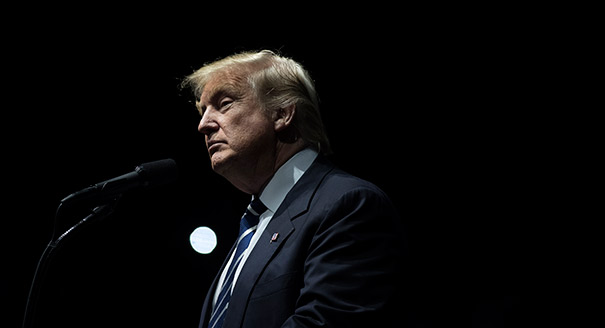
It has repeatedly been shown that the main source of U.S. policy instability is President Trump. Chinese leaders should work prudently and constructively with people around the administration.
Source: South China Morning Post
Despite the rhetoric of Donald Trump’s election campaign, including calling the US trade deficit with China equivalent to “rape,” the Chinese may feel relations with the US are going surprisingly well, now that Trump is president. There was the “successful” Mar-a-Lago summit in April; and Trump himself is set for a state visit in November.
If Beijing was worried that Trump might take up Barack Obama’s “rebalance to Asia” in earnest, there is plenty of evidence that the US remains as mired in the Middle East as ever. Trump has just reversed his criticism of the war in Afghanistan and is doubling down. He’s laying plans to improve deteriorated relations with Manila, Kuala Lumpur and Bangkok – to offset growing Chinese influence – but two key guided missile destroyers are out of action in the Pacific fleet due to accidents, making the US look weaker.
Trump abandoned the one strategically sensible region-wide mechanism for competing economically with China, the Trans-Pacific Partnership (TPP), leaving Beijing to organise regional trade according to its preferences. His withdrawal from the Paris climate accord then ceded moral authority to China.
Trump returned to the “one-China policy” after a phone call with Taiwan’s president, Tsai Ing-wen, left his stand in doubt, but later conflated actions on trade, Taiwan, North Korea and the South China Sea, in reaction to Beijing’s perceived weakness on pressurising Pyongyang. Normally, each of these issue sets is handled on its own terms and not together, to keep them from becoming unmanageable. China’s reaction was accordingly muted.
The White House backed away from national-security-based sanctions on iron and steel, possibly because they were intended to be aimed at China’s industries but may have hit other trading partners harder. But Trump issued an executive order Section 301 investigation of China’s intellectual property rights violations under the 1974 Trade Act, including forced sharing of proprietary secrets to participate in Chinese markets. Trade representative Robert Lighthizer has started the process, and concern about the issue is shared broadly, not just by Trump’s political base. Action is probably a year away.
So, for China, what’s not to like about Trump’s time in office? He is all bark, no bite. To top it off, the leading exponent of an economic war with China (and conflict with the “deep state” of traditional establishment or “globalist” interests), White House chief strategist Stephen Bannon, was dismissed. He left noisily, but with no doubt that he would have worked tirelessly to undermine America’s relations with China. Only, now he will do it from outside, not inside.
China’s deft personal diplomacy through Trump’s son-in-law Jared Kushner and others, its calm reaction to barks from Washington, and focus on programmatic expansion of influence with neighbours have stood it in good stead. But Beijing should not rest easy. The “globalists” of the deep state have not yet subdued the greatest source of policy instability – Trump himself.
Trump has repeatedly shown that he hates being scripted, or reading from teleprompters, and is most himself when he reverts to unscripted campaign rhetoric before his support base. And there to egg him on will be an untrammelled Steve Bannon. Bannon’s acolytes, Sebastian Gorka and Stephen Miller, remain close to Trump, even as Gorka exits the White House.
Trump may yet conclude that his political fortunes lie with returning to campaign promises and away from establishmentarian advisors who are ascendant at the moment and restraining him. This could be triggered or reinforced by the investigation of Trump’s campaign activities by Special Counsel Robert Mueller, or other failures to get his legislative agenda into law.
President Xi Jinping and China would be well advised to work constructively with the reasonable people around the Trump administration to reinforce their ability to cocoon Trump from himself.
The hardline trade trio of Lighthizer, Commerce Secretary Wilbur Ross and erstwhile trade advisor Peter Navarro are all still in place and planning to reverse America’s deficits. Their target remains China.
This article was originally published in the South China Morning Post.

Distinguished Fellow, Asia Program
Paal previously served as vice chairman of JPMorgan Chase International and as unofficial U.S. representative to Taiwan as director of the American Institute in Taiwan.
Recent Work
Douglas H. Paal


Douglas H. Paal, Tong Zhao, Chen Qi, …
Carnegie does not take institutional positions on public policy issues; the views represented herein are those of the author(s) and do not necessarily reflect the views of Carnegie, its staff, or its trustees.

The EU can impose sanctions but struggles to enforce them without the United States. With Washington increasingly disinterested in backing European interests, the bloc must now fend for itself.


Nicu Popescu, Tiago Antunes

Russia is testing the waters of NATO’s mutual defense clause. What do strikes in Romanian territorial waters mean for the alliance’s posture toward Moscow?

Dimitar Bechev

With its public finances in shambles, the far right polling at 35 percent ahead of the 2027 presidential election, and a growing protest movement, is France’s crisis a threat to the EU’s geopolitical awakening?

Rym Momtaz, ed.

Ahead of a tough winter for Ukraine, Donald Trump’s swing back toward Russia bodes ill. But instead of panicking, Kyiv’s European allies are focusing on action.
Rym Momtaz

Funding Ukraine remains a priority for European leaders. As Russia’s war of aggression heads into another winter, two feasible options to mobilize support for Kyiv should be fast-tracked.


Vladyslav Rashkovan, Gregory P. Wilson