

Q&A
Paul Haenle, Philippe Le Corre
{
  "authors": [
    "Philippe Le Corre"
  ],
  "type": "legacyinthemedia",
  "centerAffiliationAll": "dc",
  "centers": [
    "Carnegie Endowment for International Peace",
    "Carnegie China"
  ],
  "collections": [],
  "englishNewsletterAll": "asia",
  "nonEnglishNewsletterAll": "",
  "primaryCenter": "Carnegie Endowment for International Peace",
  "programAffiliation": "AP",
  "programs": [
    "Asia",
    "Europe"
  ],
  "projects": [],
  "regions": [
    "East Asia",
    "China",
    "Western Europe",
    "Iran"
  ],
  "topics": [
    "Economy",
    "Trade",
    "Foreign Policy"
  ]
}
Source: Getty
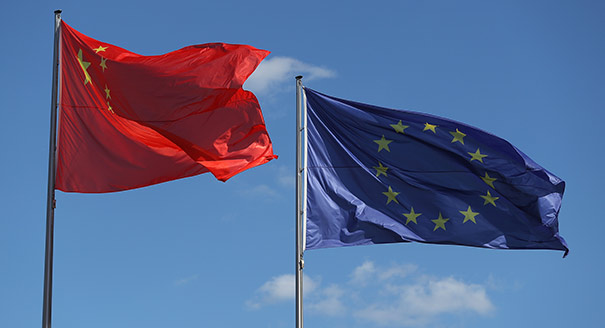
As Europe becomes a preferred playing field for Chinese foreign direct investment, leaders of bloc nations have been drawn into a debate on the creation of a long-anticipated screening mechanism.
Source: Nikkei Asian Review
As Europe becomes a preferred playing field for Chinese foreign direct investment, leaders of bloc nations have been drawn into a debate on the creation of a long-anticipated screening mechanism.
China has the most at stake. While Chinese investment into Europe was insignificant during the first decade of the 21st century, there has been a surge since 2010, partly as a result of the global financial crisis ravaging several southern European economies and buffeting others. Some 35 billion euros ($x) was invested last year alone, a 77 increase from 2015 according to the Mercator Institute for China Studies (Merics). All 28 members of the EU have taken part in this bounty.
It is thus high time that member states agree on a common approach toward foreign direct investment. European Commission President Jean-Claude Juncker took up this point in his annual State of the Union address last month. “If a foreign state-owned company wants to purchase a European harbor, part of our energy infrastructure or a defense technology firm, this should only happen with transparency,” he said.
Juncker’s comments follow a request by the economic ministers of Germany, France and Italy earlier this year for the commission to look into foreign investment in technology companies and infrastructure.
Many bloc members however have remained silent on the issue or even been critical. Using terminology often embraced by Chinese officials, Polish Prime Minister Beata Szydlo said in June that “Poland will firmly oppose protectionist measures in the EU.” A Finnish minister was equally critical in comments after Juncker’s speech.
The nonbinding cooperation system between member states and the union that Juncker has proposed “can be activated when a specific foreign investment in one or several member states may affect the security or public order of another.” The planned framework would allow members to share details of proposed acquisitions on the grounds of security or public order, including those related to research, transport, energy or space.
Chinese businesses have been actively pursuing European technology companies. Foreign acquisitions are one of the avenues that Beijing is pursuing under its “Made in China 2025” strategy for becoming a world leader in robotics, semiconductors, alternative-energy vehicles, biopharmaceuticals and medical devices. State-owned companies have been responsible for two-thirds of the European deals, with a concentration in high-profile infrastructure projects, including ports, airports, high-speed railways and energy facilities.
Major deals since 2010 have included the purchase of Kuka, Germany’s top robotics company, by appliance manufacturer Midea Group; the acquisition of a 22% stake in Energias de Portugal, that country’s national grid operator, by China Three Gorges; and the Hinkley Point C nuclear power project in the U.K. which is being partly financed by a Chinese consortium.
Germany, China’s largest European trading partner, has received much of the buyout interest, including 11 billion euros worth last year, led by the Kuka deal. To those accusing the EU of protectionism, it should be said the authorities have so far blocked only one deal, the purchase last year of German semiconductor company Aixtron by Fujian Grand Chip Investment Fund.
At the same time, many European companies are finding it more difficult than before to access the Chinese market. EU investments in China amounted to just $8 billion in 2016. The EU Chamber of Commerce in China has called for more reciprocity and better market access for European companies. Talks about an EU-China bilateral investment treaty have made little progress as Beijing leans toward deals with individual states.
Europe is coming to grips with new realities and needs to do more to protect its companies without turning away foreign investors. This dilemma is perhaps most apparent in Greece.
After months of hesitation following his election in 2015, Prime Minister Alexis Tsipras declared that Greece intended to “serve as China’s gateway into Europe.” Last year, China’s COSCO Shipping Ports acquired a two-thirds stake in Piraeus Port to make it a main gateway for Beijing’s Belt and Road Initiative. Many Chinese companies are now using Piraeus as their principal port of entry into southern Europe.
Whether Greece will support the European Commission’s plan to increase screening of foreign direct investment, or at least remain neutral, is an open question. In July, it blocked the issuance of an EU statement at the United Nations criticizing China’s human-rights record.
Eastern and Central European countries, including 11 EU members (*) that are part of the so-called “16+1” group with China may also have mixed feelings about Brussels’ plans. Like Greece, several of these countries have been chastised by EU and German officials since the 2008 European debt crisis. Some in Eastern Europe are also unhappy with the way Brussels has handled the refugee crisis and all of the states need cash and have been welcoming Chinese investment in infrastructure.
This is best symbolized by the 350km Belgrade-Budapest high-speed railway project, which China Railway Group started building in 2015. The project has been slowed by a European Commission investigation into whether Hungary ignored EU competition rules in awarding construction contracts.
In acknowledging the interests of members like Greece and Hungary, the commission will have to navigate between demonstrating that Europe is open for business and trying to implement the new investment screening framework. No doubt this topic will lead to much intra-European discussions. As the continent’s economy improves, it is quite possible to envisage more cross-European investment in line with the “new EU” that French President Emmanuel Macron outlined in a speech last month. But the EU will still need outside investors, and for many members, China will still appear the most likely source.
(*) The 16 members are: Albania, Bosnia and Herzegovina, Bulgaria, Croatia, the Czech Republic, Estonia, Hungary, Latvia, Lithuania, Macedonia, Montenegro, Poland, Romania, Serbia, Slovakia, Slovenia
This article was originally published in the Nikkei Asian Review.
Former Nonresident Senior Fellow, Europe Program
Philippe Le Corre was a nonresident senior fellow in the Europe Program at the Carnegie Endowment for International Peace.
Recent Work

Paul Haenle, Philippe Le Corre

Erik Brattberg, Philippe Le Corre, Paul Stronski, …
Carnegie does not take institutional positions on public policy issues; the views represented herein are those of the author(s) and do not necessarily reflect the views of Carnegie, its staff, or its trustees.

The European Commissioner for Trade is headed to China. But after President Xi’s bridge-building visit to Washington, can a more isolated EU overcome Beijing’s stranglehold on critical raw materials? Who will blink first?

Rym Momtaz, ed.

European NATO countries are wrestling with the possibility of U.S. disengagement from the alliance. With the continent’s security increasingly uncertain, governments must restore the credibility of their collective defense.



Hans-Dieter Lucas, Adam Thomson, Pierre Vimont

The domestic impacts of how long it is taking to end the war in Ukraine have pushed the French electorate to the political extremes and compromised the country’s diplomatic capacity.
Rym Momtaz

Before the next wave of EU enlargement takes place, the union needs to grapple with thorny questions of how power is distributed among its members.


Emil Sondaj Hansen, Ditte Brasso Sørensen

The new U.S.–Denmark–Greenland agreement will help Washington exert political, economic, and financial dominance under the guise of security. Yet, it acknowledged Copenhagen’s and Nuuk’s sovereignty on the island.

Marc Pierini