

Commentary
Richard Youngs
{
  "authors": [
    "Richard Youngs"
  ],
  "type": "legacyinthemedia",
  "centerAffiliationAll": "dc",
  "centers": [
    "Carnegie Endowment for International Peace",
    "Carnegie Europe"
  ],
  "collections": [],
  "englishNewsletterAll": "ctw",
  "nonEnglishNewsletterAll": "",
  "primaryCenter": "Carnegie Europe",
  "programAffiliation": "EP",
  "programs": [
    "Europe"
  ],
  "projects": [],
  "regions": [
    "Europe",
    "Western Europe",
    "Iran"
  ],
  "topics": [
    "EU",
    "Democracy",
    "Political Reform"
  ]
}
Source: Getty
Brussels must reexamine its hands-off approach to the political impasse in Spain. Otherwise, Europe risks sleepwalking into yet another conflict.
Source: POLITICO Europe
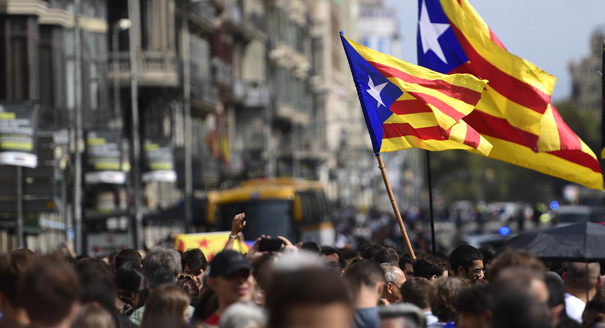
As the Catalan crisis lurches into a new phase, with the focus now on elections called for December 21, the European Union has to reexamine its hands-off approach to the political impasse.
Brussels and national governments were right to unequivocally oppose the Catalan government’s illegal and unilateral move to secede from Spain. But this response should be one element of a wider European strategy, not its entirety.The EU stood by Prime Minister Mariano Rajoy even when some of his hard-line tactics — though constitutionally justified — were politically myopic. This was the right thing to do. But the EU offered its support in such an unconditional way that it allowed Rajoy to take it as a European blank check to follow the toughest course against Catalonia.
Brussels meekly accepted Rajoy’s insistence that it had no right to act as mediator. It also refrained from criticizing Spain’s limited and uncreative leader, even when it was clear that by following the narrow script of “restoring legality,” he was eschewing countless political opportunities to defuse tensions.
In the past few days, the Spanish government appears to have gained the upper hand against Catalonia’s reckless and now-imploding secessionist faction. But this may still fall short of a definitive victory. Whatever the outcome of December’s election, Madrid’s actions could still intensify hostility and frustrations in the region, deepening the discontent among many Catalans and dragging this conflict out for years to come.
It beggars belief that, in the years this crisis has been brewing, Spain’s political elite failed to put a well-worked alternative to the Catalans, at least as a basis for positive discussion. Every day sees a new spate of identikit articles, speeches and interviews out of Madrid admonishing the Catalan government. While they are right to do so, it is disappointing that no one has put forward constructive, balanced and original ideas for how the crisis might be extinguished.
If the EU does not broaden its approach to handling this major political crisis, it will be complicit in its outcome.
Catalonia will test the bloc’s identity as a political project of reconciliation. If the EU fails to help defuse tensions in Spain, voters across the bloc could, quite rightly, lose faith in its grand rhetoric about the importance of looking beyond the nation-state. If they see the EU as little more than a defender of incumbent governments, it will be no surprise they turn to anti-establishment parties to make their voices heard.
Brussels has a role to play here, even if it is not a formal mediator. It must put pressure on Rajoy’s government to accept European involvement in devising a workable solution to the crisis. This will require creativity and compromise, not only from Catalonia but also from Madrid.
The crux of the matter will be to devise some kind of arrangement for Catalonia that does not allow the region to claim independence but grants it more autonomy than standard models of federalism. The EU prides itself for being based on notions of shared sovereignty and confederalism: Surely it would be worth exploring if these could generate useful approaches to the Catalan crisis.
One solution would be for the EU to devise something it might call an “autonomous member territory,” and to grant it at least some of the rights, representation and capacities that member countries have in Brussels. Acknowledging Catalonia in this way would elevate its status at the EU table, without independence. It’s a template that could apply to other territories too.
The offer of a tangible upgrade in European status could go a long way to keep a wave of secessionism across Europe at bay.
The EU will not come out of this situation well if it is seen to have tied itself to a government that so inflexibly blocks political compromise.
Let’s not forget that Rajoy’s Popular Party is one of Europe’s most corrupt political parties and has been riddled with dozens of major fraud cases over the past few years. And yet, even as the party repeatedly falls on the wrong side of the law, the EU celebrates it as a defender of the rule of law — a tenuous basis for its support.
The Catalan crisis is, of course, Spain’s to resolve. But the EU must — at the very least — help unstick debate by proposing innovative solutions that go beyond the narrow and now-repetitive focus on constitutional legality.
Europe can’t afford to sleepwalk through yet another conflict.

Senior Fellow, Democracy, Conflict, and Governance Program
Richard Youngs is a senior fellow in the Democracy, Conflict, and Governance Program, based at Carnegie Europe. He works on EU foreign policy and on issues of international democracy.
Recent Work
Richard Youngs

Richard Youngs, Erik Jones, Dan Baer, …
Carnegie does not take institutional positions on public policy issues; the views represented herein are those of the author(s) and do not necessarily reflect the views of Carnegie, its staff, or its trustees.

The European Commissioner for Trade is headed to China. But after President Xi’s bridge-building visit to Washington, can a more isolated EU overcome Beijing’s stranglehold on critical raw materials? Who will blink first?

Rym Momtaz, ed.

European NATO countries are wrestling with the possibility of U.S. disengagement from the alliance. With the continent’s security increasingly uncertain, governments must restore the credibility of their collective defense.



Hans-Dieter Lucas, Adam Thomson, Pierre Vimont

The domestic impacts of how long it is taking to end the war in Ukraine have pushed the French electorate to the political extremes and compromised the country’s diplomatic capacity.
Rym Momtaz

Before the next wave of EU enlargement takes place, the union needs to grapple with thorny questions of how power is distributed among its members.


Emil Sondaj Hansen, Ditte Brasso Sørensen

The new U.S.–Denmark–Greenland agreement will help Washington exert political, economic, and financial dominance under the guise of security. Yet, it acknowledged Copenhagen’s and Nuuk’s sovereignty on the island.

Marc Pierini