

Article
Carole Nakhle
{
  "authors": [
    "Carole Nakhle"
  ],
  "type": "legacyinthemedia",
  "centerAffiliationAll": "dc",
  "centers": [
    "Carnegie Endowment for International Peace",
    "Malcolm H. Kerr Carnegie Middle East Center"
  ],
  "collections": [],
  "englishNewsletterAll": "menaTransitions",
  "nonEnglishNewsletterAll": "",
  "primaryCenter": "Malcolm H. Kerr Carnegie Middle East Center",
  "programAffiliation": "MEP",
  "programs": [
    "Middle East"
  ],
  "projects": [
    "Carnegie Oil Initiative"
  ],
  "regions": [
    "Gulf",
    "United Arab Emirates",
    "Middle East"
  ],
  "topics": [
    "Economy",
    "Climate Change"
  ]
}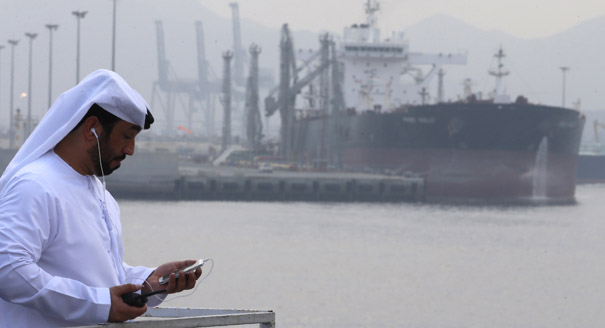
Source: Getty
Today, oil is facing mounting pressure as the world tries hard to move towards a greener, cleaner future and vows to end the age of fossil fuels.
Source: Oil Review Middle East
Typically, when one thinks of the UAE, it is the association with oil and its vast wealth that dominates the attention. The skyscrapers crowding the small land, the golden gates to lavish palaces, the endless alleys of trees erected in the middle of the desert, and the private helicopters circling the skies, are just some examples of what oil has brought to this relatively young nation.
Increasingly, clean sources of energy have to be added to this picture. The UAE is undertaking huge efforts to switch its own energy supply away from oil and gas and towards a cleaner mix of renewables, nuclear and clean coal. Like everywhere else in the world, this is an expensive undertaking, requiring government support. Oil and gas, on the other hand, are available domestically and are relatively cheap. This poses an interesting dilemma.Today, oil is facing mounting pressure as the world tries hard to move towards a greener, cleaner future and vows to end the age of fossil fuels. At their annual summit in 2015, the G7 leaders agreed to phase out fossil fuel use by the end of the century. This year, countries including France and the UK announced they were banning the sales of petrol and diesel engines as early as 2040, while China, with the fastest growing demand for oil in the world, is racing ahead with the expansion of renewable and nuclear energy. Concerns about peak oil supply only a few years ago have been replaced by talks about peak oil demand – which, as many experts are arguing, is not far away. But if hydrocarbon revenues will really come under threat, how will petrostates, including the UAE, finance their energy transition?
This article was originally published in Oil Review Middle East, Issue 7 2017.

Former Nonresident Scholar, Middle East Center
Nakhle was a nonresident scholar at Carnegie Middle East Center, specializing in international petroleum contracts and fiscal regimes for the oil and gas industry, world oil and gas market developments, energy policy, and oil and gas revenue management.
Recent Work
Carole Nakhle
Carole Nakhle
Carnegie does not take institutional positions on public policy issues; the views represented herein are those of the author(s) and do not necessarily reflect the views of Carnegie, its staff, or its trustees.
Europe’s industrial supply chains leave it vulnerable to global shocks. The EU needs a pragmatic green industrial strategy that balances durable partnerships and bolsters homegrown clean tech without sacrificing low-carbon ambition.


Milo McBride, Pauline Gerard

When the U.S.-Iran memorandum of understanding was announced, the UK, France, Germany, and Italy declared their readiness to help demine the Strait of Hormuz and lift nuclear sanctions on Tehran. But does Europe need new tools to recover a diplomatic role?

Rym Momtaz, ed.

As geopolitical rivalry weaponizes global supply chains, the EU’s true vulnerability lies in emerging-risk imports. For these goods, suppliers are growing more concentrated, substitution more difficult, and political risk is looming.

Sinan Ülgen

The EU is putting together a new security strategy to meet today’s myriad challenges. But for any proposal to be effective, the union needs to grapple with its identity and ambitions.

Pierre Vimont
The EU’s new migration policy is not suited to today’s realities. With climate change increasingly becoming a driver of displacement, Europe needs to rethink its deterrence-focused approach.

Shana Tabak