

Commentary
The EU can impose sanctions but struggles to enforce them without the United States. With Washington increasingly disinterested in backing European interests, the bloc must now fend for itself.
Nicu Popescu, Tiago Antunes
{
  "authors": [
    "Richard Sokolsky",
    "Andrew Miller"
  ],
  "type": "legacyinthemedia",
  "centerAffiliationAll": "",
  "centers": [
    "Carnegie Endowment for International Peace",
    "Malcolm H. Kerr Carnegie Middle East Center"
  ],
  "collections": [],
  "englishNewsletterAll": "",
  "nonEnglishNewsletterAll": "",
  "primaryCenter": "Carnegie Endowment for International Peace",
  "programAffiliation": "",
  "programs": [],
  "projects": [],
  "regions": [
    "North America",
    "United States",
    "North Africa",
    "Egypt"
  ],
  "topics": [
    "Political Reform",
    "Foreign Policy"
  ]
}
Source: Getty
U.S. and Egyptian interests are increasingly divergent and the relationship now has far less common purpose than it once did.
Source: New York Times
When Vice President Mike Pence visits Egypt on Wednesday, he will follow in the footsteps of countless American officials who have stopped in Cairo to laud the “strategic partnership” between the United States and Egypt.
This has become a vacuous and badly outdated talking point — the kind we both drafted during our years in the government. Mr. Pence shouldn’t pay lip service to it.
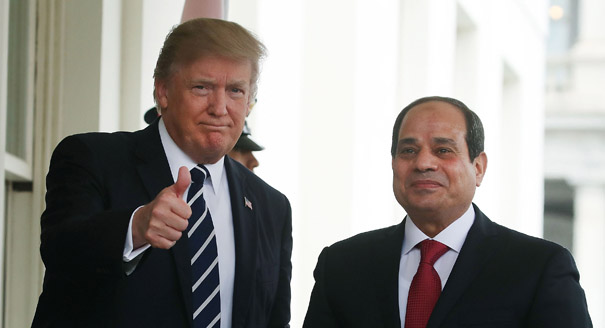
American and Egyptian interests are increasingly divergent and the relationship now has far less common purpose than it once did. Mr. Pence should make clear to Abdel Fattah el-Sisi, Egypt’s president, that the two countries need a reset, beginning with a major reduction in American military assistance.
In addition to saving American taxpayers’ money, this would send an important message to other recipients of American aid that our support is not unconditional. It would also help to rein in an arrangement that has distorted Egyptian-American relations.
Any doubts that Egypt has ceased to be a strategic partner to the United States were eliminated with the recent preliminary Egyptian-Russian agreement to grant reciprocal access to each other’s air bases. But this is just the most recent example of profoundly unfriendly behavior by a purported friend. In Libya, Egypt has consistently provided military support to Gen. Khalifa Hifter, whose Libyan National Army has clashed with forces loyal to the internationally recognized and United States-backed government. At the United Nations Security Council, Egypt has made common cause with Russia to oppose the United States on issues from Syria to Israel/Palestine. And this year, revelations emerged of Egyptian military and economic cooperation with North Korea.
Even where American and Egyptian goals remain aligned, Egypt struggles to promote our mutual objectives effectively. Washington has not grasped a new reality: Because of its internal decay, Egypt is no longer a regional heavyweight that can anchor America’s Middle East policy.
The Sisi government has contributed shockingly little to the campaign against the Islamic State in Syria and Iraq. Cairo consistently has ignored American offers to train Egyptian forces in the counterinsurgency doctrine and tactics that could help defeat the insurgency in Sinai. The importance of American access to Egyptian airspace has declined; and American privileges at the Suez Canal are drastically exaggerated. Contrary to prevailing wisdom, the U.S. Navy does not receive head-of-the-line privileges, whereby our ships can jump ahead of other vessels.
There was a time when both countries derived important mutual benefits, including reliable Egyptian support for the United States’ interests in the Middle East. But over the past decade, the United States has poured more than $13 billion in security assistance into Egypt with little to show for it except more jobs for a defense industry exporting materiél that is ill-suited to Egypt’s defense needs and that allow the Egyptian military to sustain a patronage system that distorts the economy and fuels corruption.
For too long, the United States has allowed the Egyptian government to treat security assistance as an entitlement owed for making peace with Israel. The United States has not held Egypt accountable for how this money is spent and whether it serves broader American objectives in the region, giving Egypt a free ride on American generosity. The Obama administration took initial steps to make military assistance less generous and limit the weapons systems Egypt could buy with American funds. The Trump administration has withheld or reprogrammed more than $200 million in military assistance.
This is a start. More needs to be done.
In light of Egypt’s declining strategic importance and its problematic behavior, Washington should sharply reduce its annual military assistance by $500 million to $800 million to align our resources with our priorities. A cut in Egypt’s aid would free up badly needed funds. And a move to start reducing security aid to Egypt to a level that is more in line with the actual value the United States derives from the relationship would be broadly popular in Congress, which has grown frustrated with Cairo.
The risks are limited. Egypt is unlikely to change its behavior in response to less aid. It won’t, for example, end its peace treaty with Israel or cease its counterterrorism cooperation with the United States. It will, of course, continue to fight local jihadists.
Advocates of a closer relationship with Egypt argue that cutting aid would make Cairo less willing to accept American military training, but there is scant evidence that years of generous support have fostered a desire in Egypt for additional training opportunities in critical areas like counter-insurgency. Rather, disabusing Cairo of the notion that assistance is an entitlement might help to restore some leverage to extract concessions from Cairo. And, while instability in Egypt is a legitimate concern, we are deluding ourselves to think that American assistance is the difference between order and chaos.
Instead of acknowledging that Egypt’s importance has diminished, President Trump has doubled down on the relationship, promising to be a “loyal friend” to Egypt and lavishing Mr. Sisi with praise. The White House has gone silent on the Egyptian government’s abhorrent human rights abuses, which fuel radicalization, increasing the global threat from terrorism. In so closely tying the United States to the Sisi government and its repressive practices, the administration is all but ensuring that millions of marginalized Egyptian youth will view the United States with hostility.
America is getting a bad deal in Egypt. That’s ironic for a president who prides himself as a negotiator. Mr. Pence’s visit is an opportunity to turn a new page with Egypt, and make the United States’ commitment to the country commensurate with what Washington receives in return. If the Trump administration does this, it will take a small but important step toward restoring America’s tarnished credibility and reputation in the region.

Nonresident Senior Fellow, Russia and Eurasia Program
Richard Sokolsky is a nonresident senior fellow in Carnegie’s Russia and Eurasia Program. His work focuses on U.S. policy toward Russia in the wake of the Ukraine crisis.
Former Nonresident Scholar, Middle East Program
Andrew Miller was a nonresident scholar in Carnegie’s Middle East Program.
Carnegie does not take institutional positions on public policy issues; the views represented herein are those of the author(s) and do not necessarily reflect the views of Carnegie, its staff, or its trustees.

The EU can impose sanctions but struggles to enforce them without the United States. With Washington increasingly disinterested in backing European interests, the bloc must now fend for itself.


Nicu Popescu, Tiago Antunes

Russia is testing the waters of NATO’s mutual defense clause. What do strikes in Romanian territorial waters mean for the alliance’s posture toward Moscow?

Dimitar Bechev

With its public finances in shambles, the far right polling at 35 percent ahead of the 2027 presidential election, and a growing protest movement, is France’s crisis a threat to the EU’s geopolitical awakening?

Rym Momtaz, ed.

Ahead of a tough winter for Ukraine, Donald Trump’s swing back toward Russia bodes ill. But instead of panicking, Kyiv’s European allies are focusing on action.
Rym Momtaz

Funding Ukraine remains a priority for European leaders. As Russia’s war of aggression heads into another winter, two feasible options to mobilize support for Kyiv should be fast-tracked.


Vladyslav Rashkovan, Gregory P. Wilson