

Commentary
Andrey Pertsev
{
  "authors": [
    "Andrey Pertsev"
  ],
  "type": "commentary",
  "centerAffiliationAll": "",
  "centers": [
    "Carnegie Endowment for International Peace",
    "Carnegie Russia Eurasia Center"
  ],
  "collections": [
    "Inside Russia"
  ],
  "englishNewsletterAll": "",
  "nonEnglishNewsletterAll": "",
  "primaryCenter": "Carnegie Russia Eurasia Center",
  "programAffiliation": "",
  "programs": [],
  "projects": [],
  "regions": [],
  "topics": [
    "Economy"
  ]
}
Source: Getty
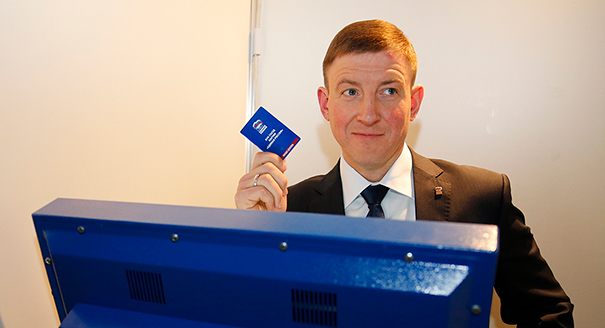
United Russia’s new leader, Andrei Turchak, is asserting the independence of the pro-presidential party as a distinct force in domestic politics. As the ruling regime’s power vertical begins to fragment, United Russia will now seek to take credit for its own contribution to Vladimir Putin’s victory.
Before Vladimir Putin announced his intention to run again for president, intrigue swirled around the issue of who would nominate him. Would he run as the candidate of United Russia, the pro-Kremlin party formed in 2001, or as an independent formally backed by the looser coalition of friendly groups, known as the All-Russia People’s Front? In the end, Putin chose neither option and was merely nominated by “volunteers and workers.” Both political movements stayed in the background.
In the last election of 2012, Putin did run as a United Russia candidate, but his campaign contained few reminders of that fact. The architect of Putin’s victory was deemed to be then deputy chief of staff of the presidential administration, Vyacheslav Volodin. In the 2018 election, several figures are coordinating the campaign, including Volodin, now speaker of parliament, and Sergei Kiriyenko from the presidential administration. An intriguing role is being played by Andrei Turchak, head of United Russia, who in just a few months has revamped the ruling party.
Turchak is the son of Anatoly Turchak, an old acquaintance of Putin. He ascended to the top of the elite by serving as Russia’s youngest governor, of Pskov region. By becoming head of the General Council and de facto leader of United Russia—its formal chairman, Dmitry Medvedev, is removed from day-to-day operations—Turchak inherited a key pillar of power in modern Russia, which possesses the constitutional majority in parliament and majorities in all regional legislatures.
Several top officials have run the party before Turchak assumed his position. It now seems evident that he seeks to carve out a distinct role for himself in the party vis-à-vis its other past patrons.
As secretary of the General Council, Turchak has called himself a “constructive” rather than “neutral” figure among the various influence groups. He has stated his intention to place the United Russia Duma faction, which Volodin believes is firmly in his pocket, under party control. But Turchak is also not Kiriyenko’s man, and his family ties in the Kremlin guarantee him access to President Vladimir Putin.
There is little the presidential administration can do to bring United Russia back under its full control as the key figures in the party are now either neutral or have been brought in by Turchak.
Just as Volodin likes to demonstrate that the Duma belongs to him, Turchak shows that only he is in charge of United Russia. The party’s day-to-day operations now revolve exclusively around Turchak. He has begun transferring additional funds to the party’s regional branches.
Turchak has also vocally rejected the idea that the party should be “completely dependent” on the executive branch and has acquired status symbols that demonstrate his growing influence. He has traveled around Russia, meeting local party activists and governors, who received him as a powerful federal figure. The upper house of parliament, the Federation Council, created a deputy speaker position especially for Turchak, and Chairwoman Valentina Matviyenko even accidentally referred to Turchak as the “new chairman.”
In the midst of the campaign season, Turchak has now entered the race to reap the rewards of Putin’s impending victory. The curious situation in which Putin is supported by both everyone and no one specifically has created a vacuum as no leading formal or informal figure is spearheading the campaign. Instead, presidential envoys and governors, including Volodin, are creating their own campaign headquarters. Turchak has joined an advocacy group on nominating Putin and is reportedly considering setting up his own “informal campaign headquarters.” The race is on to become the informal headquarters that will contribute most to Putin’s victory and high voter turnout.
Turchak envisions United Russia as playing a central role in helping achieve this goal—after all, the party directs all the local branches and coordinating councils, which are working for Putin’s campaign. United Russia structures will now compete with the offices of presidential envoys, and, by extension, with the presidential administration to get out the vote.
Turchak’s stance is an indication of how there are now different autonomous forces in Russian domestic politics, whose leaders have their own personal access to the main stakeholder, Vladimir Putin. Each structure has its own bargaining power and can form coalitions with others under the umbrella of a “Domestic Policy Corporation.” In this new corporate setup, the influence of each subsidiary will depend on Putin’s assessment of its contribution to his campaign. Meanwhile, the subsidiaries will continue to break away from the grip of a once-unified domestic policy holding and try to take over their counterparts.

Andrey Pertsev is a journalist with Meduza website.
Recent Work
Andrey Pertsev
Andrey Pertsev
Carnegie does not take institutional positions on public policy issues; the views represented herein are those of the author(s) and do not necessarily reflect the views of Carnegie, its staff, or its trustees.

A summer of escalation in the Black Sea has hurt Ukraine economically and is exacerbating world food security. A truce is needed—as is a broader reframing of Europe’s Ukraine strategy.

Thomas de Waal
As geopolitical rivalry weaponizes global supply chains, the EU’s true vulnerability lies in emerging-risk imports. For these goods, suppliers are growing more concentrated, substitution more difficult, and political risk is looming.

Sinan Ülgen
The EU is putting together a new security strategy to meet today’s myriad challenges. But for any proposal to be effective, the union needs to grapple with its identity and ambitions.

Pierre Vimont
Between the United States’ market-driven approach and China's state-led industrial strategy, Europe is reckoning with how it can remain competitive in the global economy. But is Europe in danger of becoming a U.S. or China colony?
Noah Barkin, Anu Bradford
The U.S.-sponsored TRIPP deal is driving the Armenia-Azerbaijan peace process forward. But foreign and domestic hurdles remain before connectivity and economic interdependence can open up the South Caucasus.

Thomas de Waal, Areg Kochinyan, Zaur Shiriyev