

Q&A
Suzanne Maloney, Aaron David Miller, Karim Sadjadpour
{
  "authors": [
    "Karim Sadjadpour"
  ],
  "type": "legacyinthemedia",
  "centerAffiliationAll": "dc",
  "centers": [
    "Carnegie Endowment for International Peace",
    "Malcolm H. Kerr Carnegie Middle East Center"
  ],
  "collections": [
    "Iranian Proliferation"
  ],
  "englishNewsletterAll": "menaTransitions",
  "nonEnglishNewsletterAll": "",
  "primaryCenter": "Carnegie Endowment for International Peace",
  "programAffiliation": "MEP",
  "programs": [
    "Middle East"
  ],
  "projects": [],
  "regions": [
    "Middle East",
    "Iran"
  ],
  "topics": [
    "Political Reform",
    "Democracy",
    "Security",
    "Nuclear Policy",
    "Civil Society"
  ]
}
Source: Getty
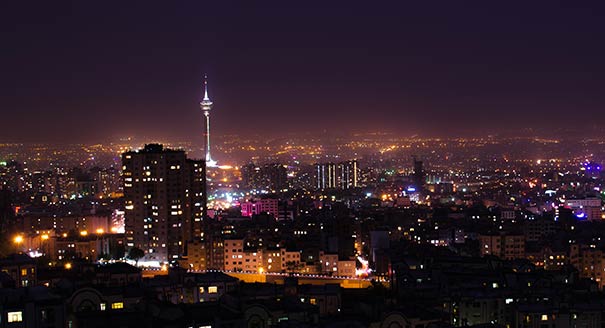
As protests continue across Iran, there are many questions about the strength of the regime, the protesters’ goals, and how regional and international actors will respond.
Source: Slate
On Thursday, protests broke out all over Iran and have so far resulted in the deaths of at least a dozen people. The causes of the upheaval, including discontent with the country’s economy and its stifling political system, have put pressure on both Iran’s supreme leader, Ayatollah Ali Khamenei, and its less conservative president, Hassan Rouhani.
To discuss the situation in Iran, I spoke by phone with Karim Sadjadpour, a senior fellow at the Carnegie Endowment for International Peace. During the course of our conversation, which has been edited and condensed for clarity, we discussed just how strong Iran’s regime is, what the demonstrators really want, and how the United States and Iran’s neighbors are likely to react.
Karim Sadjadpour: I think it's true that Iran has become more powerful externally as a result of power vacuums in the Middle East. In 2003, we removed the government of Iraq, and Iran has effectively filled that power vacuum. The 2011 uprising in the Arab world destroyed central governments in places like Yemen, in Syria to some extent, and Iran also tried to fill those power vacuums. Certainly, it's true that in the Middle East, Iran's influence has expanded, but I think the story we have missed is growing economic, political, and social frustration within Iran.
It’s difficult to confirm, but I think it's very plausible. But if indeed it was hard-liners who encouraged people to voice their economic frustrations against President Rouhani, it's now taken on a new life. It's being fueled by the same type of anger and frustrations that fuel anti-government protests around the world: a combination of rising living costs, corruption, repression. But I think one thing that is somewhat unique about the Islamic Republic of Iran is that it's not only politically and economically authoritarian, but it's also socially authoritarian. It tells you what you can wear, what you can or can't drink, whom you can interact with. I think that's been a long-time source of frustration in particular for young Iranians.
Well, I'm guessing that many of the people who are protesting are people who probably voted for President Rouhani. Not necessarily because they love him, but because they thought he was the best choice offered to them. So, it's difficult for Rouhani to come out and advocate crushing them because these were essentially his constituents. Now, there are concerns that some Iranians have that the Revolutionary Guard are actually allowing these protests to fester to eventually use as a pretext for coming in and crushing them and expanding their authority in the country.
One of the things we have to keep in mind is that these protests, the citizens who are protesting, they're leaderless. They're unorganized. They're unarmed. The regime's coercive apparatus, the Revolutionary Guard and the Basij militia, they're heavily armed. They're heavily organized. They have a level of experience with repression and crowd control. They have that down to a science. Not only can they rely on an Iranian coercive apparatus, but for the last decade, Iran has been training the Shia militias. You know, Hezbollah in Lebanon. They've been assembling Afghan and Pakistani militia men to fight in Syria. So, if they're worried they can't count on Iranians to repress other Iranians, the regime potentially has the Shia mercenaries at their disposal.
I think that Gulf officials, particularly Saudi officials, are very enthusiastic that the Iranian regime is being embarrassed, because for the last years, it's been Iranian officials who are predicting the collapse of the House of Saud.
One of the paradoxes of Iran in the Middle Eastern context is that most Middle Eastern governments are ruled by secular autocrats who are repressing primarily Islamist opposition. That's the case in Egypt, the Assad regime, to some extent, I would argue the Persian Gulf monarchies. In Iran, you have the opposite dynamic. It's an Islamist autocracy, repressing a primarily secular opposition. So, I think that many people believe that if Iran were to become a more representative government, and pursue national interests instead of revolutionary ideology, that would bode well for the United States, for Saudi Arabia.
I think in every country around the world, including in the United States, there are hard-line elements that thrive by using external threats for internal expediency. Frankly, that captures the Islamic Republic of Iran above all. That's what the regime has been doing for four decades, using external threats for internal political expediency.
People were overwhelmingly supportive of the nuclear deal. I've always argued that Iranian society aspires to be like South Korea, not North Korea. But I think ... Crane Brinton, who wrote a book about revolutions, he argued that popular uprisings oftentimes happen when people's expectations are raised and then abruptly dashed. So, people's expectations were raised by the nuclear deal, but the quality of life hasn't materially improved.
One thing you notice from the protest is that I haven't heard any slogans denouncing sanctions or denouncing America or Donald Trump. The slogans are essentially denouncing Iran's leadership and corruption and mismanagement. So, I think this is one of the things we unfortunately miss by a lack of access to Iran, is that these kinds of daily frustrations that, not really people in Tehran, but people outside of Tehran have been experiencing. We haven't been exposed to that. We're much more reliant on journalists whose main access is through Foreign Minister Javad Zarif, who has tweeted that all Iranians are sympathetic to the revolutionary guards and all Iranians are opposed to U.S. policies, which ... Iran is a diverse society of 80 million people. Some support the regime. Many dislike the regime. If there's one thing we've learned, it is that all of our big data and polling, no one got the election of Donald Trump right. So, we really have to be humble about our ability to make judgments.
I think the White House, the Trump administration, should not be focusing on what to say, but what to do. I think what's most important for them to do is to think about ways to prevent the Iranian government from being able to shut down the internet, and control and monopolize communication. One way I think the U.S. can do that is to make clear to companies and countries around the world that if they're found complicit in providing the Iranian government the means and technology to repress or censor people, they'll be censured by the United States.
Is it harder to tell companies that, when we are not consistent in our outrage about countries in the region repressing their people? Listen, if you're an American politician or you're working at the State Department, and you're thinking about U.S. national interests, a protest movement against a government whose official slogan is "Death to America" is more appealing to you than a protest movement against the Jordanian monarchy, which is allied with the United States. So, there's always going to be a moral inconsistency there because you're not looking at this through a purely moral lens. You're looking at this through the lens of U.S. national interests. So yeah, anti-government protests in Iran give U.S. officials hope. Anti-government protests in Jordan or Saudi Arabia would give U.S. officials indigestion.

Senior Fellow, Middle East Program
Karim Sadjadpour is a senior fellow at the Carnegie Endowment for International Peace, where he focuses on Iran and U.S. foreign policy toward the Middle East.
Recent Work


Suzanne Maloney, Aaron David Miller, Karim Sadjadpour

Aaron David Miller, Karim Sadjadpour, Robin Wright
Carnegie does not take institutional positions on public policy issues; the views represented herein are those of the author(s) and do not necessarily reflect the views of Carnegie, its staff, or its trustees.

Mounting economic strain and battlefield losses will not necessarily make the Kremlin less dangerous. They could instead push Moscow toward a more aggressive hybrid campaign designed to test NATO’s Eastern flank, exploit allied hesitation, and fracture European resolve.

Maksym Beznosiuk

Over the past ten years, NATO has held almost as many summits as it did during the entirety of the Cold War. Are they still useful, or is it time to stop holding annual meetings?

Rym Momtaz, ed.

As the EU confronts profound challenges, several leaders have called for fundamental reform to the union’s model—but only modest, superficial changes have resulted. What if Europe really could be reimagined from zero today: What should such a redesigned European order look like?

Richard Youngs, ed.
As Russia's war on Ukraine drags on, NATO is expanding its footprint in the Black Sea. Turkey, Romania, and Bulgaria are upgrading their fleets and deepening trilateral cooperation.

Dimitar Bechev
Far-right leader Marine Le Pen can—and will—run in France’s next presidential election. What does the outcome of her appeal against a 2025 embezzlement conviction mean for the country’s political future?
Catherine Fieschi