

Research
- +5
Alper Coşkun, Fatih Ceylan, Tacan İldem, …
{
  "authors": [
    "Sinan Ülgen"
  ],
  "type": "legacyinthemedia",
  "centerAffiliationAll": "dc",
  "centers": [
    "Carnegie Endowment for International Peace",
    "Carnegie Europe",
    "Malcolm H. Kerr Carnegie Middle East Center"
  ],
  "collections": [
    "Transatlantic Cooperation"
  ],
  "englishNewsletterAll": "ctw",
  "nonEnglishNewsletterAll": "",
  "primaryCenter": "Carnegie Europe",
  "programAffiliation": "EP",
  "programs": [
    "Europe"
  ],
  "projects": [],
  "regions": [
    "Middle East",
    "Europe",
    "North America",
    "Türkiye",
    "United States",
    "Syria",
    "Iran"
  ],
  "topics": [
    "Security",
    "Political Reform"
  ]
}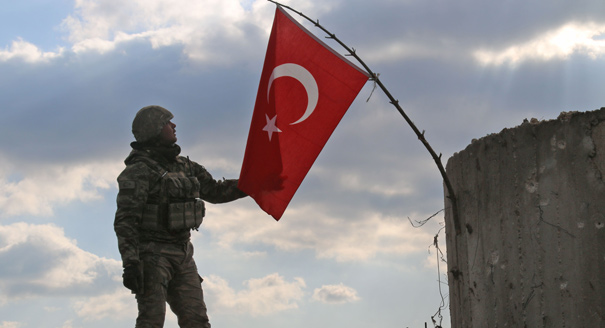
Source: Getty
Ankara’s activity in Syria raises the alarming prospect of military confrontation.
Source: Financial Times
Turkey’s cross border military operation in northern Syria has raised the terrifying prospect of a direct confrontation between two Nato allies. Yet much will depend not only on the exact scope of this campaign, but also on Washington’s reading of Turkey’s true intentions.
Ankara’s initial aim was to seize control of the Afrin enclave held by Syrian Kurdish militia the YPG, an offshoot of the Kurdistan Workers’ party (PKK), an entity deemed a terrorist organisation both by Turkey and the US. However, Turkish president Recep Tayyip Erdogan said that the operation is to be extended to Manbij and possibly further east towards Rojava, both Syrian Kurdish cantons under YPG control.Yet unlike Afrin, where Russia has influence, Manbij and Rojava are enclaves used by the US to equip and train the YPG for the fight against Isis. More than 2,000 American military personnel and special forces are stationed in the region. In a rather testy recent telephone call with Mr Erdogan, US president Donald Trump alerted his counterpart to the possibility of a military confrontation between Turkish soldiers and US troops on Syrian soil.
This extreme scenario for two NATO allies is now within the realm of the possible. The key consideration is whether Turkey is genuinely willing to challenge the US militarily in Syria. Or is Ankara’s aggressive rhetoric part of a concerted effort to deter the Americans from engaging more deeply with the Syrian Kurds? Equally important is the question whether Washington believes that the Turks are bluffing and that they will not attack the YPG in Manbij and beyond.
History shows that when trust erodes, parties can miscalculate. Worryingly, the institutional ties that previously underpinned the relationship between the US and Turkey have frayed. Military links are now obsolete. Moreover, the weakening of the traditional foreign policy establishments in both Ankara and in Washington makes the situation even harder to manage.
A direct confrontation between Turkish and American troops will have serious long-term implications for transatlantic security. Given the interest in Moscow, Tehran or even in Damascus in such a scenario, the risks of a “false flag” intervention designed to provoke a crisis cannot be discounted.
Not only would the bilateral relationship between the two countries suffer irreparable damage in such circumstances, Turkey’s future commitment to Nato would also be thrown into question. Turkish public opinion is already sceptical of the benefits of membership of the alliance. A poll in November 2017 found that 67 per cent of Turks believe that the country’s security can be assured outside of Nato.
This scepticism is even more pronounced among supporters of the ruling Justice and Development party (AKP). According to the same survey, 65 per cent of the Turkish public and 73 per cent of the AKP’s electorate regard the US as a hostile nation. Only 2 per cent of Turks consider the US a friendly country.
What can the US do about this? Instead of testing Turkey’s resolve in northern Syria, Washington should strive to identify areas of mutual interest with Ankara. Turkey and the US could jointly take the lead in creating a humanitarian corridor for the civilians in Afrin facing the prospect either of urban warfare or siege to be safely transported outside the conflict zone.
A climate of co-operation between the US and Turkey would help restore the trust that has been lost. This will be essential if negotiations between the two allies on the future of Syria — not to mention the emerging new security order in the Middle East — are to succeed.
This article was originally published by the Financial Times.

Senior Fellow, Carnegie Europe
Sinan Ülgen is a senior fellow at Carnegie Europe in Brussels, where his research focuses on Turkish foreign policy, transatlantic relations, international trade, economic security, and digital policy.
Recent Work

Alper Coşkun, Fatih Ceylan, Tacan İldem, …
Carnegie does not take institutional positions on public policy issues; the views represented herein are those of the author(s) and do not necessarily reflect the views of Carnegie, its staff, or its trustees.

The EU can impose sanctions but struggles to enforce them without the United States. With Washington increasingly disinterested in backing European interests, the bloc must now fend for itself.


Nicu Popescu, Tiago Antunes

Russia is testing the waters of NATO’s mutual defense clause. What do strikes in Romanian territorial waters mean for the alliance’s posture toward Moscow?

Dimitar Bechev

With its public finances in shambles, the far right polling at 35 percent ahead of the 2027 presidential election, and a growing protest movement, is France’s crisis a threat to the EU’s geopolitical awakening?

Rym Momtaz, ed.

Ahead of a tough winter for Ukraine, Donald Trump’s swing back toward Russia bodes ill. But instead of panicking, Kyiv’s European allies are focusing on action.
Rym Momtaz

Funding Ukraine remains a priority for European leaders. As Russia’s war of aggression heads into another winter, two feasible options to mobilize support for Kyiv should be fast-tracked.


Vladyslav Rashkovan, Gregory P. Wilson