

Commentary
The EU can impose sanctions but struggles to enforce them without the United States. With Washington increasingly disinterested in backing European interests, the bloc must now fend for itself.
Nicu Popescu, Tiago Antunes
{
  "authors": [
    "Se Young Jang"
  ],
  "type": "other",
  "centerAffiliationAll": "dc",
  "centers": [
    "Carnegie Endowment for International Peace"
  ],
  "collections": [
    "Korean Peninsula"
  ],
  "englishNewsletterAll": "ctw",
  "nonEnglishNewsletterAll": "",
  "primaryCenter": "Carnegie Endowment for International Peace",
  "programAffiliation": "NPP",
  "programs": [
    "Nuclear Policy"
  ],
  "projects": [],
  "regions": [
    "North America",
    "East Asia",
    "North Korea"
  ],
  "topics": [
    "Democracy",
    "Foreign Policy",
    "Nuclear Policy",
    "Global Governance"
  ]
}
Source: Getty
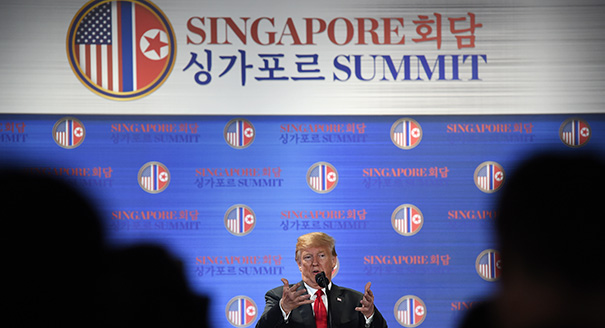
Though the joint statement from the Trump-Kim summit remains vague, the meeting could be an effective confidence-building measure in steps toward implementing a denuclearization agreement.
Source: Asia and the Pacific Policy Society
Reality is sometimes beyond our imagination. Last year when Donald Trump and Kim Jong-un were involved in a war of words sharply criticising each other, we never imagined that the two leaders would ever be able to meet face-to-face and talk about opening a new chapter for the two long-term adversaries.
During the 12 June summit, the first ever between a sitting US president and a North Korean leader, Trump and Kim put forward their first steps on dismantling the 70-year old Cold War regime in Korea since the Peninsula was divided in 1948. This summit, accompanied by the Panmunjom Declaration in April between the two Koreas, signals a great geopolitical shift in Northeast Asia.
On a practical level, the joint statement of the Trump-Kim summit remains somewhat vague because it does not contain concrete arrangements or a roadmap on denuclearization and security guarantees. However, such a meeting between the top leaders from Washington and Pyongyang can be one of the most effective confidence-building measures which would allow the implementation of the agreement. Trump also appears to accept the necessity of a phased approach toward denuclearisation, instead of demanding Pyongyang to immediately hand over or dismantle all their nuclear weapons and intercontinental ballistic missiles. This is at least a positive signal for the time being.
Both Trump and Kim need to make this deal a success for domestic reasons. To succeed, more concrete work needs to be done at the working level, and South Korea and other regional powers should be appropriately informed and consulted. In this sense, the coming weeks or months will be critical to see how sincere and ready the two countries are to bring peace to the Korean Peninsula.
This article was originally published in Asia and the Pacify Policy Society.
Former Nonresident Scholar, Nuclear Policy Program
Se Young Jang was a nonresident scholar in the Nuclear Policy Program at the Carnegie Endowment for International Peace.
Carnegie does not take institutional positions on public policy issues; the views represented herein are those of the author(s) and do not necessarily reflect the views of Carnegie, its staff, or its trustees.

The EU can impose sanctions but struggles to enforce them without the United States. With Washington increasingly disinterested in backing European interests, the bloc must now fend for itself.


Nicu Popescu, Tiago Antunes

Russia is testing the waters of NATO’s mutual defense clause. What do strikes in Romanian territorial waters mean for the alliance’s posture toward Moscow?

Dimitar Bechev

With its public finances in shambles, the far right polling at 35 percent ahead of the 2027 presidential election, and a growing protest movement, is France’s crisis a threat to the EU’s geopolitical awakening?

Rym Momtaz, ed.

Ahead of a tough winter for Ukraine, Donald Trump’s swing back toward Russia bodes ill. But instead of panicking, Kyiv’s European allies are focusing on action.
Rym Momtaz

Funding Ukraine remains a priority for European leaders. As Russia’s war of aggression heads into another winter, two feasible options to mobilize support for Kyiv should be fast-tracked.


Vladyslav Rashkovan, Gregory P. Wilson