

Article
- +1
Rudra Chaudhuri, Tejas Bharadwaj, Konark Bhandari, …
{
  "authors": [
    "Rudra Chaudhuri"
  ],
  "type": "legacyinthemedia",
  "centerAffiliationAll": "dc",
  "centers": [
    "Carnegie Endowment for International Peace",
    "Carnegie India"
  ],
  "collections": [],
  "englishNewsletterAll": "ctw",
  "nonEnglishNewsletterAll": "",
  "primaryCenter": "Carnegie India",
  "programAffiliation": "SAP",
  "programs": [
    "South Asia"
  ],
  "projects": [
    "Security Studies"
  ],
  "regions": [
    "India",
    "South Asia"
  ],
  "topics": [
    "Domestic Politics",
    "Foreign Policy",
    "Political Reform",
    "Democracy"
  ]
}
Source: Getty
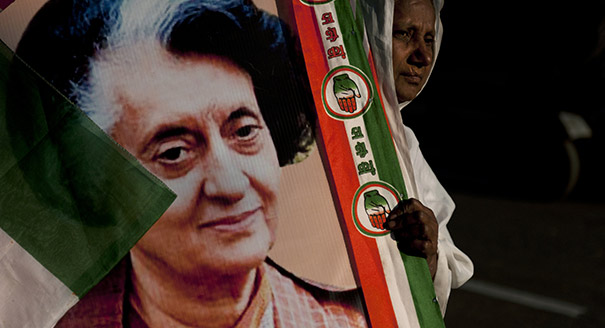
There are many lessons to be drawn from the darker days of India’s political history. The one that ought to be demystified is the view that the suspension or promotion of democracy necessarily stuns or shocks international leaders to the extent that those in India might expect them to.
Source: Indian Express
In one of his many tweets on the Emergency, senior minister Arun Jaitley wrote: “Prolonged Emergency in India brought pressures on Mrs Gandhi from international media and world leaders, who were aghast at the very suggestion that Pandit Nehru’s daughter had abandoned the path of democracy and turned dictatorial.”
There is little doubt that the international media were in fact “aghast” by the continuing effects of Indira Gandhi’s Emergency Proclamation Order. The Times of London had no hesitation in calling the Emergency a “coup” as early as July 1, 1975, only five days after a pliant President inked away Indian democracy. The New York Times referred to Indira Gandhi as the “dictator of India,” whilst Lewis Simon, the Washington Post correspondent in India became something of Gandhi’s bete noire. Simon’s articles focussed on the fate of the Opposition and highlighted the importance of Jayaprakash Narayan in the fight against autocracy. In the last piece written by him prior to being expelled from India, he wrote: “The custom officials had just confiscated my notebooks and I was being escorted by a policeman to the plane when it occurred to me with dumbfounding suddenness: How little it took to destroy democracy.”
By the third week of July 1975, correspondents for the BBC, Newsweek, the Daily Telegraph, The Times, and the New York Times were either dismissed from India or voluntarily left because they refused to sign restrictive censorship agreements hastily written-up by the Information and Broadcasting Ministry. Many international journalists moved to Thailand and other parts of Southeast Asia, reporting on the Emergency from afar. Some found themselves in Pakistan where they were welcomed like “heroes”. It was only in September 1976, prior to a three-day visit by Margaret Thatcher, then the Leader of the Opposition in Britain, that the Indira Gandhi government relaxed censorship rules for foreign correspondents.
As one official close to the then Indian prime minister put it, the aim was to avoid the “embarrassment that would be caused if the ban were maintained” when Thatcher met with Indira Gandhi and other “non-communist” opposition leaders in India. The seeming inducement did little to stop the international media in their prolonged attacks against India Gandhi and her government. Gandhi was often referred to as “India’s puritan nanny”. Stories of India’s intelligence agencies serving Indira Gandhi just like “palace guards” serve their monarch were reported on a daily basis. Arun Jaitley’s argument that the international media was able to bring pressure on the then Indian PM is unquestionable. A survey of hundreds of archival documents, many of them openly available in India, make clear the connection between international media pressure and Indira Gandhi’s decision to call for elections in January 1977. Yet, Jaitley’s view that “world leaders” were equally able to bring such “pressures”, perhaps requires qualification.
To put it bluntly, the administration of Gerald Ford in the United States and Harold Wilson (and then James Callaghan in 1976) in the United Kingdom could not care less about the Emergency. Ford became president following the resignation and near impeachment of Richard Nixon. As much as he tried, it was almost impossible to shake-off the stain of the Nixon scandal. Further, his administration was forced to focus on plummeting oil prices following the 1973 “oil shock” and the after effects of the failures in Vietnam. Wilson, on the other hand, came to power following a hung parliament in 1974. His main international focus was the onset of détente with the Soviet Union and stronger relations with America, specifically with the Secretary of State Henry Kissinger. As Dennis Kux, the then Country Director for India in the US State Department argued, South Asia did not matter at all.
“Business as usual” was the rallying cry for both William Saxbe — the then American ambassador in India — and Michael Walker, the then British high commissioner to India. That democracy had been squashed and Indian jails overflowed with political prisoners mattered little for those more concerned about the increasing influence of the Soviet Union in India’s political and economic life. In early 1976, and with a view to keep India “on-side,” Wilson’s government authorised £115 million of aid or the largest 100 per cent grant-based payment for any country. For Eduard Luard, the highest-ranking bureaucrat in the British Foreign and Commonwealth Office, the logic for the “business as usual” advance was simple. “I think we will have to learn to take India as we find her,” he told his staffers, “whether or not we like her current system of government”. As far as the Ford administration was concerned, the tide against Indira Gandhi turned only towards the end of 1976. It had nothing to do with democracy. The prime minister’s continuing public accusations against the Central Intelligence Agency led to the near snapping of ties.
To an extent, Jaitley’s position on the expected advance of international leaders is understandable. For historians, democracy is the reason why India has long been considered the “diplomatic prize” in South Asia. American leaders have publicly framed Indian democracy as the fundamental factor that shapes their outlook towards the country. During the Emergency, politicians like the late Edward Kennedy spoke loudly about the “gross violations of human rights in India”. “Free JP” campaigns were funded and led by those in Britain once close to V K Krishna Menon. Yet, as far as the British and American governments were concerned, democracy itself mattered little. There are many lessons to be drawn from the darker days of India’s political history. The one that ought to be demystified is the view that the suspension or promotion of democracy necessarily stuns or shocks international leaders to the extent that those in India might expect them to.
This article was originally published in the Indian Express.

Former Director, Carnegie India
Rudra Chaudhuri was the director of Carnegie India. His research focuses on the diplomatic history of South Asia, contemporary security issues, and the important role of emerging technologies and digital public infrastructure in diplomacy, statecraft, and development. He and his team at Carnegie India chair and convene the Global Technology Summit, co-hosted with the Ministry of External Affairs, Government of India.
Recent Work


Rudra Chaudhuri, Tejas Bharadwaj, Konark Bhandari, …
Rudra Chaudhuri
Carnegie does not take institutional positions on public policy issues; the views represented herein are those of the author(s) and do not necessarily reflect the views of Carnegie, its staff, or its trustees.

Ahead of a tough winter for Ukraine, Donald Trump’s swing back toward Russia bodes ill. But instead of panicking, Kyiv’s European allies are focusing on action.

Rym Momtaz

Funding Ukraine remains a priority for European leaders. As Russia’s war of aggression heads into another winter, two feasible options to mobilize support for Kyiv should be fast-tracked.


Vladyslav Rashkovan, Gregory P. Wilson

While the EU and European governments are embracing the much-lauded middle-power moment, this entails three difficult conundrums.

Richard Youngs

A notable degree of participative democracy has firmly arrived in Europe. But to have more far-reaching impact, democratic deliberation needs to move into a radically new phase.
Richard Youngs

Much has been said of the changes Brussels is trying to make to the EU enlargement process. Here’s why gradual integration might—or might not—be the answer.

Dimitar Bechev