

Commentary
Alexander Baunov
{
  "authors": [
    "Alexander Baunov"
  ],
  "type": "legacyinthemedia",
  "centerAffiliationAll": "",
  "centers": [
    "Carnegie Endowment for International Peace",
    "Carnegie Russia Eurasia Center"
  ],
  "collections": [],
  "englishNewsletterAll": "",
  "nonEnglishNewsletterAll": "",
  "primaryCenter": "Carnegie Endowment for International Peace",
  "programAffiliation": "",
  "programs": [],
  "projects": [],
  "regions": [],
  "topics": [
    "Foreign Policy"
  ]
}
Source: Getty
Any agreement that results in rapprochement with the West may provide some economic growth from sanctions relief, but it may also shift balance of power within the Russian political establishment from the powerful hawks to the system’s liberals.
Source: Axios
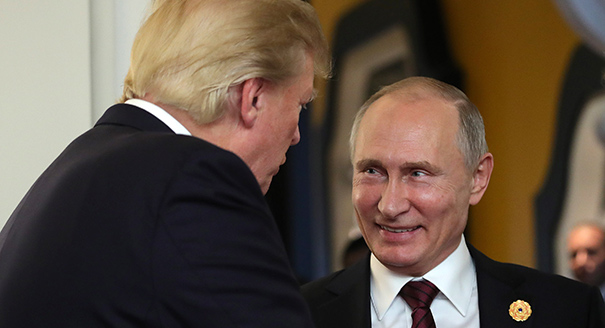
Many critics of President Trump's foreign policy believe he is giving Russian President Vladimir Putin a gift by agreeing to a summit while ignoring sources of tension such as the annexation of Crimea and foreign election meddling. But a chummy photo op goes a very short way to meeting Putin’s actual needs.
Reality check: In his fourth and final term, Putin is focused on domestic priorities such as lifting the economy out of stagnation, improving infrastructure and raising the retirement age to ease social-program budgets. Sanctions and a toxic international environment are big obstacles to these plans. To deliver on this agenda, he needs Trump to deliver on a calmer foreign-policy and business environment.
The Russian angle: Russia’s political class and its allies are as concerned about the Helsinki summit as their American counterparts. The hawks in Moscow think Putin is ready to exchange part of Russia’s political and military resurgence — perhaps through concessions in Donbas and Syria — to ease sanctions and spur economic growth.
Conservatives in the Russian security establishment want to ensure that Western nations can’t mobilize a unified, anti-Russian front. They like the fact that the West is split and see Trump as widening this divide — with his disregard for U.S. allies and NATO, including the previously unthinkable collapse of U.S.–German relations. Satisfaction with the status quo is why many Russians oppose major new agreements with Trump’s White House.
The bottom line: Any agreement that results in rapprochement with the West may provide some economic growth from sanctions relief, but it may also shift balance of power within the Russian political establishment from the powerful hawks to the system’s liberals.

Senior Fellow, Editor-in-Chief, Carnegie Russia Eurasia Center
Baunov is a senior fellow and editor-in-chief at the Carnegie Russia Eurasia Center.
Recent Work
Alexander Baunov
Alexander Baunov
Carnegie does not take institutional positions on public policy issues; the views represented herein are those of the author(s) and do not necessarily reflect the views of Carnegie, its staff, or its trustees.

Are Germany’s economic, industrial, and political struggles becoming a liability for the EU’s ability to rise to the geopolitical moment?

Rym Momtaz, ed.

European Commission President Ursula von der Leyen is about to give her annual address on the state of the EU. Here’s what she won’t—but should—say.
Rym Momtaz

The aftermath of the Ceuta crisis shows Europe has drawn the wrong lessons. Rather than doubling down on failed migration policies, the EU needs to address the underlying roots of such episodes.

Richard Youngs

Canadian Prime Minister Mark Carney has twice inspired praise for standing up to U.S. President Donald Trump: at the 2026 World Economic Forum in Davos and on Canada-U.S. trade negotiations. Is Carney showing a third way better than the EU has in dealing with the Trump administration?
Rym Momtaz, ed.

The EU’s responses to two recent incidents expose the gulf between European perceptions and capabilities. Unless the union can bridge that gap, it will never become a real geostrategic power.
Rym Momtaz