

Commentary
Pierre Vimont
{
  "authors": [
    "Pierre Vimont"
  ],
  "type": "legacyinthemedia",
  "centerAffiliationAll": "dc",
  "centers": [
    "Carnegie Endowment for International Peace",
    "Carnegie Europe"
  ],
  "collections": [
    "Transatlantic Cooperation"
  ],
  "englishNewsletterAll": "ctw",
  "nonEnglishNewsletterAll": "",
  "primaryCenter": "Carnegie Europe",
  "programAffiliation": "EP",
  "programs": [
    "Europe"
  ],
  "projects": [],
  "regions": [
    "Europe",
    "North America",
    "Western Europe",
    "Iran"
  ],
  "topics": [
    "Security",
    "Foreign Policy"
  ]
}
Source: Getty
The U.S. midterm elections will not reset transatlantic relations. Europeans should brace for more of the rough transactional and zero-sum approach that has defined the relationship over the past two years.
Source: Politico Europe
NEW YORK — Europe’s political class has been waiting for the U.S. midterm elections. Traumatized by U.S. President Donald Trump’s unpredictability and his rough handling of the transatlantic relationship, they have allowed themselves to hope the Democratic Party will make significant gains and put the Continent’s most important alliance back on track.
Their optimism, cautious as it is, is unfounded. The most likely result of the midterms — whether or not they constitute a major upset — will be the continued deterioration of the transatlantic partnership. Europeans should brace for more of the rough transactional and zero-sum approach that has defined the relationship over the past two years.To be sure, there are some reasons to be hopeful. American voters, handed their first chance since the 2016 presidential election to modify the course of their country, could take the opportunity to voice their distrust of the administration’s policies. If Democrats seize the majority in the House of Representatives, or even take control the Senate, they will have renewed leverage to check the president’s policies and steer U.S. foreign policy onto a more positive course.
When it comes to Europe, the thinking goes, that would mean a return to a comfortable relationship between the U.S. and its partners across the Atlantic. Adults would be back in the room, and the uneasy atmosphere triggered by Trump’s controversial decisions — to abandon the Paris Agreement on climate change, pull out of the Iran nuclear deal, and launch a series of trade wars — will gradually fade away.
It’s a tantalizing scenario. But it’s also far-fetched. Even if one takes a Democratic victory for granted (and with Trump, as we’ve learned, it’s best to do nothing of the sort), assuming the U.S. would take such a track overlooks important domestic dynamics.
The U.S. Congress retains limited powers when dealing with foreign matters. This will become glaringly obvious if, as most polls predict, Democrats take the House and Republicans retain the Senate. The resulting institutional deadlock will benefit the executive branch.
What’s more, midterms rarely mark a significant change in the White House. They are an opportunity for voters to inflict a severe drubbing to its incumbent, but they rarely result in an important change of policy.
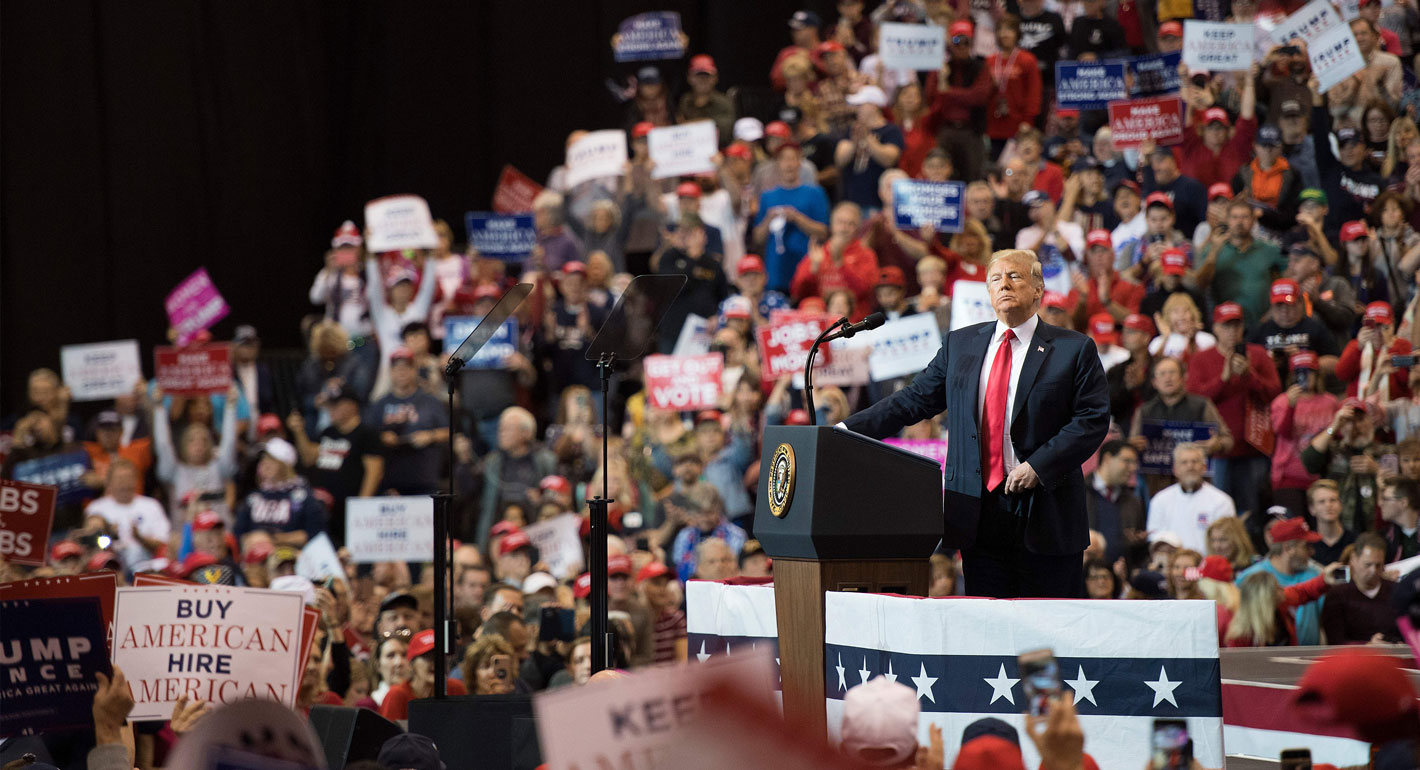
The crucial and meaningful political rendezvous for American polity takes place at presidential elections, not in between. Undoubtedly, this year, Trump’s very special brand of politics has transformed the midterms into a quasi-referendum on his personality. And the polls appear to confirm an unusual level of interest from the electorate. To a very large extent, Trump himself has not shied away from presenting the election this way, firing up his base with polemical speeches.
But an unfavorable result for the president will not convince him to change his behavior or his policies. In many ways, the electoral campaign that just ended has been a rehearsal for the next presidential race — and we should expect to see him double down on the same issues, and with the same overall abrasiveness, time and again from now until 2020.
More than ever, Trump sees foreign policy through the lens of domestic politics. The emphasis Trump has put on migration, internal security and the protection of American manufacturing jobs, along with his reluctance to put human rights at the forefront of his diplomatic action (as seen in the case of the murdered columnist Jamal Khashoggi), gives a rather accurate taste of the presidential agenda for the months ahead.
There is no sign we should expect anything to change on that front, as domestic concerns continue to prevail over all matters related to the foreign field. Emboldened if successful, perhaps a little more cautious in the case of a midterm setback, Trump won’t be budged by diplomatic considerations that could derail his domestic priorities.
The course has been set: For Trump, foreign policy serves the purpose of comforting his base of faithful supporters and voters. If there is any dose of strategy in the U.S. administration’s diplomacy, it relates to that specific objective. The rest belongs to transactional deals, personal relations or day-to-day whims.
Where does this leave Europe? Probably not in a very comfortable place. Europeans need to come to terms with the unpalatable reality that Trump is here to stay — and with him his approach to diplomacy.
Even if Trump suffers a major midterm electoral defeat, with the Democrats taking both chambers, the prospect of positive breakthroughs in Europe’s interests is slim. The result, rather, would be a highly dysfunctional confrontation between the White House and Congress, which will only serve to undermine U.S. external action and further complicate European efforts to improve world governance.
The U.S. midterms will not help Europe answer its eternal question: How to define its role on the global stage. If the Continent’s political class wants to keep alive the hope of a better future, it should stop looking at the U.S. for leadership — but rather think about how Europe can take on that role for itself.

Senior Fellow, Carnegie Europe
Pierre Vimont is a senior fellow at Carnegie Europe. His research focuses on the European Neighborhood Policy, transatlantic relations, and French foreign policy.
Recent Work
Pierre Vimont
Pierre Vimont
Carnegie does not take institutional positions on public policy issues; the views represented herein are those of the author(s) and do not necessarily reflect the views of Carnegie, its staff, or its trustees.

Amid uncertainty caused by the Iran war, the global drive for nonproliferation has stalled. With Europe diplomatically marginalized and countries reassessing their nuclear options, efforts to curb the spread of nuclear weapons risk becoming irrelevant.

Jane Darby Menton
Between the United States’ market-driven approach and China's state-led industrial strategy, Europe is reckoning with how it can remain competitive in the global economy. But is Europe in danger of becoming a U.S. or China colony?


Noah Barkin, Anu Bradford
Preparing candidate countries for EU membership is no longer enough. As the enlargement process becomes a reality, the union must also prepare its own societies.

Iliriana Gjoni
Five countries staged the biggest political boycott in Eurovision history over Israel’s participation. With the FIFA World Cup and other sporting or cultural touchstones on the horizon, are boycotts effective?

Rym Momtaz, ed.
The full list of humiliations Europe has endured since Donald Trump returned to the White House makes for grim reading. But Washington’s adversarial approach to its allies undermines its own power base.
Rym Momtaz