

Commentary
Russia is testing the waters of NATO’s mutual defense clause. What do strikes in Romanian territorial waters mean for the alliance’s posture toward Moscow?
Dimitar Bechev
{
  "authors": [
    "Richard Sokolsky",
    "Aaron David Miller"
  ],
  "type": "legacyinthemedia",
  "centerAffiliationAll": "",
  "centers": [
    "Carnegie Endowment for International Peace",
    "Malcolm H. Kerr Carnegie Middle East Center"
  ],
  "collections": [],
  "englishNewsletterAll": "",
  "nonEnglishNewsletterAll": "",
  "primaryCenter": "Carnegie Endowment for International Peace",
  "programAffiliation": "",
  "programs": [],
  "projects": [],
  "regions": [
    "North America",
    "United States",
    "Middle East"
  ],
  "topics": [
    "Political Reform",
    "Security",
    "Foreign Policy",
    "Global Governance"
  ]
}
Source: Getty
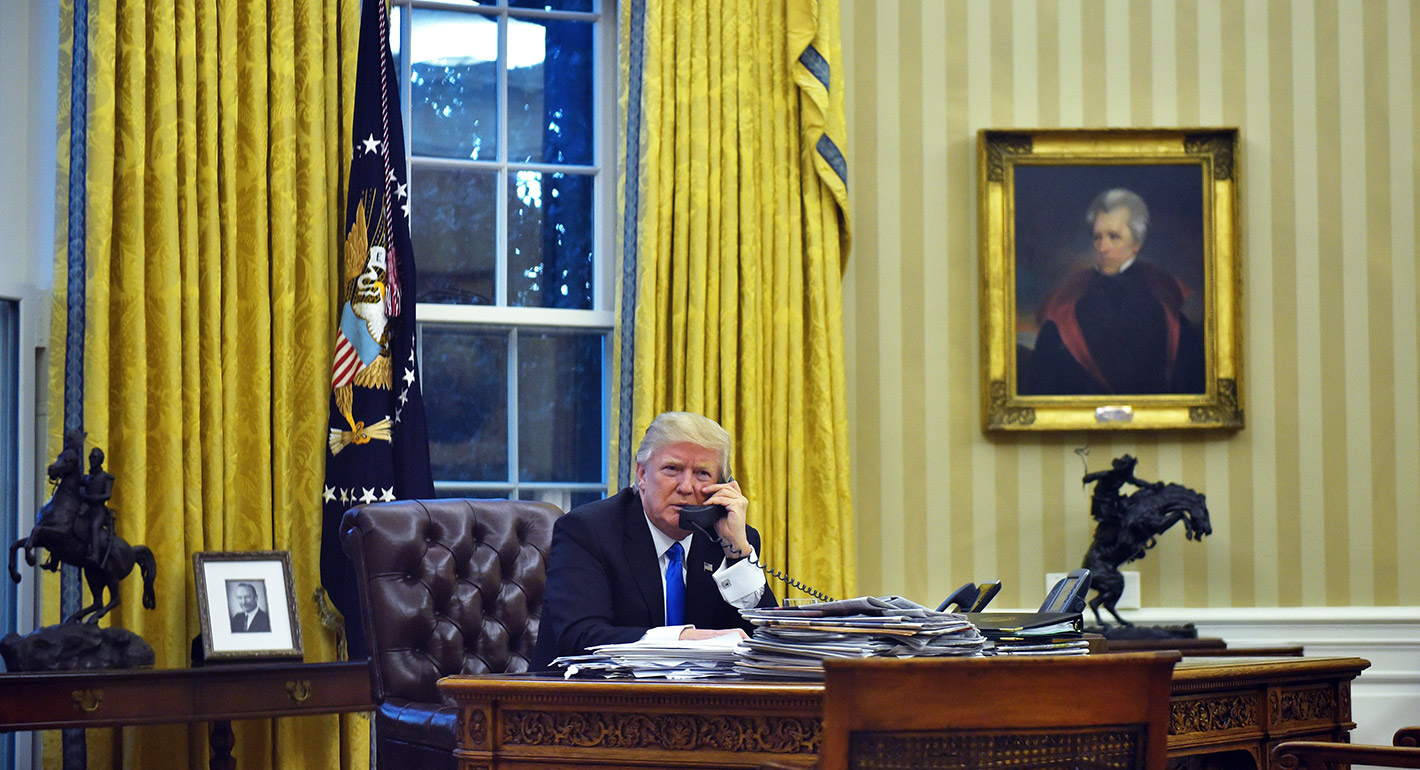
President Trump has defined his presidency in terms of the successes and failures of his predecessors, especially when it comes to wars in the Middle East.
Source: USA Today
How ironic that, halfway through President Donald Trump’s term and as Trump himself has done many times, Secretary of State Mike Pompeo blasted former president Barack Obama as weak and vacillating in his recent speech in Cairo.
Why? Because while Trump is Mars and Obama is Venus, they’re alike in one important respect: when it comes to the use of force, especially in the Middle East, both believe the United States should avoid starting new wars and try to get out of old ones.
But Trump is surrounded by two foreign policy advisers who are far more hawkish and eager to remain in Syria to use military power to contain Iran, and even to create pressure that might lead to regime change in Tehran. If Trump isn’t careful and disciplined — qualities that sadly have been MIA in his foreign policy as in his presidency overall — he could end up in an unnecessary and dangerous war with Iran that Obama also sought to avoid.
All new administrations try to separate themselves from their predecessors. But rarely has one president defined himself so blatantly in terms of the successes and failures of another. Trump campaigned on the message that he was the anti-Obama and after two years he’s still on message.
By and large, he has made good on his commitment to demolish Obama’s legacy —whether it’s withdrawing from the Paris Climate accord, the Trans-Pacific Partnership or the Iran deal; pursuing Muslim travel bans; trying to overturn the Affordable Care Act, or opening a US Embassy in Jerusalem.
The one area where Obama and Trump are more birds of a feather is their mutual aversion to starting new wars or building nations. Despite Trump’s bellicose rhetoric, he’s been remarkably restrained when it comes to deploying the U.S. military for purposes other than countering terrorism. Instead of a war with North Korea over nuclear weapons, Trump is relying on diplomacy; instead of escalating U.S. military commitments in Syria or Afghanistan, he is trying to head for the exits.
Trump has made greater use of drone attacks. And he’s also intensified the fight against the Islamic State’s Caliphate and struck Syria twice in retaliation for the Assad regime’s use of chemical weapons. But like Obama, who was opposed to using military power to fix the Arab world, the purpose of these missions has been narrowly defined as counter-terrorism, not nation-building or regime change. As Trump opined in 2017 in a major speech on Afghanistan, “We are not nation-building again. We are killing terrorists.”
Trump has been far more risk averse on Syria than Pompeo and National Security Adviser John Bolton. Bolton and Pompeo see Syria as an opportunity to roll back Iranian influence, but Trump — convinced that the U.S. was well on its way to defeating ISIS —does not share their focus on Iran.
Trump’s decision to order the withdrawal from Syria within 30 days was impulsive and reckless and of course unrealistic. But it tracked with his goal of reducing America’s military footprint in the Middle East. In his first Cabinet meeting of 2019, Trump said, stunningly: “Iran can do what it wants in Syria.”
Ultimately Trump was persuaded to at least slow down the withdrawal. And Bolton and Pompeo were recently in the region to reassure allies that the U.S. was not abandoning them. Bolton showed how out of step they were with the president by publicly announcing conditions, including the defeat of ISIS and protection of the Kurds, that were unrealistic and might guarantee that no withdrawal ever took place.
Their desire to create a more orderly draw-down makes sense. What does not, and puts them at odds with Trump, is their interest in keeping U.S. troops in Syria to force Tehran to withdraw Iranian and Iranian-backed forces. In his Cairo speech, Pompeo called for getting “every Iranian boot” out of Syria. This is not the same as letting Iran do what it wants there. Last week, consistent with Trump's view, the U.S. started withdrawing military equipment.
The hawkish Bolton has been on a crusade to topple the regime in Iran since he was a senior official in the George W. Bush administration and called for military strikes and regime change while he was out of government. He was a prominent cheerleader for abandoning the nuclear agreement with Iran and (along with Pompeo) authored the “maximum pressure” campaign against Iran as well as the unrealizable demands Iran would have meet to get sanctions removed. Late last year, to the dismay of Mattis and other military officials, Bolton asked the Pentagon to provide possible military options to strike Iran after pro-Iranian militias fired rockets that landed in an empty lot adjacent to the U.S. Embassy in Baghdad.
The president has talked tough on Iran, but seems to have no interest in a serious military confrontation with the regime unless Iran provoked one. In fact, last July he offered — perhaps half seriously, and in another echo of Obama — to meet the Iranian president anywhere without preconditions to negotiate a new Iran deal.
Still, given his own mercurial nature and Iran’s behavior, Trump could abandon caution and — egged on by Bolton and Pompeo — adopt a more aggressive posture toward Iran, especially in the absence of Mattis’ prudence and restraint. At least on this one issue, America’s security interests would be better served if he went with his gut and ignored the more hawkish advice of the big brains around him.

Nonresident Senior Fellow, Russia and Eurasia Program
Richard Sokolsky is a nonresident senior fellow in Carnegie’s Russia and Eurasia Program. His work focuses on U.S. policy toward Russia in the wake of the Ukraine crisis.

Senior Fellow, American Statecraft Program
Aaron David Miller is a senior fellow at the Carnegie Endowment for International Peace, focusing on U.S. foreign policy.
Carnegie does not take institutional positions on public policy issues; the views represented herein are those of the author(s) and do not necessarily reflect the views of Carnegie, its staff, or its trustees.

Russia is testing the waters of NATO’s mutual defense clause. What do strikes in Romanian territorial waters mean for the alliance’s posture toward Moscow?

Dimitar Bechev

With its public finances in shambles, the far right polling at 35 percent ahead of the 2027 presidential election, and a growing protest movement, is France’s crisis a threat to the EU’s geopolitical awakening?

Rym Momtaz, ed.

Ahead of a tough winter for Ukraine, Donald Trump’s swing back toward Russia bodes ill. But instead of panicking, Kyiv’s European allies are focusing on action.
Rym Momtaz

Funding Ukraine remains a priority for European leaders. As Russia’s war of aggression heads into another winter, two feasible options to mobilize support for Kyiv should be fast-tracked.


Vladyslav Rashkovan, Gregory P. Wilson

While the EU and European governments are embracing the much-lauded middle-power moment, this entails three difficult conundrums.

Richard Youngs