

Article
Paul Stronski
{
  "authors": [
    "Paul Stronski"
  ],
  "type": "questionAnswer",
  "centerAffiliationAll": "dc",
  "centers": [
    "Carnegie Endowment for International Peace"
  ],
  "collections": [],
  "englishNewsletterAll": "ctw",
  "nonEnglishNewsletterAll": "",
  "primaryCenter": "Carnegie Endowment for International Peace",
  "programAffiliation": "russia",
  "programs": [
    "Russia and Eurasia"
  ],
  "projects": [],
  "regions": [
    "Russia",
    "Eastern Europe"
  ],
  "topics": [
    "Foreign Policy"
  ]
}
Source: Getty
The Kremlin has been flexing its influence in Southeast Europe. What is its ultimate goal?
Russia is asserting itself in the Balkans in a variety of ways. One is soft power. Moscow is trying to make itself more persuasive and attractive by highlighting Russia’s cultural and religious ties to the region. It cultivates Russian-friendly media outlets and journalists, hoping to spread pro-Russian or anti-Western narratives in local languages. And it offers free content from Russian news outlets, like Sputnik, making it more likely that Russian-friendly narratives will circulate through the Balkan media.
Russia has many proxies to expand its clout. These include the Russian Orthodox church, several prominent Russian oligarchs, other Russian businesses, and authoritarian-style Balkan politicians. Some of their activities appear closely coordinated with Russia’s overarching government policies, but others seem to be self-driven.
Moscow is also nurturing economic and trade relations in strategic sectors—like energy, banking, retail, and real estate—to create greater dependencies on Russia. To reinforce these efforts, Russia also seeks to exacerbate political and social fissures in several Balkan countries by giving money and public relations support to far-right groups.
The Kremlin does not see the Balkans as a region of vital strategic interest. Instead, it sees Balkan states as tools to influence broader European security issues. Russia’s overarching goal is to delay and complicate the expansion of NATO and the European Union (EU).
Moscow is quite aware that the Balkans is the last part of Europe—before the former Soviet countries—that is yet to be fully integrated into Western political and security structures. So it hopes that by slowing down the integration process in the Balkans, it can prevent the West from renewing attempts to pull countries like Ukraine or Georgia into Euro-Atlantic institutions.
Another added benefit for Moscow is distraction. Russia’s activity in the Balkans deflects Western attention from Russia’s bad behavior in its immediate neighborhood—for example, the militarization of the Kerch Strait and Black Sea, its attempts to push the boundaries of breakaway territories deeper into Georgia proper, and its pressure on the governments of Armenia and Belarus.
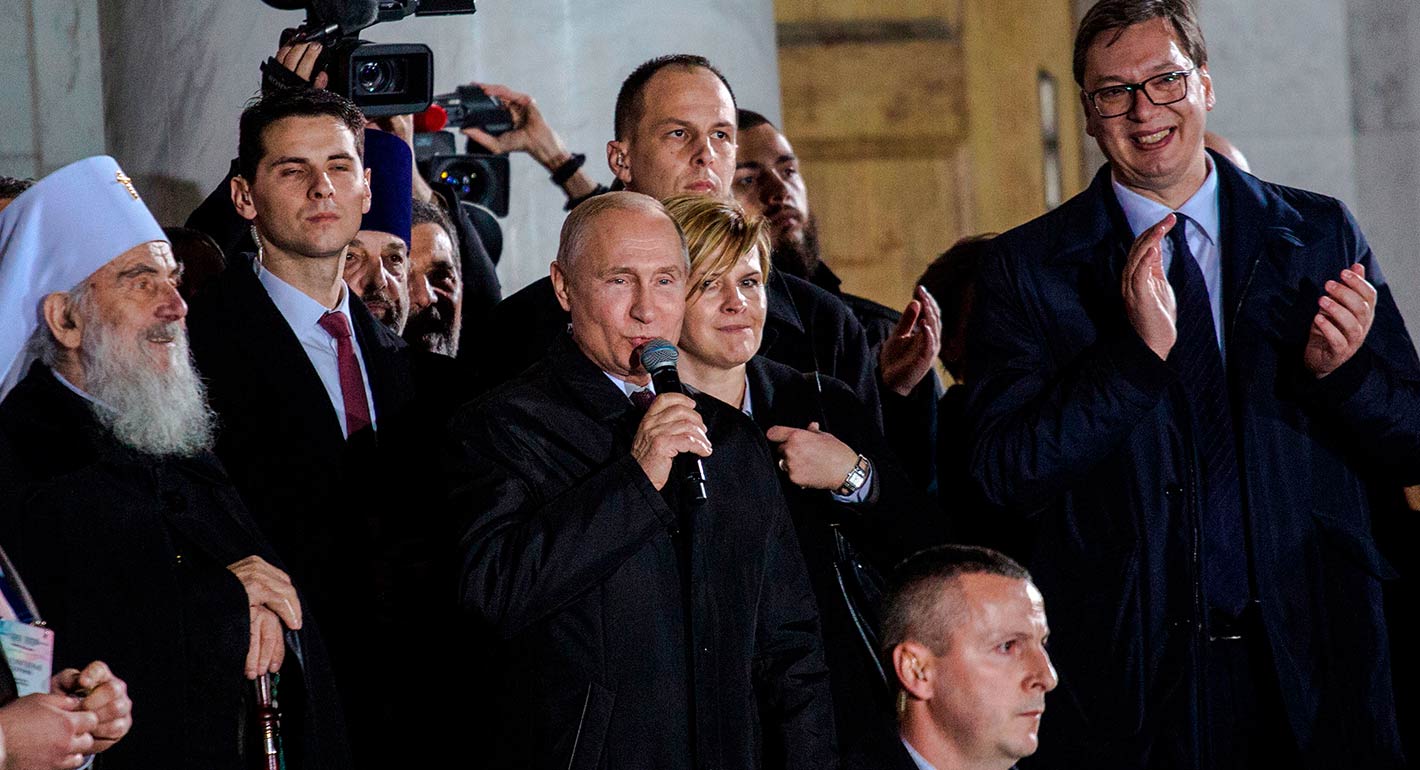
Russia shares religious ties with the Orthodox populations of the Balkans, especially in Bulgaria, Greece, Macedonia, Montenegro, and Serbia. Moscow uses Orthodoxy to promote itself as a defender of traditional family values in the region. This comes at a time when Brussels is demanding greater respect for ethnic, religious, or sexual minorities in order to join the EU.
Nonetheless, Russia’s cultural and historic ties to the region are often exaggerated. Russia’s engagement in the Balkans has traditionally been more about influencing European security issues.
Russia’s historic engagements with the Balkans have not always turned out successfully. Its support for Serbia before World War I ended up pulling the Russian Empire into that catastrophe, which weakened the tsarist regime. After the Russian Revolution, many Russian exiles fled the Soviet Union to Belgrade, making the city a prominent European hotbed of anti-Soviet sentiment.
During the Cold War, neither Albania nor Yugoslavia were Soviet satellites by any means. Russia’s narrative of close ties with the Balkans overlooks these parts of the story.
It depends on whom you ask. In much of Bosnia and Herzegovina or Kosovo, Russia is largely unpopular. These countries look more toward the West, and the United States in particular. Many local people see Russian support for ethnic Serb populations as destabilizing, and they worry about Russian support to fringe far-right groups that could be used to disrupt political decisionmaking. In Bosnia and Herzegovina, for example, Russia is not only cultivating ethnic Serb nationalists but also engaging ethnic Croat politicians. Given the country’s history of violence, Bosniaks find this dual engagement particularly troubling.
In Orthodox-majority countries, popular attitudes toward Russia are more positive. Russia’s efforts to promote itself as defender of Orthodoxy have helped build goodwill. Russian senior officials visit frequently, shoring up diplomatic ties. But Moscow does not always deliver on its promises of investments or loans, causing some to question its reliability.
However, the West does not look all that great right now either. The slow pace of European integration has caused frustration, as has a growing perception that the United States has lost interest. U.S. President Donald Trump’s general disdain for NATO and other multilateral institutions has prompted some to question the benefits of Euro-Atlantic integration. And Western leaders like Trump or British Prime Minister Theresa May look erratic or weak when compared to the carefully controlled image of Vladimir Putin.
Meanwhile, Brexit and the migrant crisis have damaged the credibility of the European Union. The Balkans were on the front lines of that mass population movement, and the decision of some European countries to close their borders put a lot of economic and social strain on the region.
With the West distracted, a vacuum of leadership in the region has provided Russia with many openings to exert itself.
There is a lot of talk about Russia’s schemes in the region, particularly after the 2016 Russian-backed coup attempt in Montenegro that was intended to prevent that country’s accession to NATO. Russia’s machinations to prevent a resolution to Greece and Macedonia’s name dispute have also been covered by the media.
Those efforts have highlighted more sinister Russian activity in the region and prompted NATO to refocus its attention on pushing back against Russian influence.
However, analysts in the West must be careful of overinflating Russia’s power in the region. Moscow’s meddling has backfired in some ways—for example, its maneuvers to stop Montenegro’s NATO bid and to undermine the Macedonian name deal both failed. Yet Russia may have something else up its sleeve to complicate these countries’ Euro-Atlantic trajectories.

Former Senior Fellow, Russia and Eurasia Program
Paul Stronski was a senior fellow in Carnegie’s Russia and Eurasia Program, where his research focuses on the relationship between Russia and neighboring countries in Central Asia and the South Caucasus.
Recent Work
Paul Stronski
Paul Stronski
Carnegie does not take institutional positions on public policy issues; the views represented herein are those of the author(s) and do not necessarily reflect the views of Carnegie, its staff, or its trustees.

With its public finances in shambles, the far right polling at 35 percent ahead of the 2027 presidential election, and a growing protest movement, is France’s crisis a threat to the EU’s geopolitical awakening?

Rym Momtaz, ed.

Ahead of a tough winter for Ukraine, Donald Trump’s swing back toward Russia bodes ill. But instead of panicking, Kyiv’s European allies are focusing on action.
Rym Momtaz

Funding Ukraine remains a priority for European leaders. As Russia’s war of aggression heads into another winter, two feasible options to mobilize support for Kyiv should be fast-tracked.


Vladyslav Rashkovan, Gregory P. Wilson

While the EU and European governments are embracing the much-lauded middle-power moment, this entails three difficult conundrums.

Richard Youngs

Europe is facing rising populism internally as well as external pressures from Russia, China, Turkey, and the United States.

Dimitar Bechev