

Commentary
- +11
Cornelius Adebahr, Dan Baer, Rosa Balfour, …
{
  "authors": [
    "Erik Brattberg"
  ],
  "type": "commentary",
  "centerAffiliationAll": "dc",
  "centers": [
    "Carnegie Endowment for International Peace"
  ],
  "collections": [
    "European Foreign Policy in a New Transatlantic Context"
  ],
  "englishNewsletterAll": "ctw",
  "nonEnglishNewsletterAll": "",
  "primaryCenter": "Carnegie Endowment for International Peace",
  "programAffiliation": "EP",
  "programs": [
    "Europe"
  ],
  "projects": [],
  "regions": [
    "Eastern Europe",
    "Western Europe",
    "Iran"
  ],
  "topics": [
    "Political Reform",
    "Democracy",
    "Climate Change"
  ]
}
Source: Getty
If anything, growing fragmentation in the European Parliament means that the prospects for any serious EU reform agenda seem even less promising over the next few years.
Many observers predicted that the 2019 European Parliament elections would be a referendum on what lies ahead for the European Union (EU). Both far-right populists such as Italian Deputy Prime Minister Matteo Salvini and pro-European centrists such as French President Emmanuel Macron fed this narrative, campaigning under the respective banners of “less” versus “more” European integration.
But the early results offer no definitive verdict on Europe’s future direction over the next five years. Anti-European populists are here to stay, but they will not be able to bring the European project down. Yet rising fragmentation and political divisions threaten to sap much of the EU’s unity, vitality, and focus at a crucial juncture. Or it could be an opportunity for the EU to hit the restart button. As other external powers like Russia and China seek to divide Europe, ensuring that the EU does not become ungovernable will be a crucial challenge.
Europeans’ interest in the European Parliament electoral contests was clearly higher than normal. For the first time in two decades, voter turnout exceeded 50 percent (up from 42.6 percent in the 2014 election), reversing a long-term downward trend. It is plausible that the high stakes of the elections and active media interest in the contests helped mobilize voters, although turnout in Europe-wide elections still remain far lower than in most national elections in Europe. The higher turnout benefited both pro-European Greens and liberal parties as well as populists, while traditional center-left and center-right parties suffered at the ballot boxes.
The fear that anti-European nationalists would sweep across the European continent turned out to be overblown, although euroskeptics did make some gains. In the majority of member states, pro-European parties finished first. In several countries—such as Austria, Denmark, Germany, the Netherlands, and Spain—far-right parties fell far short of early predictions. Even so, Salvini’s party, Lega Nord, won decisively with around 34 percent of the vote, while Fidesz, the nationalist party led by Hungarian Prime Minister Viktor Orbán, garnered half of the Hungarian vote. So far-right parties consolidated their position in certain pockets of the European political map, but for the most part their surge fell short of expectations.
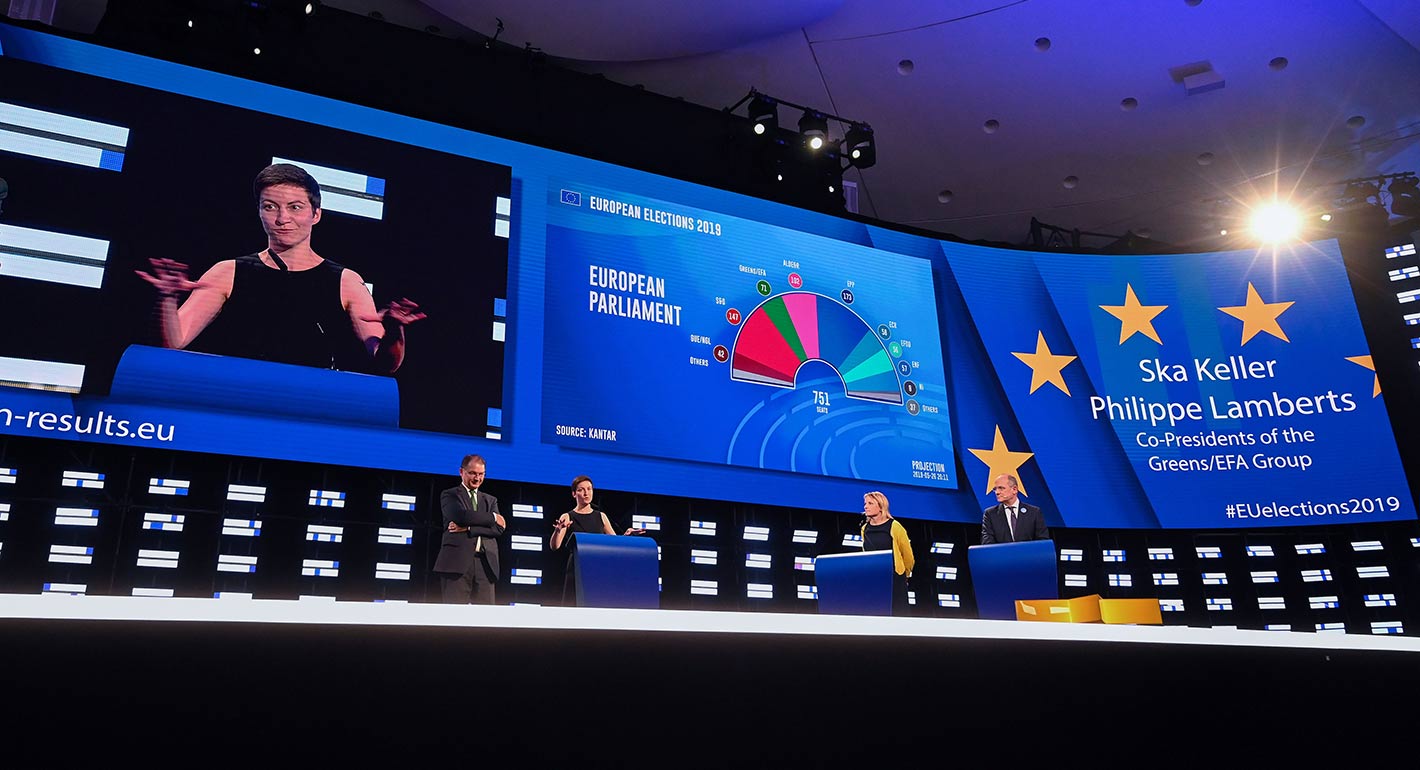
The European Parliament’s two mainstream heavyweights lost a combined seventy-seven seats and will no longer enjoy an outright majority. That said, the center-right European People’s Party (EPP) will remain the largest pan-European group in the European Parliament followed by the center-left Progressive Alliance of Socialists and Democrats (S&D). The gains by the Greens, the Alliance of Liberals and Democrats for Europe (ALDE) group, and Macron’s En Marche can make up for some of these losses, providing pro-Europeans with a sizable two-thirds majority. It will be worth watching to see whether mainstream parties manage to adapt to this new balance of power by forming coalitions and adopting legislation together on a wide variety of issues. A crucial early test will be the appointment of the next European Commission, as both the Greens and the liberals will likely want to assert themselves on this decision. Meanwhile, far-right parties will no doubt seek to make their presence known by exerting influence especially on issues like migration and the EU budget. They may even seek to play an obstructionist role on certain issues if they can act cohesively as a bloc.
European Green parties were mostly big winners, often at the expense of Social Democrats. The Greens did particularly well in Germany, where they doubled their vote share (to 20.5 percent) compared to 2014 and ended up the country’s second-largest party. The German Greens were dominant among younger voters. The fact that many voters ranked climate change as one of the top issues helps account for this ongoing generational shift in European politics, particularly away from Social Democratic parties to the Greens. Many prominent Social Democratic parties across Europe (especially one of Germany’s ruling party, the SPD) continued a years-long trend of losing ground, although parties in Denmark, the Netherlands, and Spain held their own better than many of their peers.
The race in France between President Emmanuel Macron’s En Marche party and Marine Le Pen’s National Rally garnered much attention. In the end, Le Pen managed to eke out a narrow win, albeit with fewer votes than in 2014. Though this is clearly a defeat for Macron who went all in on winning the European Parliament elections, Le Pen’s victory is mostly symbolic. Moreover, Macron fared far better than his predecessor François Hollande did five years ago, and the collapse of the French Socialist and Republican parties (who combined received less than 15 percent) means that Macron’s chances of standing for re-election in the next national elections in 2022 look very promising.
If anything, growing fragmentation in the European Parliament means that the prospects for any serious EU reform agenda seem even less promising over the next few years. As a result, the governments of member states may seek to assert themselves, potentially leading to a loss of influence by the European Parliament, which has been gaining power in recent years. At the same time, higher voter turnout could make the institution more important and harder to ignore in terms of EU decisionmaking.
It is also possible that centrist parties, despite their many internal differences, can manage to build consensus in the EU at least around some less grandiose, common sense projects for the next five years. A cursory list of such issues might include climate change, external border security, artificial intelligence and technological innovation, and upgrading Europe’s global role. If so, a more diverse European Parliament can actually be a healthy development and a rare opportunity to revisit tired old approaches and debates.
Correction: This piece originally referred to the Christian Democratic Union as a prominent Social Democratic party. This has been fixed.

Former Director, Europe Program, Fellow
Erik Brattberg was director of the Europe Program and a fellow at the Carnegie Endowment for International Peace in Washington. He is an expert on European politics and security and transatlantic relations.
Recent Work



Cornelius Adebahr, Dan Baer, Rosa Balfour, …

Erik Brattberg, Philippe Le Corre, Paul Stronski, …
Carnegie does not take institutional positions on public policy issues; the views represented herein are those of the author(s) and do not necessarily reflect the views of Carnegie, its staff, or its trustees.

A notable degree of participative democracy has firmly arrived in Europe. But to have more far-reaching impact, democratic deliberation needs to move into a radically new phase.

Richard Youngs

The domestic impacts of how long it is taking to end the war in Ukraine have pushed the French electorate to the political extremes and compromised the country’s diplomatic capacity.

Rym Momtaz

Before the next wave of EU enlargement takes place, the union needs to grapple with thorny questions of how power is distributed among its members.


Emil Sondaj Hansen, Ditte Brasso Sørensen

A summer of escalation in the Black Sea has hurt Ukraine economically and is exacerbating world food security. A truce is needed—as is a broader reframing of Europe’s Ukraine strategy.

Thomas de Waal

Are Germany’s economic, industrial, and political struggles becoming a liability for the EU’s ability to rise to the geopolitical moment?
Rym Momtaz, ed.