

Commentary
With its public finances in shambles, the far right polling at 35 percent ahead of the 2027 presidential election, and a growing protest movement, is France’s crisis a threat to the EU’s geopolitical awakening?
Rym Momtaz, ed.
{
  "authors": [
    "Balázs Jarábik",
    "Dániel Bartha"
  ],
  "type": "legacyinthemedia",
  "centerAffiliationAll": "",
  "centers": [
    "Carnegie Endowment for International Peace",
    "Carnegie Europe"
  ],
  "collections": [
    "EU Integration and Enlargement"
  ],
  "englishNewsletterAll": "",
  "nonEnglishNewsletterAll": "",
  "primaryCenter": "Carnegie Endowment for International Peace",
  "programAffiliation": "",
  "programs": [],
  "projects": [],
  "regions": [
    "Western Europe",
    "Europe"
  ],
  "topics": [
    "EU"
  ]
}
Source: Getty
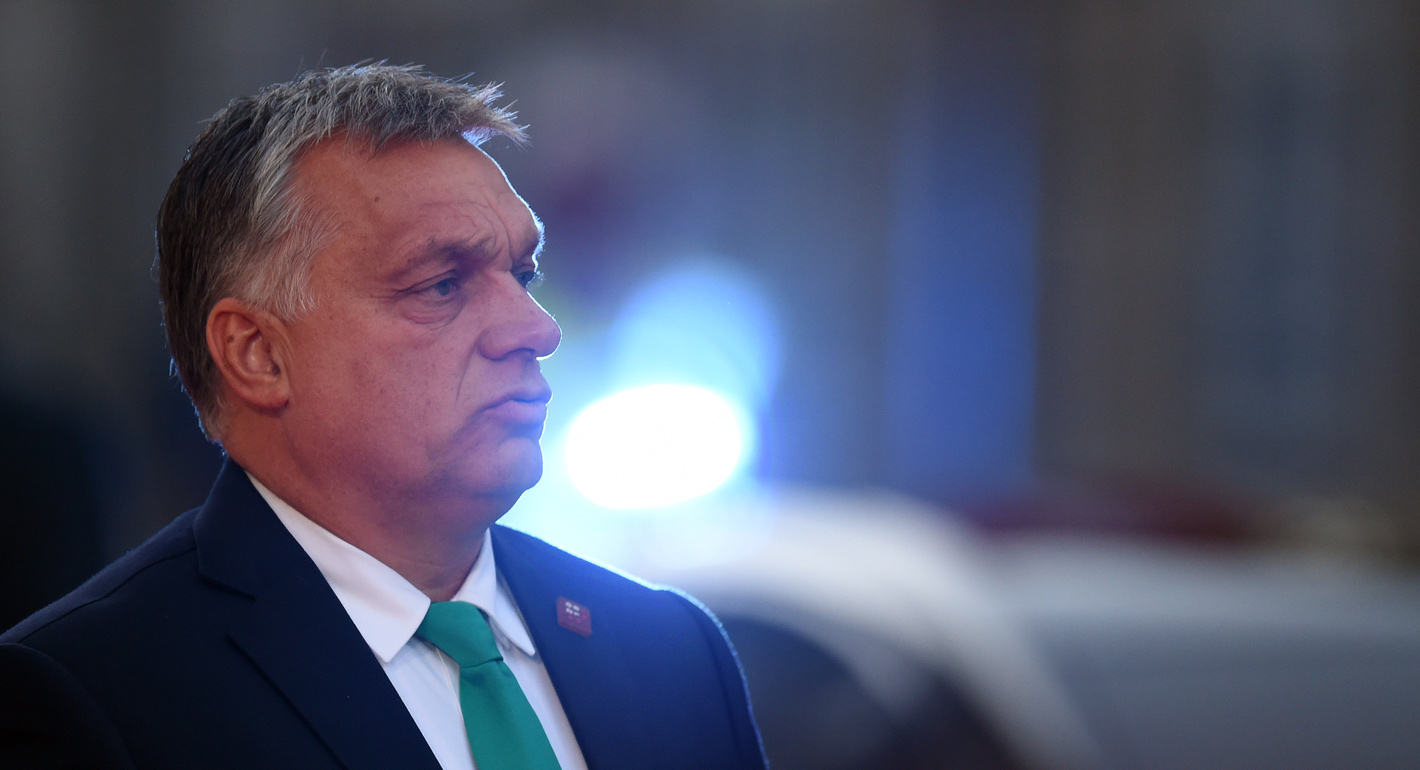
Despite securing a place among the very few European leaders with a landslide victory under their belt in the 2019 EU election, Hungarian Prime Minister Viktor Orbán is not celebrating.
Source: EurActiv
Despite of securing a place among the very few European leaders with a landslide victory under their belts in the European Parliamentary election, Hungary’s prime minister, Viktor Orbán is not celebrating.
His push for the European People’s Party’s further shift towards right was unsuccessful. The bet that populists will have at least a blocking force in the EP will most likely not pay off. Given the European Parliament’s decade long big party coalitions, and current political trends, it was a wishful thinking from the beginning.
Moreover, Orbán’s illiberal rhetoric and cultural war elevated to the European level contributed to the rise of liberals at home as well as in Europe. In Hungary, the party of the former Socialist prime minister, Ferenc Gyurcsány, led by the energetic Klara Dobrev (Gyurcsány’s wife) came second with 16% of the votes. The young, Western educated liberals Momentum secured third place with 10%, giving a sign of hope for the opposition.
In the EU, the new political division lines are climate change and illiberalism – and less so on migration or particularly economic governance that European voters are actually unhappy about. Representing two different angles of behaviour but the same neoliberal economics, Orbán needs French President Macron to maintain his position as much as Macron needs him.Thus far playing successfully on the European field continues to be Orbán’s unfulfilled aspirations. One of the key reasons is that Orbán has been applying a similar strategy what worked successfully at home – making the center right the political mainstream and Fidesz a dominating party therein.
However, Hungary was in a different situation when he took over in 2010. The economy was in tatters, the country needed an almost $26 billion bailout in 2008 after years of high deficit, unsustainable debt levels, very low social spending, and mismanagement by the socialist-liberal government coalitions. For the majority of Hungarians Orbán is managing the economy better, what is the main reason behind Fidesz`s continuous popularity. Meanwhile, the opposition is oversaturated with previously discredited political figures.
Successful (re)branding plays an important role as well. Orbán’s famous “unorthodox policies” – utilising domestic sources of financing, reducing the budget deficit and foreign debt, and taxing consumption instead of investment – is actually in line with the Washington Consensus. Budapest nevertheless bailed out people, not banks, reduced utility costs after renationalising the energy sector, and put the supporting of families in the focus of its social policies.
Although he made building up Hungarian business champions (too often his own friends) a government policy, Budapest had not only made peace with the multinationals, but has also become a global corporate tax heaven itself. Understandably so as 52% of the value added of Hungarian GDP is produced by international large companies – which accounts for less than 15% of the employment rate. Even though the Hungarian economy keeps outgrowing its EU peers, this is based on a whopping 8% net inflow of external resources (comprising of EU funds and remittances).Many in the West ignores the actual local context, that the Hungarian situation emerged from the mixture of an incomplete transformation after communism and the impacts of the global financial crisis, implying that Hungary is no longer a democracy.
Orbán certainly emerges as a traditionalist leader with authoritarian behaviour. He has been dominating the public space and asserted control over a serious chunk of the media. He has been undoubtedly weakening democratic institutions. Yet copy pasted guarantees of democratic control, checks and balances were not based on strong institutional and constitutional developments. Hungary`s real difference from its neighbours is in its mixed, majoritarian electoral system, created in 1989, which guarantees a (large) majority for the leading political force.
While the Office of the Prosecutor General of Hungary is under political influence, the courts keep maintaining and fighting for their independence. Witnessed for example by the high number of defamation cases routinely lost by pro-government media.
Hungary’s overdecentralised system – for example Budapest is still managed by 23 local governments – has not functioned well. It was easily wiped away by centralisation efforts with no public protests. Orbán’s endeavours promised to bring more efficiency to governance, for example when it comes to utilising available EU funds.
Orbán’s centralisation of governance, attacking now the freedom of the academia similarly to his effort to control the media, is an overcompensation. By now it is threatening the soundness of Budapest decision-making, for what zig-zagging on Manfred Weber is just one proof.
Thus, Orbán’s political dominance and Hungary’s centralised governance should not be conflated with a full fledge authoritarian system. Despite of his media dominance, the government is regularly losing its own “narrative wars”. The pro-government media lacks diversity and creativity, and fair from being effective. The two last cases are the Sargentini report and the so-called “slave law”, when public opinion overwhelmingly turned against the government despite its concentrated media effort. This makes the government even more defensive.
Nevertheless, the opposition has been mostly focusing on capturing the available space from each other as well as on mobilising the EU to fight against Orbán without offering a domestic vision. The EP elections clearly suggested that the opposition can only be successful with new faces. Also, the key challenges are poverty, redistribution, weak human capital and the majority of Hungarians are left leaning. That requires a vision about the role of the state. However, when it comes to the economy the opposition is as liberal as ever.
That leaves Orbán plenty of room to manoeuvre at home. In Europe though his room has further diminished. Fidesz’s fate is now locked in the coalition talks of the EPP. It will likely stay though, as its exclusion would take too much effort, while bringing little profit for the EPP.
To maintain Fidesz’s position in the EPP, Orbán already has become more consensual. The Hungarian government quickly suspended its plans to establish the administrative court system, which would have been directly managed by the Ministry of Justice.
Thus, there will be some precious time to prepare for the 2022 parliamentary elections. It would be essential to start going beyond the usual Hungarian headlines.

Political analyst, former Slovak diplomat, and consultant specializing in Eastern Europe
Dániel Bartha
Dániel Bartha is executive director of the Budapest based Center for Euro-Atlantic Integration and Democracy.
Carnegie does not take institutional positions on public policy issues; the views represented herein are those of the author(s) and do not necessarily reflect the views of Carnegie, its staff, or its trustees.

With its public finances in shambles, the far right polling at 35 percent ahead of the 2027 presidential election, and a growing protest movement, is France’s crisis a threat to the EU’s geopolitical awakening?

Rym Momtaz, ed.

Ahead of a tough winter for Ukraine, Donald Trump’s swing back toward Russia bodes ill. But instead of panicking, Kyiv’s European allies are focusing on action.
Rym Momtaz

Funding Ukraine remains a priority for European leaders. As Russia’s war of aggression heads into another winter, two feasible options to mobilize support for Kyiv should be fast-tracked.


Vladyslav Rashkovan, Gregory P. Wilson

While the EU and European governments are embracing the much-lauded middle-power moment, this entails three difficult conundrums.

Richard Youngs

Europe is facing rising populism internally as well as external pressures from Russia, China, Turkey, and the United States.

Dimitar Bechev