

Article
Frederic Grare
{
  "authors": [
    "Frederic Grare"
  ],
  "type": "other",
  "centerAffiliationAll": "dc",
  "centers": [
    "Carnegie Endowment for International Peace"
  ],
  "collections": [],
  "englishNewsletterAll": "ctw",
  "nonEnglishNewsletterAll": "",
  "primaryCenter": "Carnegie Endowment for International Peace",
  "programAffiliation": "SAP",
  "programs": [
    "South Asia"
  ],
  "projects": [],
  "regions": [
    "North America",
    "United States",
    "South Asia",
    "India"
  ],
  "topics": [
    "Foreign Policy"
  ]
}
Source: Getty
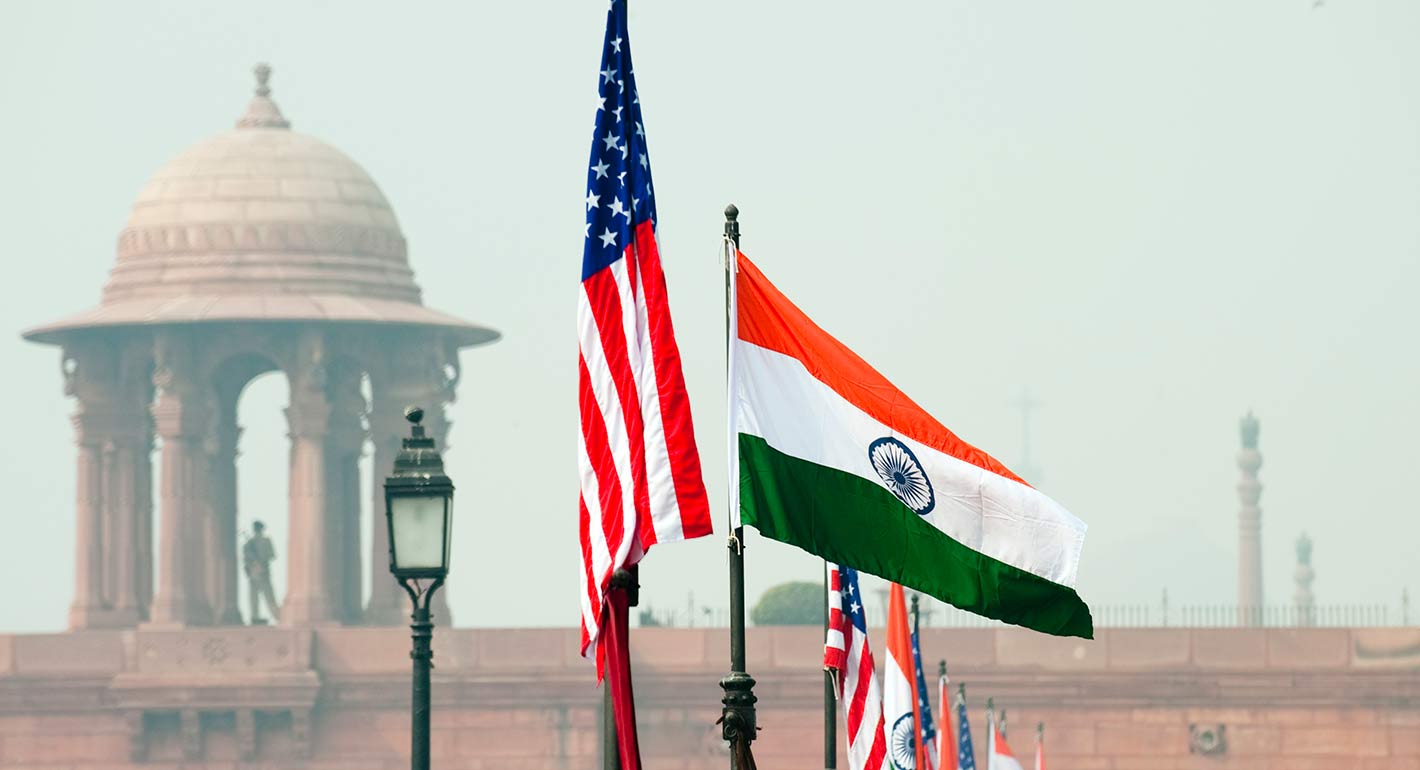
New Delhi may have to redefine the basis of its partnership with the United States in response to President Trump’s narrowly defined transactional policy toward India and aggressiveness with China.
Source: CUTS International
Relations between India and the United States go a long way. In the words of former US Ambassador Dennis Kux, until the early 1990s, India and the United States were two "estranged democracies".1 As described by Sanjaya Baru, "emerging out of the Cold War cocoon, India had to work hard to redefine its economic, political and strategic links with the developed and developing worlds, examining old assumptions and discovering new opportunities and challenges".2 Because of the ideological polarisation, which had characterized international politics and India's proximity with the USSR, the rapprochement with the United States was at the centre of this process and, to a large extent, its essence.
However, since the early 2000, all US administrations, from Bill Clinton to Donald Trump, have worked to build strong relationship with India, gradually encouraging New Delhi to assume a larger role in ensuring the security of the Indo-Pacific region. Directly and indirectly, they have helped India build its standing in Asia and despite India's reluctance, established it as a balancer to China in the region.
Like previous administrations, Trump administration too sees India as an important component of its strategy for Asia. Economic, political and strategic relations between the two countries have spectacularly intensified yet the relationship is not without ambivalence. Despite, or because of, the ongoing dynamics, questions are arising on both sides regarding the future of this relationship.
If New Delhi finds reasons for satisfaction with some of the US policies (pressures on Pakistan being one example), it has also reasons for concerns mainly due to US's handling of relations with China and Russia, exacerbated by the consequences of the "America First Policy".
The present chapter examines the evolution of US-India relations since the early 1990s. It argues that current difficulties in the relationship are less the outcome of specific policies than the consequence of deeper structural issues related to both geography and asymmetry of power, and the exacerbation of the US-China rivalry. Previous US administrations had carefully calibrated their relations with China, allowing India to engage with China while simultaneously developing an increasingly stronger partnership with the United States. The tensions between these two partially contradictory aspects of India's policy remained, therefore, manageable.
President Trump's narrowly defined transactional policies vis-à-vis India and aggressiveness with China are making these tensions more difficult to handle, paradoxically pushing India to seek some degree of accommodation with China while needing more than ever to strengthen its partnership with the United States. In the process, New Delhi may have to redefine the quid pro quo that forms the basis of its partnership with Washington. Interestingly, India's cherished strategic autonomy, which for a long time acted as an obstacle to any significant rapprochement with the United States, may become a condition for the development of the partnership.
1 Dennis Kux, India and the United States: Estranged Democracies, 1941-1991, Washington DC, National Defense University Press 1993.
2 Sanjaya Baru, Strategic Consequences of India’s Economic Performance, New Delhi, Academic Foundation, 2006, p. 136.
This chapter was originally published in World in a Nutshell, released by CUTS International.
Former Nonresident Senior Fellow, South Asia Program
Frédéric Grare was a nonresident senior fellow at the Carnegie Endowment for International Peace, where his research focuses on Indo-Pacific dynamics, the search for a security architecture, and South Asia Security issues.
Recent Work
Frederic Grare
Frederic Grare
Carnegie does not take institutional positions on public policy issues; the views represented herein are those of the author(s) and do not necessarily reflect the views of Carnegie, its staff, or its trustees.

European Commission President Ursula von der Leyen is about to give her annual address on the state of the EU. Here’s what she won’t—but should—say.

Rym Momtaz

Radical-right parties are expected to do well in upcoming elections in four of the EU's biggest member states. If successful, they could prevent the union from addressing key challenges ahead.

Stefan Lehne

The aftermath of the Ceuta crisis shows Europe has drawn the wrong lessons. Rather than doubling down on failed migration policies, the EU needs to address the underlying roots of such episodes.

Richard Youngs

Canadian Prime Minister Mark Carney has twice inspired praise for standing up to U.S. President Donald Trump: at the 2026 World Economic Forum in Davos and on Canada-U.S. trade negotiations. Is Carney showing a third way better than the EU has in dealing with the Trump administration?
Rym Momtaz, ed.

The EU’s responses to two recent incidents expose the gulf between European perceptions and capabilities. Unless the union can bridge that gap, it will never become a real geostrategic power.
Rym Momtaz