

Commentary
Balázs Jarábik
{
  "authors": [
    "Balázs Jarábik"
  ],
  "type": "legacyinthemedia",
  "centerAffiliationAll": "",
  "centers": [
    "Carnegie Endowment for International Peace",
    "Carnegie Europe"
  ],
  "collections": [
    "Europe’s Eastern Neighborhood"
  ],
  "englishNewsletterAll": "",
  "nonEnglishNewsletterAll": "",
  "primaryCenter": "Carnegie Endowment for International Peace",
  "programAffiliation": "",
  "programs": [],
  "projects": [],
  "regions": [
    "Eastern Europe",
    "Ukraine",
    "Europe"
  ],
  "topics": []
}
Source: Getty
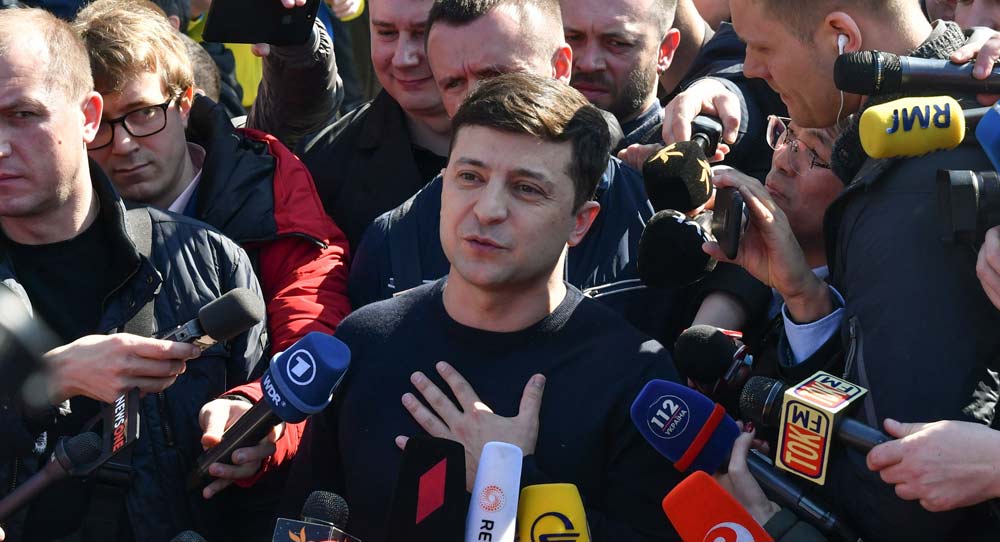
The Ukrainian parliamentary election is widely expected to give President Zelenskiy a greater mandate for reform. He has to start to deliver soon and face the resistance of the opposition.
Source: EurActiv
In Ukraine the hype is over, but the hope still holds. According to the polls 48% of Ukrainians expect the economic situation to improve, a huge jump from 14% in September 2018. Subsequently, President Volodymyr Zelenskiy’s approval rating is 67% and his “Servant of the People” party is poised to win big at the parliamentary elections this Sunday.
Zelenskiy is doing a great job of looking like a breath of fresh air. The obvious lack of experience as well as personnel chilled the original enthusiasm though. In Ukraine’s complicated political system he could end up like French president Macron, with most of power in his hands but facing serious resistance.Zelenskiy’s rule has thus far been characterized by bureaucratic inertia and the president’s own improvisation. Although he has a strong start – dismissing the parliament, changing attitude in Donbas, announcing fight against contraband as well as making hundreds of personnel changes – he has been incapable to change key policies. The Servants’ 50% lead is consolidated mostly due to the “active resistance” by the old elites, by opposing the president’s personnel decisions and policy proposals in the parliament.
Ukraine’s mixed electoral system – half of the 450 members come from single mandate districts – can make the pro-reform camp fractured. The single districts are the last remaining chance for the old elites. The oligarch Kolomoyskiy’s influence on Servant of the People is mostly evident in the single districts of his native Dnipropetrovsk region. Judging by his very frequent interviews, and his troubled business in the US, Kolomoyskyi may be using the elections to fight for his fading influence as well as for his own future.
Zelenskiy team openly admits the lack of cadres and calculates up to 30% of its candidates may turn problematic. De facto there is a civic lustration, public opinion on candidates as well as journalists’ investigations are taken seriously. There have been already several cases of exclusion of problematic candidates from the Servants.
While Zelenskiy is learning that managing the state is not running a business, his team keeps excelling in public relations and working with emotions. The new president, on the contrary to Petro Poroshenko, tries to show that there are no barriers between the rulers and citizens. He has to as media remains in the hands of the oligarchs. Zelenskiy seems to be missing a thus far a clear strategy how to manage the relations with them.
His main opposition will come from Ukraine’s pro-Russia camp. The Opposition Platform-For Life is consolidating under the leadership of Viktor Medvedchuk, Russia’s president Putin only remaining associate in Ukraine. The party with 13% support is a serious competition for Zelenskiy in the country’s south-east. At the same time Medvedchuk remains utterly unpopular nation-wide, and the party’s top candidate Boyko is toxic for majority of Ukrainians. Medvedchuk increased control over media will have a lasting negative impact though.
Other opposition is coming from patriotic forces. Yet, Poroshenko’s plummeting fortunes tell us a lot about how fed up the public is. His attempt to re-brand of his block to European Solidarity has brought mixed results. Poroshenko’s face dominates the campaign, and his loyalists the party list, while his refusal remains as high as 70%. Doubling down on Western integration as main objective means the same old for voters preferring social and economic progress. Their frequent use of “revanche” to label the new authorities’ steps are for the time being the best motivation for Zelenskiy’s voters to stay on course.
Poroshenko’s path to the parliament is further complicated by Prime Minister Groysman’s Ukrainian Future, and former secret services chief Ihor Smeshko. Both are establishment based, pro-reform and anti-corruption to distinguish from the tainted Poroshenko. Although polls don’t give Groysman a big chance to clear the 5% threshold, he may position himself to remain prime minister after the elections.
Vakarchuk’s Voice with around 8% of support is Poroshenko’s main competitor. Vakarchuk’s campaign tactics (new faces, concerts) are borrowed from Zelenskiy, patriotic and reformist messages from Poroshenko. He is less careful as Zelenskiy was during the presidential campaign, and political talk shows revealed his lack of real-life experience.
Based on the polls the new Rada will have an enormous amount of new faces, but not necessary the most competent ones. Particularly in the single mandate districts the Servants had no time for a proper selection process. Greenhorns in politics is a huge opportunity for reform but also a risk of fragmentation and else. After all, the 2014 Rada had 68% of new faces and ended up as the least trusted institution. Much will depend how the Servants will manage Ukraine’s largest parliamentary fraction ever, numbering at least 200 deputies.
After 21 July all the responsibility will be Zelenskiy’s. The time will no longer be on his side. He has to start to deliver, and to improve how government in Ukraine works.

Political analyst, former Slovak diplomat, and consultant specializing in Eastern Europe
Recent Work
Balázs Jarábik
Balázs Jarábik
Carnegie does not take institutional positions on public policy issues; the views represented herein are those of the author(s) and do not necessarily reflect the views of Carnegie, its staff, or its trustees.

Radical-right parties are expected to do well in upcoming elections in four of the EU's biggest member states. If successful, they could prevent the union from addressing key challenges ahead.

Stefan Lehne

The aftermath of the Ceuta crisis shows Europe has drawn the wrong lessons. Rather than doubling down on failed migration policies, the EU needs to address the underlying roots of such episodes.

Richard Youngs

An overwhelming victory by a far-right-wing party in a small state in eastern Germany will have major repercussions for Chancellor Friedrich Merz’s coalition.

Judy Dempsey

Canadian Prime Minister Mark Carney has twice inspired praise for standing up to U.S. President Donald Trump: at the 2026 World Economic Forum in Davos and on Canada-U.S. trade negotiations. Is Carney showing a third way better than the EU has in dealing with the Trump administration?

Rym Momtaz, ed.

The EU’s responses to two recent incidents expose the gulf between European perceptions and capabilities. Unless the union can bridge that gap, it will never become a real geostrategic power.
Rym Momtaz