

Paper
Christopher S. Chivvis, Rohan Mukherjee, Milan Vaishnav
{
  "authors": [
    "Milan Vaishnav"
  ],
  "type": "other",
  "centerAffiliationAll": "dc",
  "centers": [
    "Carnegie Endowment for International Peace"
  ],
  "collections": [],
  "englishNewsletterAll": "ctw",
  "nonEnglishNewsletterAll": "",
  "primaryCenter": "Carnegie Endowment for International Peace",
  "programAffiliation": "SAP",
  "programs": [
    "South Asia"
  ],
  "projects": [],
  "regions": [
    "North America",
    "United States",
    "South Asia",
    "India"
  ],
  "topics": [
    "Foreign Policy",
    "Global Governance"
  ]
}
Source: Getty
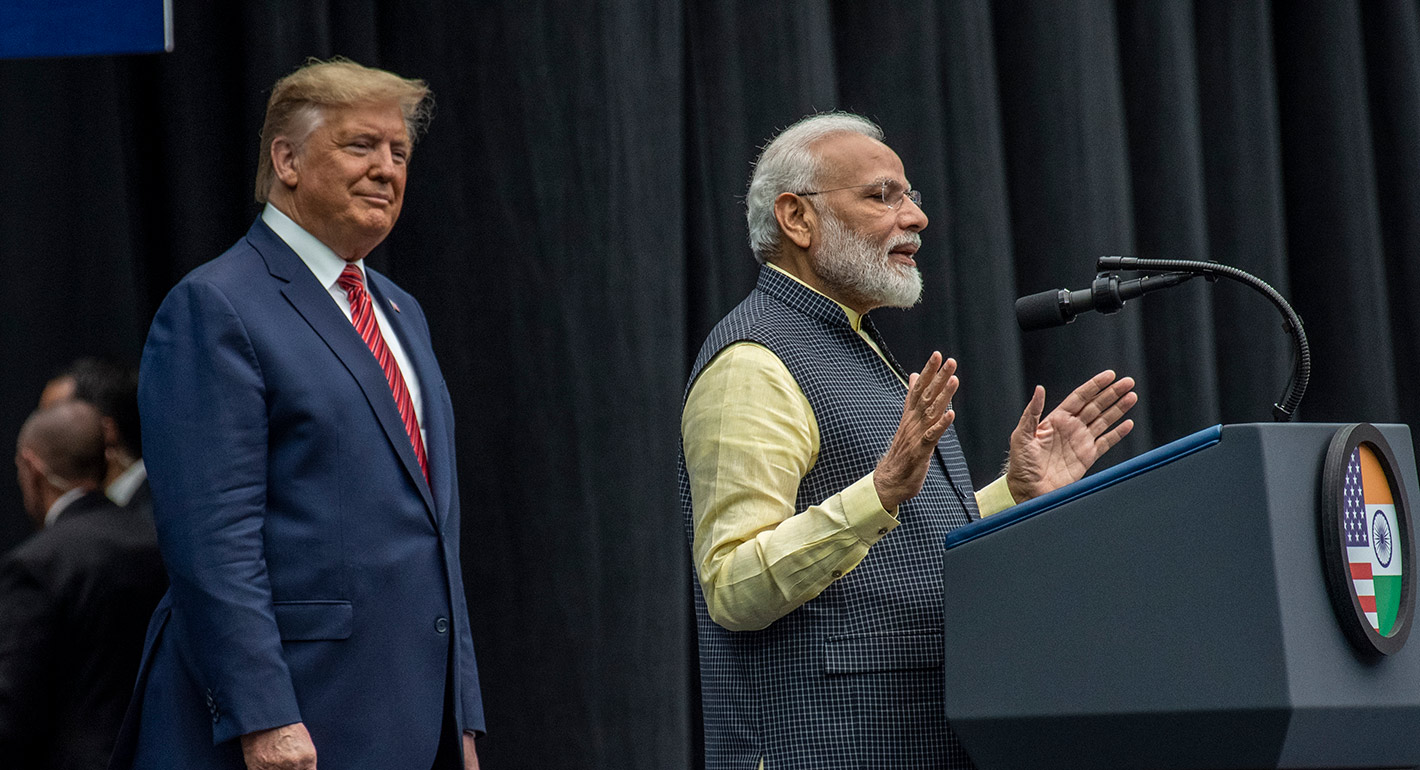
Critics assailed Modi’s speech for its personalism, but in the Trump era this is par for the course.
Source: Rediff.com
“‘America First‘ and ‘Make in India‘ are in tension with one another. At present, the strategic and defence relationship is carrying a heavy part of the load and the government-to-government dimension of the economic relationship is lagging behind,” Milan Vaishnav, director of the South Asia program and senior fellow at the Carnegie Endowment for International Peace in Washington, DC, tells Rediff.com‘s Archana Masih.
I would say that Modi did his homework on Trump. The key to Trump’s heart is flattery and Modi buttered him up big time. From name-checking his book, “Art of the Deal” to surfacing the quip, “Ab ki baar, Trump sarkar,” Modi explicitly played to Trump’s vanity. Surprisingly, Trump was extremely restrained in his remarks. He stuck to the script and heralded what both countries would like to achieve on trade, immigration, and foreign policy (namely, countering terrorism). The basis of the relationship is strategic and long-term, but Modi skillfully navigated Trump’s ego and pushed the right buttons. Critics assailed Modi’s speech for its personalism, but in the Trump era this is par for the course frankly.
I have a slightly different take on this. If you actually go back and hear what the Prime Minister said, he seems to be making a reference to a line that Trump himself used in a 2016 campaign ad: “Ab ki baar, Trump sarkar.” Some have chosen to view this as an endorsement of Trump in 2020, but I am not so sure that was Modi’s intention. If it was, then it would be an incredibly short-sighted move on the part of the PM. If the Democrats were to win in 2020, no doubt the PM would say that the U.S.-India partnership extends beyond any one head of government or any one party on either side of the Atlantic.
For starters, I am not sure Trump has ever seen a captive audience of 50,000 Americans that he could resist. More seriously though, I think Trump had at three motives. First, Texas is an increasingly “purple state” and this essentially was a free campaign appearance for the President. By standing shoulder-to-shoulder with an Indian PM, he was making a play for the votes of Indian-Americans, who account for one percent of the U.S. population (but have historically been among the most loyal supporters of the Democratic Party). Second, Trump and Modi both wanted to signal to their own domestic constituencies that the U.S.-India partnership transcends any routine irritants or differences that might exist in the day-to-day relationship--issues like trade, immigration, and the like.
Modi had three additional objectives. First, this was an opportunity to really signal to the global community that India is a major player on the world stage. When you can hold a rally for 50,000 people on American soil and have the American president show up, this is a powerful symbol. Second, Modi also wants to tap into the Indian-American community, which is a provider or remittances, investment, and support for the Prime Minister’s vision back home. The diaspora would like to a strong, less corrupt, more efficient government in India--and many in the diaspora believe Modi can deliver this change. There is an alignment of visions here. Third and finally, this was a subtle power play for U.S. domestic political consumption. Indian-Americans are an increasingly important force in American society and Modi showed that they are a force to be reckoned with, not to mention a force that he can also tap into to further Indian interests and deepen U.S.-Indian relations.
China is often the subtext of U.S.-India bonhomie. Undoubtedly, Beijing was watching nervously as the US President and Indian PM held hands and paraded around the stage. For Modi, Trump’s presence was a validation of his policies at home&mdash whether on Assam or Jammu and Kashmir or the economy. I am sure Pakistan too took notice, especially given Modi’s sharp language on Pakistan (though he never referred to the country by name) and his calls for a bilateral partnership against terrorism. Some of this anxiety in Islamabad may have dissipated after Imran Khan’s warm meeting with Trump on the sidelines of the UN General Assembly the very next day where Trump had praise for Khan and once more volunteered, if both sides agreed, to mediate the Kashmir dispute.
Typically, these big pronouncements come before or after these bilateral meetings. This is the course of things in U.S.–Indian relations. It is really impossible to know what is happening behind the scenes but the rumor mill is strong that we will see at least a minor U.S.–India trade deal in which India will make concessions on price caps on medical devices, expand access to U.S. agricultural exports, and roll back tariffs on electronics in exchange for reinstatement of unilateral trade preferences under the GSP (Generalized System of Preferences) program. To be sure, this does not eliminate the thorns in the side of the relationship. But it does give confidence that both sides are working in earnest and that political attention from the top can help drive solutions.
I doubt even Trump has delusions that he can achieve a rapprochement between India and Pakistan. Whenever the subject comes up, he inevitably talks about how intractable the issue is and how long it has been going on. Trump desperately wants global recognition—not to mention a Nobel Peace Prize—but even he knows he is unlikely to find one on these grounds.
I think we are in dangerous territory if we start taking progress for granted. There is no doubt that there has been significant and steady progress since 2000. For the last two decades, governments of all stripes—in Delhi and in Washington—have worked towards strengthening and broadening ties. We are not out of the woods though. “America First” and “Make in India” are in tension with one another. At present, the strategic and defense relationship is carrying a heavy part of the load and the government-to-government dimension of the economic relationship is lagging behind (private financial flows continue regardless). There is no guarantee that, left unchecked, the economic issues would not spill over to the strategic side of the house. This is especially likely if the Indian economy experiences a protracted growth slowdown.
I think it certainly took away many of the negative talking points, even if it did not change the fundamentals. The U.S.–India relationship is never as great—or as bad—as its supporters or detractors make it out to be. Cheerleading and naysaying are two great traditions in world capitals—Delhi and Washington are no exception to that rule.

Director and Senior Fellow, South Asia Program
Milan Vaishnav is a senior fellow and director of the South Asia Program and the host of the Grand Tamasha podcast at the Carnegie Endowment for International Peace. His primary research focus is the political economy of India, and he examines issues such as corruption and governance, state capacity, federalism, and electoral behavior. He also conducts research on the Indian diaspora.
Recent Work
Christopher S. Chivvis, Rohan Mukherjee, Milan Vaishnav



Sophia Besch, Eric Ciaramella, Steve Feldstein, …
Carnegie does not take institutional positions on public policy issues; the views represented herein are those of the author(s) and do not necessarily reflect the views of Carnegie, its staff, or its trustees.

The EU can impose sanctions but struggles to enforce them without the United States. With Washington increasingly disinterested in backing European interests, the bloc must now fend for itself.


Nicu Popescu, Tiago Antunes

Russia is testing the waters of NATO’s mutual defense clause. What do strikes in Romanian territorial waters mean for the alliance’s posture toward Moscow?

Dimitar Bechev

With its public finances in shambles, the far right polling at 35 percent ahead of the 2027 presidential election, and a growing protest movement, is France’s crisis a threat to the EU’s geopolitical awakening?

Rym Momtaz, ed.

Ahead of a tough winter for Ukraine, Donald Trump’s swing back toward Russia bodes ill. But instead of panicking, Kyiv’s European allies are focusing on action.
Rym Momtaz

Funding Ukraine remains a priority for European leaders. As Russia’s war of aggression heads into another winter, two feasible options to mobilize support for Kyiv should be fast-tracked.


Vladyslav Rashkovan, Gregory P. Wilson