

Commentary
Ahead of a tough winter for Ukraine, Donald Trump’s swing back toward Russia bodes ill. But instead of panicking, Kyiv’s European allies are focusing on action.
Rym Momtaz
{
  "authors": [
    "Shin Kawashima",
    "Matake Kamiya",
    "James L. Schoff"
  ],
  "type": "other",
  "centerAffiliationAll": "dc",
  "centers": [
    "Carnegie Endowment for International Peace"
  ],
  "collections": [
    "The United States and Japan in Asia"
  ],
  "englishNewsletterAll": "asia",
  "nonEnglishNewsletterAll": "",
  "primaryCenter": "Carnegie Endowment for International Peace",
  "programAffiliation": "AP",
  "programs": [
    "Asia"
  ],
  "projects": [],
  "regions": [
    "North America",
    "United States",
    "East Asia",
    "China",
    "Japan"
  ],
  "topics": [
    "Democracy",
    "Global Governance"
  ]
}
Source: Getty
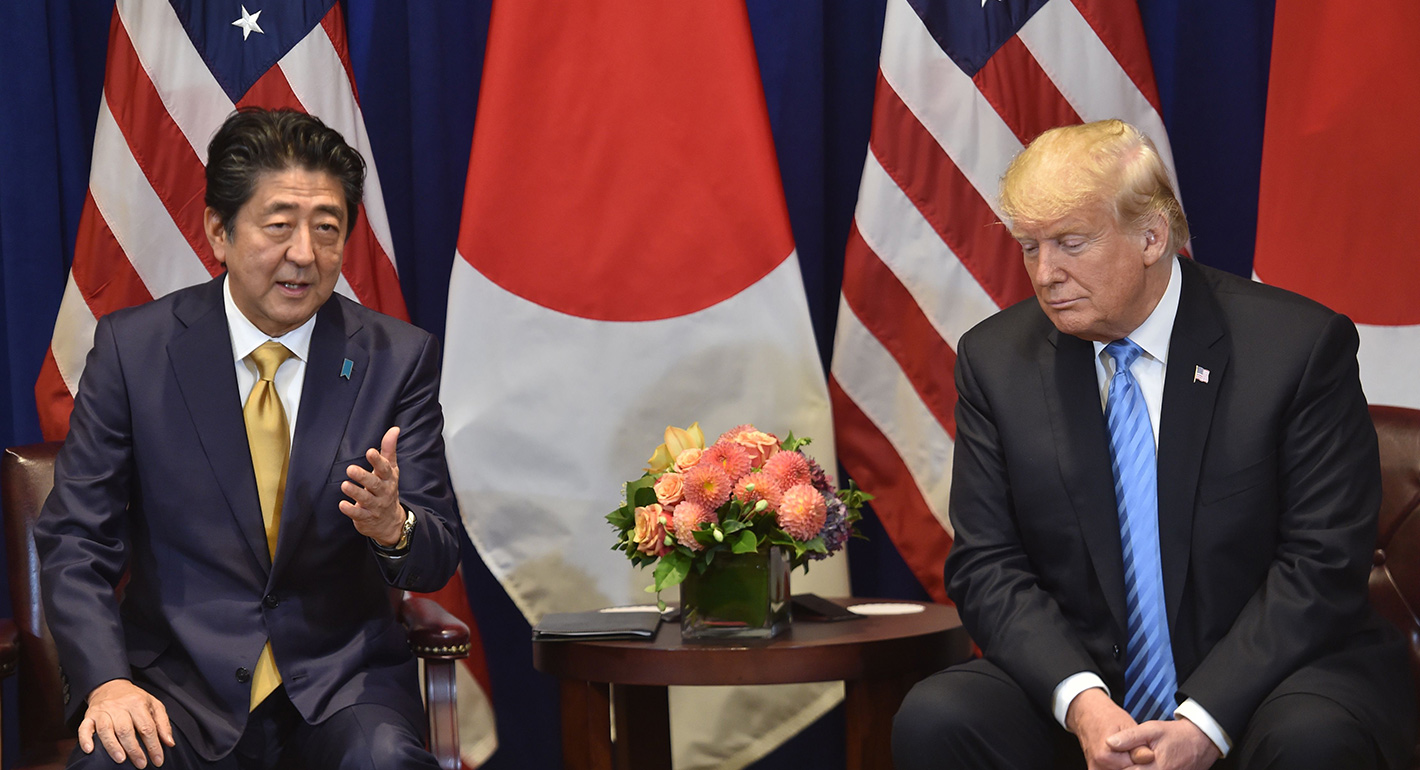
Washington and Tokyo should remain in sync as they respond to China’s resurgence in various domains.
This brief is part of the China Risk and China Opportunity for the U.S.-Japan Alliance project.
The United States and Japan share common perceptions toward China and East Asia, similar goals, and common approaches to addressing regional issues. However, the geopolitical contexts of their respective relationships with China are different, and perception or policy gaps sometimes crop up. Both countries need to recognize this possibility and protect against the potential negative impacts.
Japanese perceptions have become so negative that more than 80 percent of the Japanese public does not feel any affinity toward China. At the same time, more than 80 percent of them still view the Japan-China relationship and its future development as important. Behind this dichotomy lies the two countries’ proximity as neighbors and deep economic interdependence. Many Japanese people seem to believe that, although China represents a potential threat to their country’s security, Tokyo should maintain a certain level of good relations with Beijing in light of its own national interests. Public opinion generally supports Japanese Prime Minister Shinzo Abe’s ongoing efforts to improve the country’s relations with China.
On the other hand, U.S. views of China have deteriorated drastically over the last few years. This trend was most clearly symbolized by the speech delivered by U.S. Vice President Mike Pence at the Hudson Institute in October 2018, in which he defined the U.S.-China rivalry not only in military and economic terms but also in terms of values and ideology. He also emphasized the administration’s firm determination to prevail in that competition.
With the confrontation between the United States and China intensifying, Washington and Tokyo both are fully determined to resist China’s increasing military assertiveness, including its encroachment in others’ maritime space. However, many Japanese observers have a sizable objection to adopting a purely confrontational posture toward China on matters of economics and nontraditional security. In particular, there are strong concerns in Japan that the U.S.-China confrontation in the high-tech sector could have negative effects on supply chains between Japan and China. Meanwhile there is some skepticism in the United States over the Abe administration’s recent efforts to improve relations with China. Unless Washington takes a milder approach that eschews zero-sum competition in favor of a form of broader coexistence with Beijing in the areas of economics and nontraditional security, there could be discordance between the United States and Japan when it comes to addressing China-related issues.
While the United States and Japan seem to share similar views of China’s push to invest in infrastructure across Eurasia through the Belt and Road Initiative (BRI), the two countries’ views on the Free and Open Indo-Pacific (FOIP) differ in subtle ways. FOIP refers to the allies’ regional foreign policy vision for Asia that seeks to maximize information sharing and all countries’ access to regional benefits based on rules equally applied to all parties. (This entails an open, rules-based system rather than a more restrictive order dominated by a few powerful countries.) Whereas U.S. policymakers tend to discuss FOIP in terms of checking China with an emphasis on security issues, the Japanese government has been balancing this military angle with the possibility of coordination between FOIP and the BRI in terms of economics and nontraditional security. While the FOIP concept is open to a wide range of interpretations and forms of implementation going forward, the United States and Japan should avoid giving the impression to China and other countries concerned that there are large discrepancies in their interpretations of FOIP. The two allies need to continue aligning their perceptions and coordinating their policies on this front.
Besides, Japan strongly hopes for continued U.S. engagement in Asia. Tokyo is focused on the prospects of U.S. involvement in regional international frameworks such as the East Asia Summit and the Asia Pacific Economic Cooperation (APEC) forum. But given that U.S. President Donald Trump did not attend the East Asia Summit or the APEC forum in November 2018, the prospects of U.S. engagement in Asia are becoming increasingly uncertain. This state of affairs may lead to discrepancies between the allies’ respective attitudes toward China.
There also have been concerns in Japan about a possible perception gap between Washington and Tokyo on North Korea. For example, many Japanese observers worry that the United States, which has made particularly strong objections to North Korea’s long-range ballistic missiles, does not perceive Pyongyang’s short-range and medium-range missiles to be as threatening as Tokyo does. Japan’s concerns grew in June 2019 as mainstream U.S. media outlets reported, in the wake of the third—abruptly held—U.S.–North Korea meeting at Panmunjom, that the Trump administration might consider settling for negotiating a nuclear freeze, which would stop further production of more nuclear weapons but leaves North Korea’s current nuclear arsenal intact.
The United States and Japan, as well as other concerned countries, need to align their perceptions of North Korea, so they can handle matters in accordance with United Nations Security Council resolutions and other relevant international agreements. Policy coordination between Tokyo and Washington is also essential for keeping Beijing committed to North Korean denuclearization. Yet while U.S. experts on East Asian security understand Japan’s concerns, it is unclear to what extent the Trump administration recognizes them and factors them into its decisionmaking.
During the Cold War, the United States and its allies in the Western Pacific established a so-called hub-and-spokes security architecture. Unlike North Atlantic Treaty Organization members, U.S. allies in Asia are not united by their own alliances with other U.S. partners. This situation remains unchanged. Washington and Tokyo can only build a multilateral network of security relationships covering both the Western Pacific and the Indian Ocean under the FOIP banner by involving the existing bilateral hub-and-spokes system. To do so, the United States and Japan need to communicate well and coordinate policy on a broad range of regional issues.
For example, in developing a FOIP vision, the United States has sought to strengthen its commitment to Taiwan including in the military domain. However, this approach does not automatically strengthen Japan’s security involvement in Taiwan. What matters is to what extent the United States and Japan can agree on where Taiwan should be placed in the security aspect of the FOIP framework and how it should be linked to the U.S.-Japan alliance.
The same is true of trilateral security relations between Washington, Tokyo, and Seoul. The cooperative framework among the United States, Japan, and South Korea is basically composed of two bilateral alliances―the one between Washington and Tokyo and the one between Washington and Seoul―with the United States as a hub. Japan and South Korea are not allies, although they engage in a certain level of security cooperation. So where to position South Korea in the security aspect of the FOIP concept is also an open question.
Because U.S. allies in Asia are not united by their own security partnerships, when the United States and Japan cooperate with other U.S. allies in the region to address China-related issues, the onus falls on the United States to encourage coordination. Yet U.S. policy coordination with Japan is vital for successful implementation and cannot be effective if the United States makes unilateral decisions such as using its military to pressure China vis-à-vis Taiwan.
At present, it is particularly indispensable that the United States play such a role, if Washington, Tokyo, and Seoul are willing to enhance security cooperation, including in response to China’s resurgence. At the same time, a crucial hurdle to overcome is the poor Japan–South Korea relationship, which is in its worst shape since the two sides concluded a treaty back in 1965. In the meanwhile, the mark of success will continue to be how closely the United States, Japan, and other regional partners can align their views and harmonize their policies in response to China’s resurgence.
Shin Kawashima is a professor in the Department of International Relations at the University of Tokyo, where he specializes in modern Chinese diplomatic history.
Matake Kamiya is a professor of international relations at the National Defense Academy of Japan, a distinguished research fellow at the Japan Forum on International Relations (JFIR), and an adjunct research fellow at the Japan Institute of International Affairs. He is the leader of the JFIR–Carnegie Endowment project called China Risk and China Opportunity for the U.S.-Japan Alliance.
James L. Schoff is a senior fellow in the Carnegie Asia Program. His research focuses on U.S.-Japan relations and regional engagement, Japanese technology innovation, and regional trade and security dynamics.
Shin Kawashima
Shin Kawashima is a professor in the department of international relations at the University of Tokyo where he specializes in modern Chinese diplomatic history.
Matake Kamiya
Matake Kamiya is a professor of international relations at the National Defense Academy of Japan and a director and distinguished research fellow at the Japan Forum on International Relations.

Former Senior Fellow, Asia Program
James L. Schoff was a senior fellow in the Carnegie Asia Program. His research focuses on U.S.-Japan relations and regional engagement, Japanese technology innovation, and regional trade and security dynamics.
Carnegie does not take institutional positions on public policy issues; the views represented herein are those of the author(s) and do not necessarily reflect the views of Carnegie, its staff, or its trustees.

Ahead of a tough winter for Ukraine, Donald Trump’s swing back toward Russia bodes ill. But instead of panicking, Kyiv’s European allies are focusing on action.

Rym Momtaz

While the EU and European governments are embracing the much-lauded middle-power moment, this entails three difficult conundrums.

Richard Youngs

Europe is facing rising populism internally as well as external pressures from Russia, China, Turkey, and the United States.

Dimitar Bechev

A notable degree of participative democracy has firmly arrived in Europe. But to have more far-reaching impact, democratic deliberation needs to move into a radically new phase.
Richard Youngs

The European Commissioner for Trade is headed to China. But after President Xi’s bridge-building visit to Washington, can a more isolated EU overcome Beijing’s stranglehold on critical raw materials? Who will blink first?
Rym Momtaz, ed.