

Article
Alejandro Martin Rodriguez, Joy Arkeh, Sarah Yerkes
{
  "authors": [
    "Sarah Yerkes"
  ],
  "type": "legacyinthemedia",
  "centerAffiliationAll": "dc",
  "centers": [
    "Carnegie Endowment for International Peace",
    "Malcolm H. Kerr Carnegie Middle East Center"
  ],
  "collections": [],
  "englishNewsletterAll": "menaTransitions",
  "nonEnglishNewsletterAll": "",
  "primaryCenter": "Carnegie Endowment for International Peace",
  "programAffiliation": "MEP",
  "programs": [
    "Middle East"
  ],
  "projects": [
    "Tunisia Monitor"
  ],
  "regions": [
    "North America",
    "United States",
    "North Africa",
    "Tunisia",
    "Maghreb"
  ],
  "topics": [
    "Political Reform",
    "Democracy",
    "Foreign Policy",
    "Global Governance"
  ]
}
Source: Getty
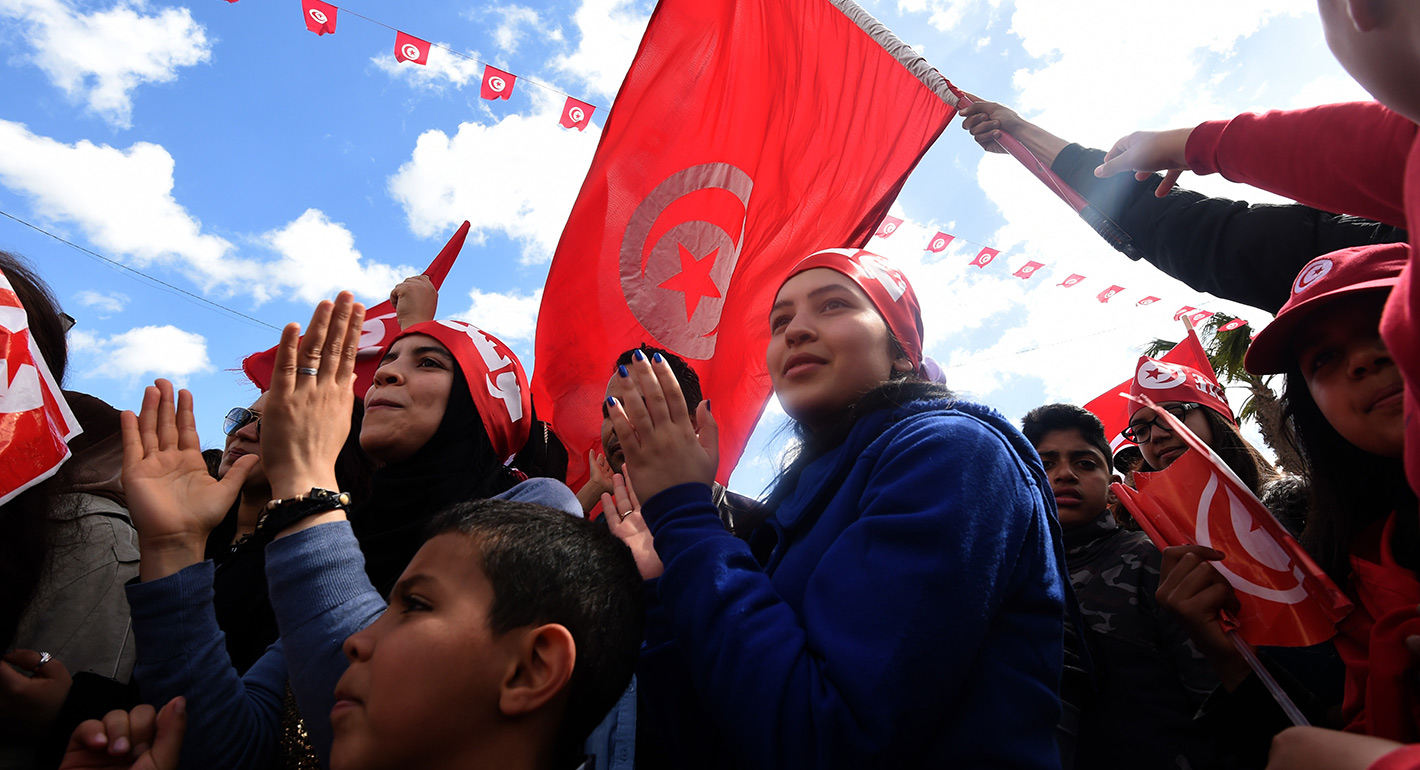
Tunisia an unprecedented opportunity for a democratic opening.
Source: Foreign Affairs
The story of how the Tunisian revolution began is well known. On December 17, 2010, a 26-year-old fruit vendor named Mohamed Bouazizi from the town of Sidi Bouzid set himself on fire outside a local government building. The man’s self-immolation—an act of protest against repeated mistreatment by police and local officials—sparked protests that quickly spread across the country. Within a few weeks, President Zine el-Abidine Ben Ali had stepped down and fled the country after 23 years in power, offering Tunisia an unprecedented opportunity for a democratic opening. A massive wave of uprisings soon swept the country’s neighbors, reaching all the way to the Levant and the Persian Gulf.

Acting Co-Director and Senior Fellow, Middle East Program
Sarah Yerkes is acting co-director and a senior fellow in Carnegie’s Middle East Program, where her research focuses on Tunisia’s political, economic, and security developments as well as state-society relations in the Middle East and North Africa.
Recent Work


Alejandro Martin Rodriguez, Joy Arkeh, Sarah Yerkes
Alejandro Martin Rodriguez, Sarah Yerkes
Carnegie does not take institutional positions on public policy issues; the views represented herein are those of the author(s) and do not necessarily reflect the views of Carnegie, its staff, or its trustees.

Before the next wave of EU enlargement takes place, the union needs to grapple with thorny questions of how power is distributed among its members.


Emil Sondaj Hansen, Ditte Brasso Sørensen

The new U.S.–Denmark–Greenland agreement will help Washington exert political, economic, and financial dominance under the guise of security. Yet, it acknowledged Copenhagen’s and Nuuk’s sovereignty on the island.

Marc Pierini

A summer of escalation in the Black Sea has hurt Ukraine economically and is exacerbating world food security. A truce is needed—as is a broader reframing of Europe’s Ukraine strategy.

Thomas de Waal

Are Germany’s economic, industrial, and political struggles becoming a liability for the EU’s ability to rise to the geopolitical moment?

Rym Momtaz, ed.

European Commission President Ursula von der Leyen is about to give her annual address on the state of the EU. Here’s what she won’t—but should—say.
Rym Momtaz