

Book
Europe is facing rising populism internally as well as external pressures from Russia, China, Turkey, and the United States.
Dimitar Bechev
{
  "authors": [
    "Aaron David Miller",
    "Richard Sokolsky"
  ],
  "type": "legacyinthemedia",
  "centerAffiliationAll": "",
  "centers": [
    "Carnegie Endowment for International Peace"
  ],
  "collections": [],
  "englishNewsletterAll": "",
  "nonEnglishNewsletterAll": "",
  "primaryCenter": "Carnegie Endowment for International Peace",
  "programAffiliation": "",
  "programs": [],
  "projects": [],
  "regions": [
    "North America",
    "United States"
  ],
  "topics": [
    "Political Reform",
    "Foreign Policy"
  ]
}
Source: Getty
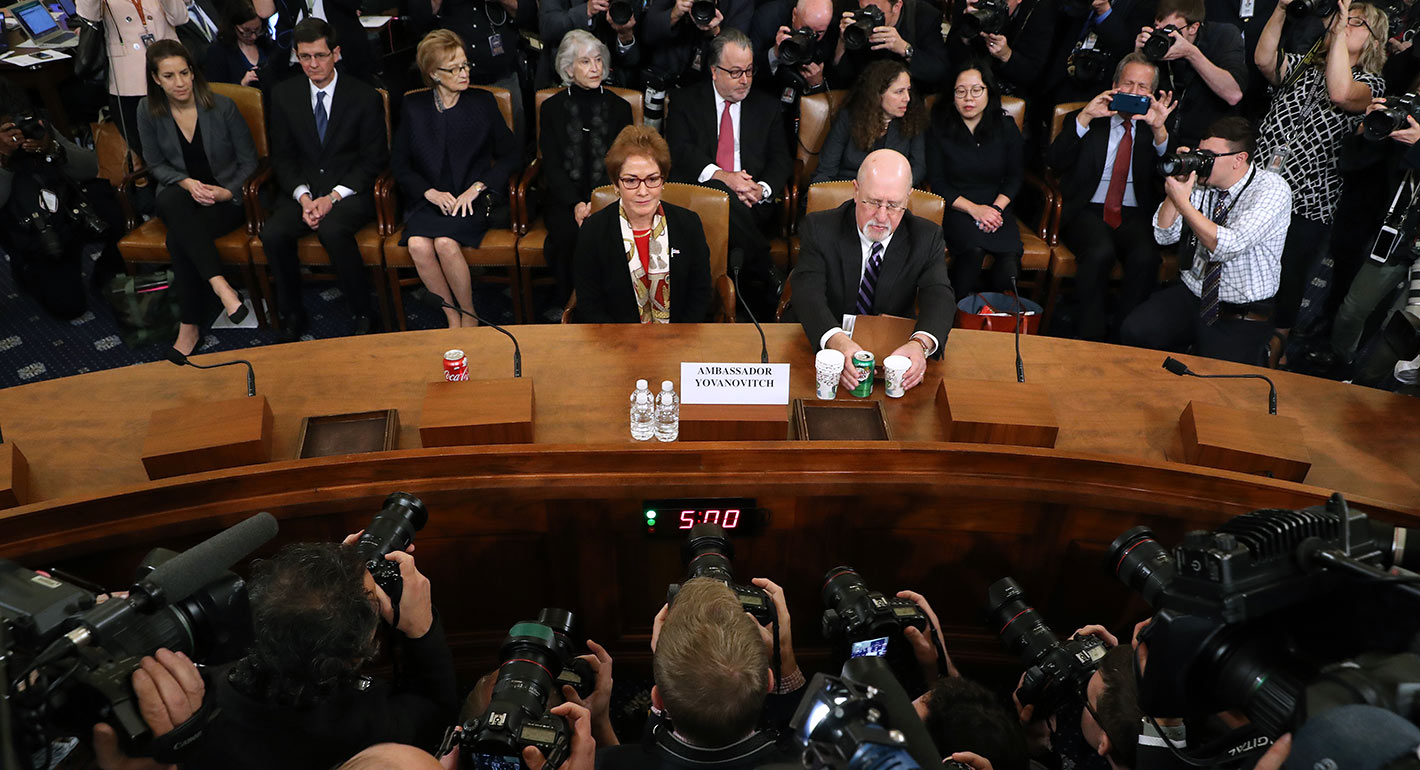
The testimony by former U.S. Ambassador to Ukraine Marie Yovanovitch and President Trump’s threatening tweets provide a window into the administration’s preternaturally destructive campaign to politicize the State Department, undermine U.S. diplomacy, and smear the reputations of career State Department officers.
Source: CNN
Friday's testimony by former US Ambassador to Ukraine Marie Yovanovitch and President Donald Trump's threatening tweets -- sent while she was testifying -- provide a devastating window into the administration's preternaturally destructive campaign to politicize the Department of State, undermine US diplomacy, and smear the reputations of career State Department officers for upholding the oath they take to defend the Constitution and American national interests.
Together, we have over 50 years of service at the State Department under both Republican and Democratic administrations and have never experienced anything like the travesty that's now taking place. Here are our takeaways.
Not since the McCarthy era of the 1950s has there been as determined a campaign to undermine and discredit career State Department officials. Back then, some 81 officials were forced out of the department amidst charges of disloyalty as alleged communist sympathizers. Secretary of State John Foster Dulles refused to stand up for his people then. And now, Secretary of State, Mike Pompeo is also not backing up his team in what former Deputy Secretary of State William Burns has described as an act of "profound political cowardice."
But today's attacks are worse than McCarthy's: they are being actively orchestrated by the President of the United States, who has shown nothing but contempt for the State Department, diplomacy, and America's professional diplomats.
Trump's tweet on Friday in the middle of Ambassador Yovanovitch's testimony is an unprecedented and real-time demonstration of his cruel campaign to destroy the career of an outstanding public servant doing her job.
"Everywhere Marie Yovanovitch went turned bad," Trump wrote on Twitter. "She started off in Somalia, how did that go? Then fast forward to Ukraine, where the new Ukrainian President spoke unfavorably about her in my second phone call with him".
Not only could this tweet be interpreted as witness intimidation, it seeks to validate Trump's earlier remarks on a call with the President that Ambassador Yovanovitch was "bad news," and builds on his threatening language that she "will be going to go through some things."
Never before, in our experience or frankly in the history of US foreign policy, has a President publicly sought to intimidate a career public civil servant. Indeed, Representative Jim Himes (D-CT) noted that the President's action could be seen as "witness tampering" and might even form the basis of one of the articles of impeachment.
Three career foreign service officers have now testified before Congress in public impeachment inquiry hearings -- in direct defiance of both the White House and the Department of State. They are alone and exposed. Secretary of State Mike Pompeo has failed to discharge his duty to support, protect and defend the Department or these dedicated professionals.
Ambassador Yovanovitch did testify that she was told that in various meetings with the president before her dismissal in May, Pompeo did argue that she should be kept in place. But it's significant that Pompeo issued no public statement supporting her or rejecting the smear campaign launched against her.
Indeed, she was told that the reason no statement was issued was the concern that it might be "undermined," presumably a reference to potential tweet or remark by the President. At the very least, Pompeo enabled the smear campaign to go unchallenged, acquiesced in the Giuliani back channel effort with Ukraine and failed to say a word in defense of Bill Taylor, George Kent or Marie Yovanovitch. These are breathtaking acts of craven political cowardice and beneath the dignity of any secretary of state.
In her testimony, Ambassador Yovanovitch spoke of the threat to US diplomacy and the hollowing out of the State Department. From the beginning of the administration, the White House has marginalized its diplomats, cut its programs and failed to fill critical vacancies, especially for Assistant Secretaries of State. Applications to the foreign service are down and political appointees for Ambassadors are up.
Senior Foreign Service officers are retiring early. Morale has never been lower.
Bottom line: the country may be too big to ruin. But the State Department is vulnerable.
We believe that given time, the Department will recover. But the real shame and travesty of the moment is that this administration seems to be doing everything it possibly can to ensure it doesn't.

Senior Fellow, American Statecraft Program
Aaron David Miller is a senior fellow at the Carnegie Endowment for International Peace, focusing on U.S. foreign policy.

Nonresident Senior Fellow, Russia and Eurasia Program
Richard Sokolsky is a nonresident senior fellow in Carnegie’s Russia and Eurasia Program. His work focuses on U.S. policy toward Russia in the wake of the Ukraine crisis.
Carnegie does not take institutional positions on public policy issues; the views represented herein are those of the author(s) and do not necessarily reflect the views of Carnegie, its staff, or its trustees.

Europe is facing rising populism internally as well as external pressures from Russia, China, Turkey, and the United States.

Dimitar Bechev

A notable degree of participative democracy has firmly arrived in Europe. But to have more far-reaching impact, democratic deliberation needs to move into a radically new phase.

Richard Youngs

Much has been said of the changes Brussels is trying to make to the EU enlargement process. Here’s why gradual integration might—or might not—be the answer.
Dimitar Bechev

The European Commissioner for Trade is headed to China. But after President Xi’s bridge-building visit to Washington, can a more isolated EU overcome Beijing’s stranglehold on critical raw materials? Who will blink first?

Rym Momtaz, ed.

European NATO countries are wrestling with the possibility of U.S. disengagement from the alliance. With the continent’s security increasingly uncertain, governments must restore the credibility of their collective defense.



Hans-Dieter Lucas, Adam Thomson, Pierre Vimont