

Article
Dalia Ghanem
{
  "authors": [
    "Dalia Ghanem"
  ],
  "type": "other",
  "centerAffiliationAll": "dc",
  "centers": [
    "Carnegie Endowment for International Peace",
    "Malcolm H. Kerr Carnegie Middle East Center"
  ],
  "collections": [
    "Arab Spring 2.0"
  ],
  "englishNewsletterAll": "menaTransitions",
  "nonEnglishNewsletterAll": "",
  "primaryCenter": "Malcolm H. Kerr Carnegie Middle East Center",
  "programAffiliation": "MEP",
  "programs": [
    "Middle East"
  ],
  "projects": [],
  "regions": [
    "Maghreb",
    "North Africa",
    "Algeria"
  ],
  "topics": [
    "Political Reform",
    "Democracy"
  ]
}
Source: Getty
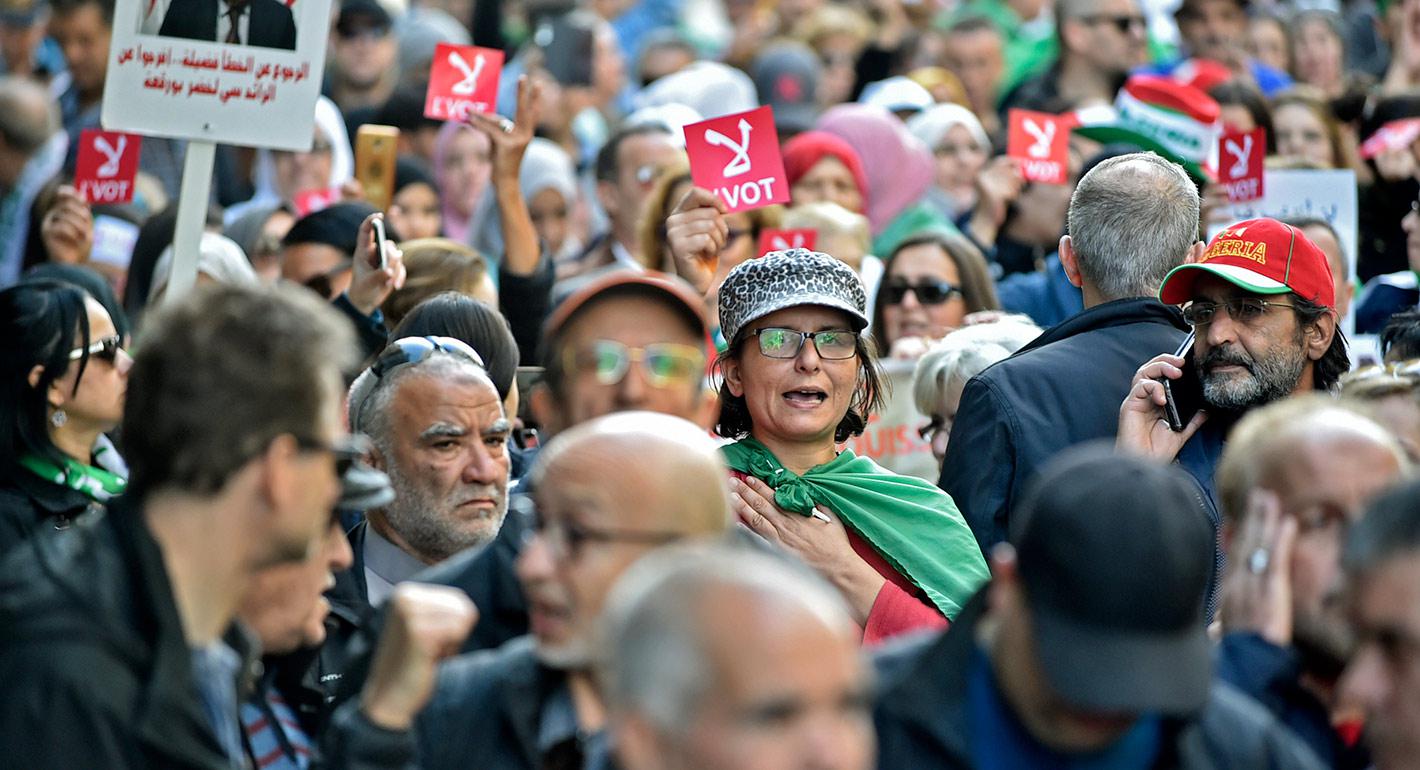
Algeria’s presidential election is scheduled for December 12, 2019. It seems set to be carefully staged and controlled. But there are still unknown variables in the mix.
This is the third presidential election that the authorities have tried to organize this year. Initially scheduled for April 18, 2019, the election was called off because of massive peaceful protests against a possible fifth term for the ailing president Abdelaziz Bouteflika. After Bouteflika’s resignation, his successor was supposed to be elected on July 4. But the election was once again called off by Algeria’s constitutional council, which rejected the only two candidates that turned in their files. Here are five things to know about this election:
The army chief of staff, General Ahmed Gaïd Salah, has been the strongman of the country since former president Abdelaziz Bouteflika’s departure. Dubbed by Algerians “Sergeant Garcia,” on September 15, he told the interim president Abdelkader Bensalah to publish a presidential decree that would allow the vote to be held before the end of the year.
While Gaïd Salah has been in the limelight since the beginning of the protests in February, Algeria’s broader military leaders are the ultimate decisionmakers. Under the guise of preserving the constitution, they have been steering the transition by imposing elections and have been using the judiciary to purge regime opponents and keep allies in line.
For most Algerians, the five candidates have no appeal and offer no real change. This election will not create dynamics that might lead to a genuine and final break with the present political system.
Quite the opposite: all the candidates are products of the political establishment. Among them, two—Abdelmadjid Tebboune and Ali Benflis—are relics of the Bouteflika era, when they were prime minister and head of government respectively. Algerians have called this situation a “circus” and the candidates “clowns,” as some of their declarations are ludicrous. Such is the case with Abdelkader Bengrina, former minister of tourism. He declared during his campaign that the heart of his presidential program is the fight against women’s celibacy, which is “dangerously” increasing. Bengrina has argued that women would be much better off if they “discovered the joys of marriage,” even if that means being a third or fourth spouse. He has also claimed that there are 11 million single Algerian women, a “scary” figure.
After years of being repressed and co-opted, the opposition parties have little ambition left for change. Many of them, including the Islamists, tried to surf the wave and capitalize on the protests. However, they were rejected by the population, who dismissed them as the regime’s sycophants.
As for opposition figures who emerged from the popular movement, such as Karim Tabbou and Mustapha Bouchachi, they did not present themselves as political leaders and refused any form of institutionalization. This has left the field open for former figures of the system to be placed in power by Algeria’s military leadership.
Various social media campaigns on Twitter and Facebook were launched to encourage people to vote. The origin of these campaigns is unclear, but it is safe to suspect the regime and its traditional backers have a hand in them.
Recently, the head of the allegedly National Independent Authority on Elections, Mohamed Charfi, declared on TV that pro-election protests have been more numerous and important than those against the election. The media has also been mobilized to spread this narrative, as well as the claim that not having an election will lead to a “constitutional void.”
Despite the fact that there is no doubt about the lack of transparency of this election and that it has been staged, there are two unknown variables.
First, the turnout. It is expected to be low, but how low? Low turnout will constitute a severe challenge to the legitimacy of the “elected” president.
The second unknown variable is the security situation. Polling stations have been closed by citizens who have built walls around them to stop people from reaching them. Furthermore, ballot boxes have been destroyed, and demonstrations are continuing. Whether the military will step in to squash the popular movement is still an open question. Security forces have already been arresting activists and journalists, and recently, we have seen a pattern of escalation.
Former Senior Resident Scholar, Malcolm H. Kerr Carnegie Middle East Center
Dalia Ghanem was a senior resident scholar at the Malcolm H. Kerr Carnegie Middle East Center in Beirut, where her research focuses on Algeria’s political, economic, social, and security developments. Her research also examines political violence, radicalization, civil-military relationships, transborder dynamics, and gender.
Recent Work
Dalia Ghanem


Frances Z. Brown, Judy Dempsey, Dalia Ghanem, …
Carnegie does not take institutional positions on public policy issues; the views represented herein are those of the author(s) and do not necessarily reflect the views of Carnegie, its staff, or its trustees.

The domestic impacts of how long it is taking to end the war in Ukraine have pushed the French electorate to the political extremes and compromised the country’s diplomatic capacity.

Rym Momtaz

Before the next wave of EU enlargement takes place, the union needs to grapple with thorny questions of how power is distributed among its members.


Emil Sondaj Hansen, Ditte Brasso Sørensen

Radical-right parties are expected to do well in upcoming elections in four of the EU's biggest member states. If successful, they could prevent the union from addressing key challenges ahead.

Stefan Lehne

An overwhelming victory by a far-right-wing party in a small state in eastern Germany will have major repercussions for Chancellor Friedrich Merz’s coalition.
Judy Dempsey

In supporting Europe’s far-right, MAGA and Russia both want the same thing: a weaker EU. Europe must defend itself without abandoning the openness these forces exploit.

Armida van Rij