

Commentary
The EU can impose sanctions but struggles to enforce them without the United States. With Washington increasingly disinterested in backing European interests, the bloc must now fend for itself.
Nicu Popescu, Tiago Antunes
{
  "authors": [
    "Dmitri Trenin",
    "Alexander Baunov",
    "Andrei Kolesnikov",
    "Tatiana Stanovaya"
  ],
  "type": "commentary",
  "centerAffiliationAll": "",
  "centers": [
    "Carnegie Endowment for International Peace",
    "Carnegie Russia Eurasia Center"
  ],
  "collections": [],
  "englishNewsletterAll": "",
  "nonEnglishNewsletterAll": "",
  "primaryCenter": "Carnegie Russia Eurasia Center",
  "programAffiliation": "",
  "programs": [],
  "projects": [],
  "regions": [
    "Russia"
  ],
  "topics": [
    "Economy"
  ]
}
Source: Getty
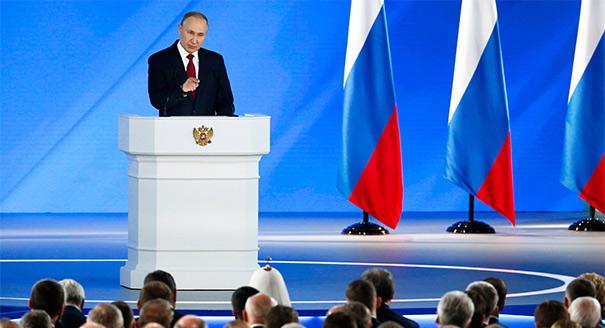
President Putin’s unexpected proposals this week to change the Russian constitution prompted the instant resignation of the Russian government. What’s he trying to achieve, and will he succeed?
Vladimir Putin appears to have finally set in motion the process of handing over the Kremlin to a successor after twenty years of running the country. Under the Russian constitution, which bars presidents from serving more than two consecutive terms, Putin must step down by the end of his current six-year term in 2024.
In his state of the nation address on Wednesday, Putin outlined several changes to the constitution, which he suggested could be put to the Russian people in a referendum. These changes were:
— allowing parliament to appoint government ministers, including the prime minister (currently they are selected by the president and approved by the parliament);
— changing the constitution to bar presidents from serving more than two terms overall, and not just two consecutive terms;
— giving more power to the State Council, currently a fairly low-profile advisory body, and enshrining its role in the constitution;
— introducing additional restrictions on who can run for president, to prevent anyone who has not lived in Russia for the last twenty-five years or has ever held a foreign passport or residency permit from running;
— giving the Russian constitution precedence over international law.
Shortly after Putin announced these proposals, the government resigned, apparently to pave the way for Putin to start implementing his plans. The president swiftly reappointed Prime Minister Dmitry Medvedev to deputy chair of the Security Council, a move that divided analysts. Some, like Tatiana Stanovaya, a nonresident scholar at the Carnegie Moscow Center, said Putin was getting rid of his long-term ally Medvedev, who is far less popular with voters. Others, such as Carnegie Moscow Center director Dmitri Trenin, said the new post means the long-serving prime minister is de facto the country’s second in command (since Putin is head of the Security Council), and have not ruled out Medvedev’s return to the presidency: he previously held the fort for Putin in 2008–2012 to enable the latter to adhere to the constitutional limit on consecutive terms.
Although Putin’s current term does not end for another four years, uncertainty over what would happen in 2024 has been making the Russian elite anxious for some time. The reforms are aimed at enabling Putin to retain influence over the political system when he is no longer president, thereby ensuring political stability and protecting Putin’s legacy from being undone by his successor.
Most of the reforms would take away power from the office of the presidency and redistribute it to the prime minister and parliament, ensuring that no future Russian president will ever amass as much power as Putin has. Russia will remain a strong presidential republic, however, and as things stand, no parliament is likely to make ministerial appointments against the wishes of the president. Putin himself may well take up a post in the newly enhanced State Council, allowing him to retain power and influence.
As for the new limit on terms, Putin may have served a total of four terms himself, but the suggestion now is that these were desperate times following the collapse of the Soviet Union and the turbulent 1990s, which required desperate measures. Those times, it is implied, are now over, says Alexander Baunov, a senior fellow at the Carnegie Moscow Center.
Excluding people who have lived abroad from running for president would eliminate Russia’s main opposition figure, Alexei Navalny, as he studied in the United States. It would also rule out other discontented Russians who have moved abroad.
The most serious repercussions could stem from the move to put the Russian constitution above international law, according to Andrei Kolesnikov, chair of the Russian Domestic Politics and Political Institutions Program at the Carnegie Moscow Center. While Russia already regularly ignores judgements from the European Court of Human Rights ordering it to pay compensation, this would officially put an end to any help from abroad for victims of Russia’s corrupt legal system.
Some analysts had predicted Putin might change the constitution to allow him to stay on as president, or even create a new country from a merger with Belarus of which he would then become the first president. Putin has made it clear that there will be a new president in 2024.
Moving to a new position while retaining significant influence is more akin to the maneuver seen last year in Kazakhstan, where Nursultan Nazarbayev relinquished the presidency after nearly three decades to become head of the Security Council, having enhanced that body’s power shortly before that. Since Putin’s proposed reforms would also increase the powers of the prime minister, some analysts are also suggesting that Putin might assume that role.
If leaders in the West were hoping that 2024 would bring a change of policy in Russia, Putin’s comments should have put those expectations to rest. In the short term, there will be no change at all, says Kolesnikov. There may be a different face at the helm, but with Putin remaining backstage, his successor is unlikely to adopt a very different approach.
Putin’s proposals will most likely be approved if a referendum is held, as the president’s approval ratings are consistently high. Nor does Putin face any resistance from any of the country’s political institutions. Constitutional changes will not encounter any serious obstacles in an authoritarian regime such as Russia, believes Kolesnikov.
Former Director, Carnegie Moscow Center
Trenin was director of the Carnegie Moscow Center from 2008 to early 2022.

Senior Fellow, Editor-in-Chief, Carnegie Russia Eurasia Center
Baunov is a senior fellow and editor-in-chief at the Carnegie Russia Eurasia Center.
Former Senior Fellow, Carnegie Russia Eurasia Center
Kolesnikov was a senior fellow at the Carnegie Russia Eurasia Center.

Senior Fellow, Carnegie Russia Eurasia Center
Tatiana Stanovaya is a senior fellow at the Carnegie Russia Eurasia Center.

The EU can impose sanctions but struggles to enforce them without the United States. With Washington increasingly disinterested in backing European interests, the bloc must now fend for itself.


Nicu Popescu, Tiago Antunes

Russia is testing the waters of NATO’s mutual defense clause. What do strikes in Romanian territorial waters mean for the alliance’s posture toward Moscow?

Dimitar Bechev

With its public finances in shambles, the far right polling at 35 percent ahead of the 2027 presidential election, and a growing protest movement, is France’s crisis a threat to the EU’s geopolitical awakening?

Rym Momtaz, ed.

Europe is facing rising populism internally as well as external pressures from Russia, China, Turkey, and the United States.
Dimitar Bechev

The European Commissioner for Trade is headed to China. But after President Xi’s bridge-building visit to Washington, can a more isolated EU overcome Beijing’s stranglehold on critical raw materials? Who will blink first?
Rym Momtaz, ed.