

Article
Frederic Wehrey, Charles H. Johnson
{
  "authors": [
    "Frederic Wehrey"
  ],
  "type": "legacyinthemedia",
  "centerAffiliationAll": "dc",
  "centers": [
    "Carnegie Endowment for International Peace",
    "Malcolm H. Kerr Carnegie Middle East Center"
  ],
  "collections": [],
  "englishNewsletterAll": "menaTransitions",
  "nonEnglishNewsletterAll": "",
  "primaryCenter": "Carnegie Endowment for International Peace",
  "programAffiliation": "MEP",
  "programs": [
    "Middle East"
  ],
  "projects": [],
  "regions": [
    "North Africa",
    "Libya"
  ],
  "topics": [
    "Political Reform",
    "Security",
    "Military",
    "Foreign Policy"
  ]
}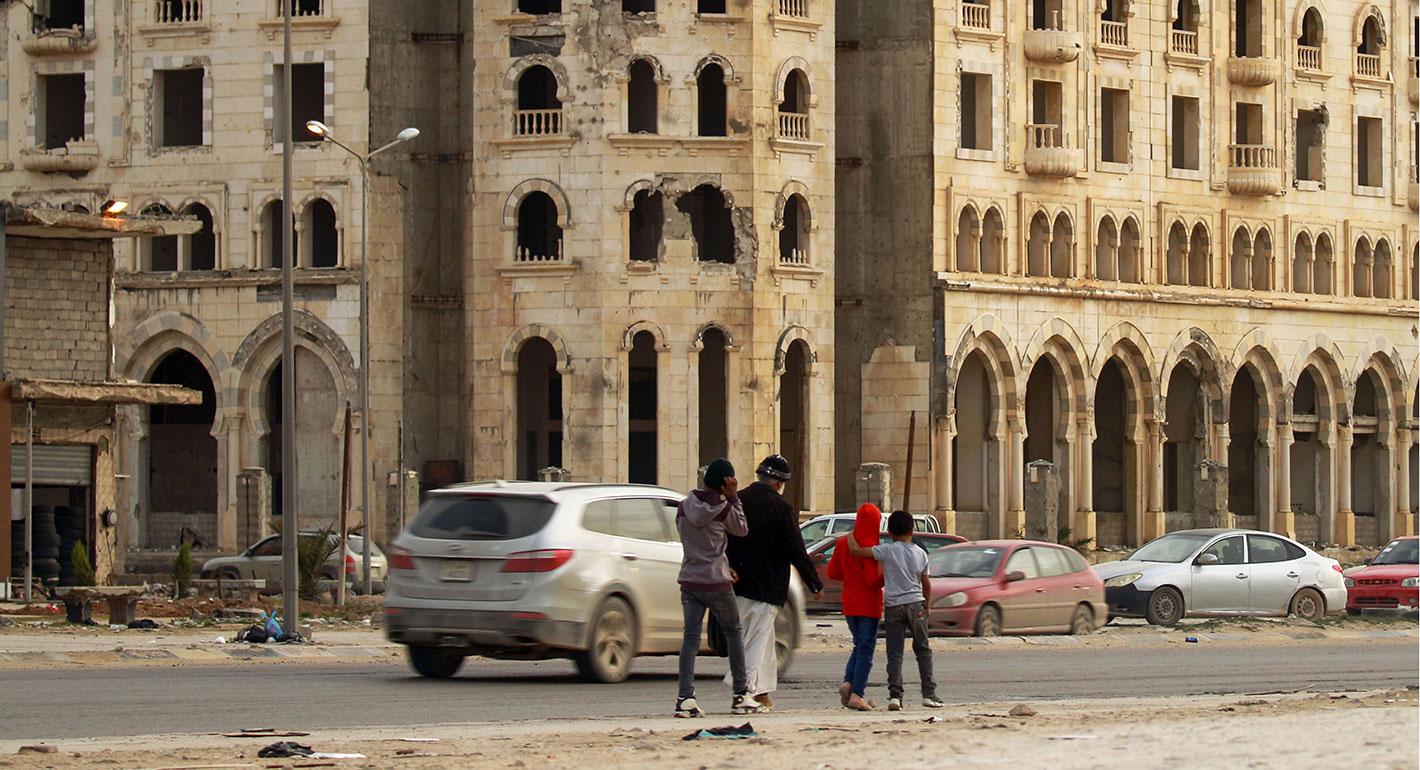
Source: Getty
The last time Libya’s war had the world’s full attention, it was being fought mainly by Libyans.
Source: Time
The last time Libya’s war had the world’s full attention, it was being fought mainly by Libyans.
For much of 2011, young revolutionaries in mismatched fatigues clamored on anti-aircraft guns, and the narrative driving events was the Arab Spring, an uprising that promised to place the power in the hands of citizens long subjugated by despots.
Though Libyans shaped the ebb and flow of battle, they were hardly alone, even then: circling high above were foreign warplanes from the NATO-led coalition that kept at bay fighters loyal to Muammar Gaddafi. And contrary to some official denials, there were also “boots on the ground” in the form of foreign special operations forces and intelligence personnel, from France, Britain, the U.S., the United Arab Emirates and Qatar, who discretely channeled weapons and training to fractious anti-Gaddafi groups. In such meddling, there were already signs of a proxy rivalry that would explode into open warfare years later.

Senior Fellow, Middle East Program
Frederic Wehrey is a senior fellow in the Middle East Program at the Carnegie Endowment for International Peace, where his research focuses on governance, conflict, and security in Libya, North Africa, and the Persian Gulf.
Recent Work
Frederic Wehrey, Charles H. Johnson
Frederic Wehrey, Charles H. Johnson
Carnegie does not take institutional positions on public policy issues; the views represented herein are those of the author(s) and do not necessarily reflect the views of Carnegie, its staff, or its trustees.

The EU can impose sanctions but struggles to enforce them without the United States. With Washington increasingly disinterested in backing European interests, the bloc must now fend for itself.


Nicu Popescu, Tiago Antunes

Russia is testing the waters of NATO’s mutual defense clause. What do strikes in Romanian territorial waters mean for the alliance’s posture toward Moscow?

Dimitar Bechev

With its public finances in shambles, the far right polling at 35 percent ahead of the 2027 presidential election, and a growing protest movement, is France’s crisis a threat to the EU’s geopolitical awakening?

Rym Momtaz, ed.

Ahead of a tough winter for Ukraine, Donald Trump’s swing back toward Russia bodes ill. But instead of panicking, Kyiv’s European allies are focusing on action.
Rym Momtaz

Funding Ukraine remains a priority for European leaders. As Russia’s war of aggression heads into another winter, two feasible options to mobilize support for Kyiv should be fast-tracked.


Vladyslav Rashkovan, Gregory P. Wilson