

Article
Frederic Wehrey, Charles H. Johnson
{
  "authors": [
    "Frederic Wehrey"
  ],
  "type": "legacyinthemedia",
  "centerAffiliationAll": "dc",
  "centers": [
    "Carnegie Endowment for International Peace",
    "Malcolm H. Kerr Carnegie Middle East Center"
  ],
  "collections": [
    "Civil-Military Relations in Arab States"
  ],
  "englishNewsletterAll": "menaTransitions",
  "nonEnglishNewsletterAll": "",
  "primaryCenter": "Malcolm H. Kerr Carnegie Middle East Center",
  "programAffiliation": "MEP",
  "programs": [
    "Middle East"
  ],
  "projects": [],
  "regions": [
    "North Africa",
    "Tunisia",
    "Maghreb"
  ],
  "topics": [
    "Political Reform",
    "Security",
    "Military"
  ]
}
Source: Getty
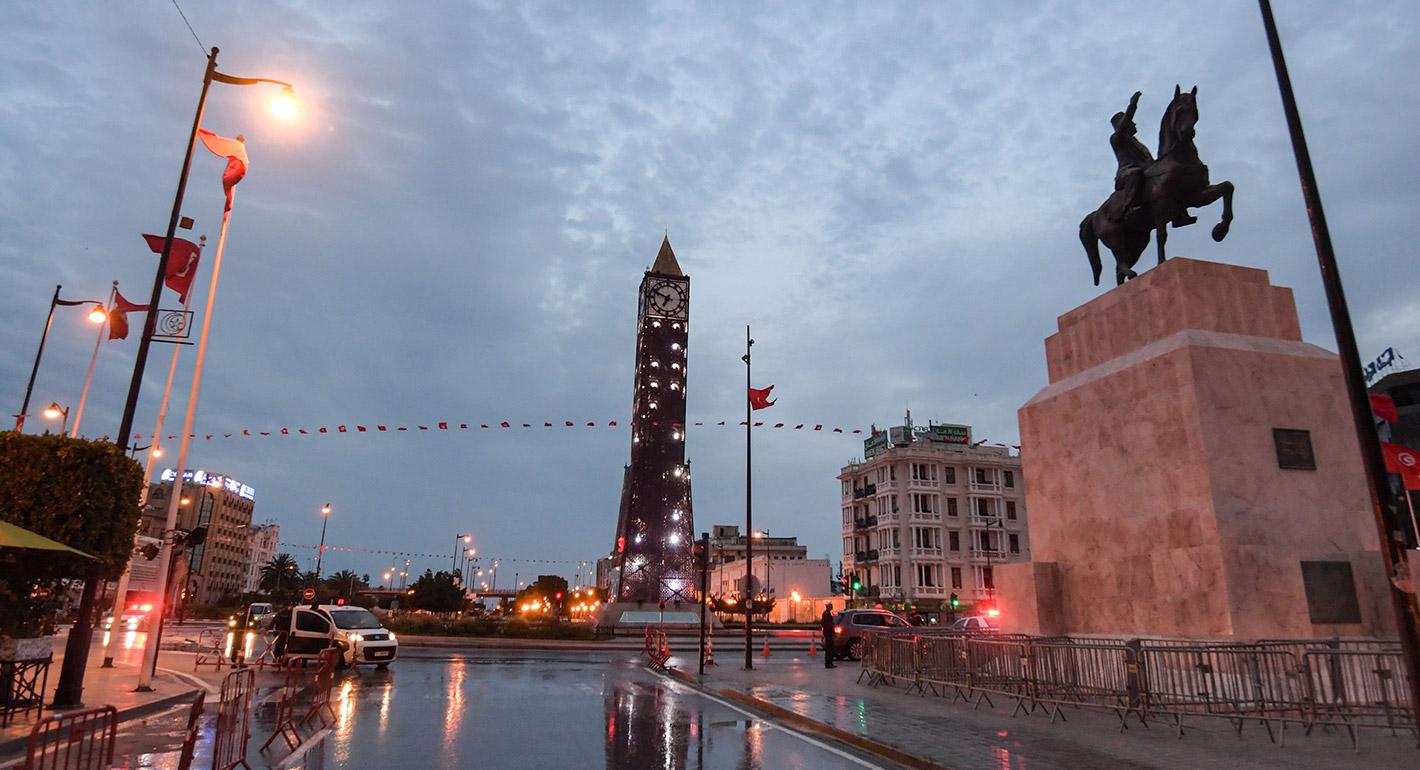
So far, the Tunisian military’s rapid response to the public health crisis in support of the elected government has been laudable. But there may be darker economic clouds on the horizon affecting the armed forces’ readiness and relations with the government.
Source: War on the Rocks
A military helicopter soars over the urban landscape, its crew scanning the city below through a cockpit video camera. They’re looking not for the enemy, but rather for their fellow citizens —crowds of them, illegally gathering in contravention of the government’s edicts on social distancing to prevent the spread of COVID-19. Sometimes they relay the coordinates of violators to ground patrols. And sometimes, as shown in one widely viewed video of a soccer match, they swoop in directly to break up the gaggle.
These flights are part of a broader mobilization of the Tunisian armed forces that, along with a range of other public health measures, have enabled this struggling Arab democracy to ride out the pandemic — so far — with relatively few cases and deaths. By the accounts of foreign observers and Tunisians alike, this military mobilization has mostly been greeted with popular support. There has been no evidence that the Tunisian military is trying to overstep its legal mandate or assert any national security prerogatives, like demanding that its members have priority in receiving protective equipment or other virus-related aid. Unlike militaries in some Arab autocracies, the Tunisian armed forces do not own commercial businesses or industries on any significant scale, for which they might be tempted to request special exemptions from government-directed restrictions...
Senior Fellow, Middle East Program
Frederic Wehrey is a senior fellow in the Middle East Program at the Carnegie Endowment for International Peace, where his research focuses on governance, conflict, and security in Libya, North Africa, and the Persian Gulf.
Recent Work
Frederic Wehrey, Charles H. Johnson
Frederic Wehrey, Charles H. Johnson
Carnegie does not take institutional positions on public policy issues; the views represented herein are those of the author(s) and do not necessarily reflect the views of Carnegie, its staff, or its trustees.

Are Germany’s economic, industrial, and political struggles becoming a liability for the EU’s ability to rise to the geopolitical moment?

Rym Momtaz, ed.

European states control several Overseas Countries and Territories around the world that carry strategic, economic, and environmental weight. As great powers challenge the rules-based order, defending them is a geopolitical imperative for Europe.

Marc Pierini

Mounting economic strain and battlefield losses will not necessarily make the Kremlin less dangerous. They could instead push Moscow toward a more aggressive hybrid campaign designed to test NATO’s Eastern flank, exploit allied hesitation, and fracture European resolve.

Maksym Beznosiuk

Over the past ten years, NATO has held almost as many summits as it did during the entirety of the Cold War. Are they still useful, or is it time to stop holding annual meetings?
Rym Momtaz, ed.

As the EU confronts profound challenges, several leaders have called for fundamental reform to the union’s model—but only modest, superficial changes have resulted. What if Europe really could be reimagined from zero today: What should such a redesigned European order look like?

Richard Youngs, ed.