

Q&A
Paul Haenle, Philippe Le Corre
{
  "authors": [
    "Philippe Le Corre"
  ],
  "type": "legacyinthemedia",
  "centerAffiliationAll": "dc",
  "centers": [
    "Carnegie Endowment for International Peace"
  ],
  "collections": [],
  "englishNewsletterAll": "ctw",
  "nonEnglishNewsletterAll": "",
  "primaryCenter": "Carnegie Endowment for International Peace",
  "programAffiliation": "EP",
  "programs": [
    "Europe"
  ],
  "projects": [],
  "regions": [
    "Iran"
  ],
  "topics": [
    "Political Reform",
    "Democracy",
    "Foreign Policy"
  ]
}
Source: Getty
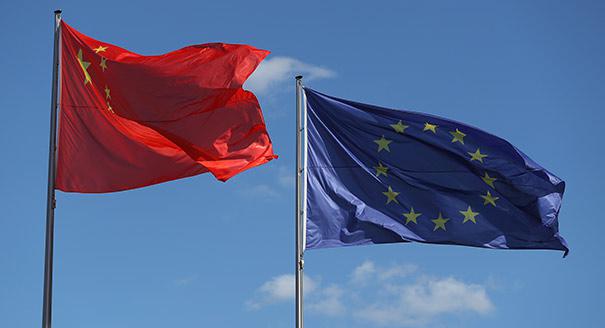
Instead of a celebration, the EU-China annual summit which took place through videoconferences on June 22, showed irreconcilable differences over issues such as Hong Kong’s newly-announced national security law, cybersecurity and human rights.
Source: ISPI
Chinese officials have been repeatedly calling for closer cooperation with Europe, but the era of Covid-19 has made China-EU relations sour to an unprecedented low level since the two formally established diplomatic relations, 45 years ago.
Instead of a celebration, the EU-China annual summit which took place through videoconferences on June 22, showed irreconcilable differences over issues such as Hong Kong’s newly-announced national security law, cybersecurity and human rights. In addition, nothing appeared noticeably conclusive on the economic front, where China has not responded to the EU’s call to finalize a much-needed “Common Agreement on Investment,” tackling the issues of state subsidies and procurement. Cooperation on other critical subjects such as climate change, global governance (including the reform of the World Trade Organization), and sustainable development seems limited to pure rhetorical language rather than concrete actions on the part of the Chinese side. Even Sino-European collaboration on Covid-related vaccines remains modest.
Rather than a final EU-China joint communique, two differing statements were released in June, following the summit. President Ursula von der Leyen of the European Commission said “the relationship between the EU and China is simultaneously one of the most strategically important and one of the most challenging that we have” adding that the relationship with China was “not an easy one.” As for Chinese president Xi Jinping, he insisted that China “wants peace instead of hegemony”. “No matter how the international situation changes, China will take the side of multilateralism and adhere to the global governance concept of extensive consultation, joint contribution and shared benefits,” he added.
Such comments are revealing in the sense that Europeans are trying their luck with a different approach to China, more defensive if not confrontational. In fact, politicians may not have a choice following Covid-19. The Chinese government is consistently seen by European public opinions as the most responsible for the severity of the pandemic. According to a recent poll, 60 percent of people in the UK and France, and 47 percent of Germans see the Chinese government as a force for bad in the world and their opinion has worsened through the pandemic. Unlike the previous financial crisis (2008-10) which had led to multiple take-overs by Chinese state-owned enterprises in southern Europe, this time Europeans do not seem attracted by prospective Chinese FDIs. Nor are Chinese investors currently willing to invest: China’s share of FDI stock stands at less than 3 percent on average across the EU. Meanwhile, the controversy around Chinese medical assistance during the peak of the pandemic has led to more confusion and back-pedalling on the part of European politicians.
Early this year, Brussels officials were still hoping that Germany would be hosting a 27+1 leaders’ summit in Leipzig with Xi Jinping, crowning Angela Merkel as the one senior European politician that could handle China. Merkel’s approach has been very much about light criticism and face-saving exercises vis-à-vis Chinese leaders. This has had a lot to do with the two countries’ fairly balanced trade relationship. For years, German machine tools and cars have been in high demand in a fast-growing China, increasing many German industrial companies’ profitability. Some experts see a reluctance from Chancellor Merkel to antagonize Beijing, which in fact risks undermining the EU’s push for a common policy toward China and perpetuating a situation where member states look out mainly for their own interests, often to the detriment of a common European front. For now, the Leipzig summit has been postponed indefinitely due to the lack of progress with China.
For the past three years, the EU has embarked on a more realistic approach to China. It has pushed for a better coordination and defence over economic issues, including FDIs, state-aid and technology transfers. Not only did the European Commission create a new FDI screening mechanism, to be operational in October, but it has also issued guidelines on 5G technology and a white paper on foreign subsidies. In addition, it launched a connectivity strategy with the hope of offering a European alternative to China’s “Belt and Road Initiative.”
The year 2019 was considered by many as turning point in the EU’s bilateral relations with China, with the publication in March of a EU-China Strategic Outlook which labeled China a “systemic rival.” The virtual summit between Xi Jinping and Ursula von der Leyen eventually took place, but the lack of progress has created a growing frustration among European leaders, following a significant propaganda effort from Beijing to promote its agenda, including its handling of the pandemic, through social media and Chinese embassy websites. This “battle of narratives” was directly addressed by High representative for foreign affairs Josep Borrell on several occasions. A special report on disinformation was even produced by the European External Action Service. In her recent statement, von der Leyen also alluded to the Commission’s growing concerns over “cyber-attacks on computing systems and hospitals.” In the follow-up interview on French radio, she added that the EU “expects the same access to the Chinese market as the Chinese have in Europe”. In other words, reciprocity has become indispensable in order to move forward with an investment treaty and a more balanced relationship.
The tougher discourse from Brussels is a far-cry from the Trump Administration’s hard-line, as the latter has been accompanied by trade sanctions and restrictions against Chinese companies on US soil, including Huawei. The current language from Washington may not be very diplomatic, but it also reflects Capitol Hills’ bipartisan and hawkish approach and has led US allies – including a majority of Europeans – to reassert their approach to China’s rise. From either side of the Atlantic, it is unlikely that major moves will take place between now and the November presidential election. Should Joe Biden be elected president, some changes could be expected leading to a more transatlantic approach. As for China, it ultimately sees its relationship with the US as its number one priority, which explains Beijing’s current wait-and-see stance.
Former Nonresident Senior Fellow, Europe Program
Philippe Le Corre was a nonresident senior fellow in the Europe Program at the Carnegie Endowment for International Peace.
Recent Work

Paul Haenle, Philippe Le Corre

Erik Brattberg, Philippe Le Corre, Paul Stronski, …
Carnegie does not take institutional positions on public policy issues; the views represented herein are those of the author(s) and do not necessarily reflect the views of Carnegie, its staff, or its trustees.

Europe is facing rising populism internally as well as external pressures from Russia, China, Turkey, and the United States.

Dimitar Bechev

A notable degree of participative democracy has firmly arrived in Europe. But to have more far-reaching impact, democratic deliberation needs to move into a radically new phase.

Richard Youngs

Much has been said of the changes Brussels is trying to make to the EU enlargement process. Here’s why gradual integration might—or might not—be the answer.
Dimitar Bechev

The European Commissioner for Trade is headed to China. But after President Xi’s bridge-building visit to Washington, can a more isolated EU overcome Beijing’s stranglehold on critical raw materials? Who will blink first?

Rym Momtaz, ed.

European NATO countries are wrestling with the possibility of U.S. disengagement from the alliance. With the continent’s security increasingly uncertain, governments must restore the credibility of their collective defense.



Hans-Dieter Lucas, Adam Thomson, Pierre Vimont