

Paper
Yezid Sayigh
{
  "authors": [
    "Yezid Sayigh"
  ],
  "type": "other",
  "centerAffiliationAll": "dc",
  "centers": [
    "Carnegie Endowment for International Peace",
    "Malcolm H. Kerr Carnegie Middle East Center"
  ],
  "collections": [
    "Civil-Military Relations in Arab States"
  ],
  "englishNewsletterAll": "menaTransitions",
  "nonEnglishNewsletterAll": "",
  "primaryCenter": "Malcolm H. Kerr Carnegie Middle East Center",
  "programAffiliation": "MEP",
  "programs": [
    "Middle East"
  ],
  "projects": [],
  "regions": [
    "Egypt",
    "North Africa"
  ],
  "topics": [
    "Political Reform",
    "Security",
    "Economy"
  ]
}
Source: Getty
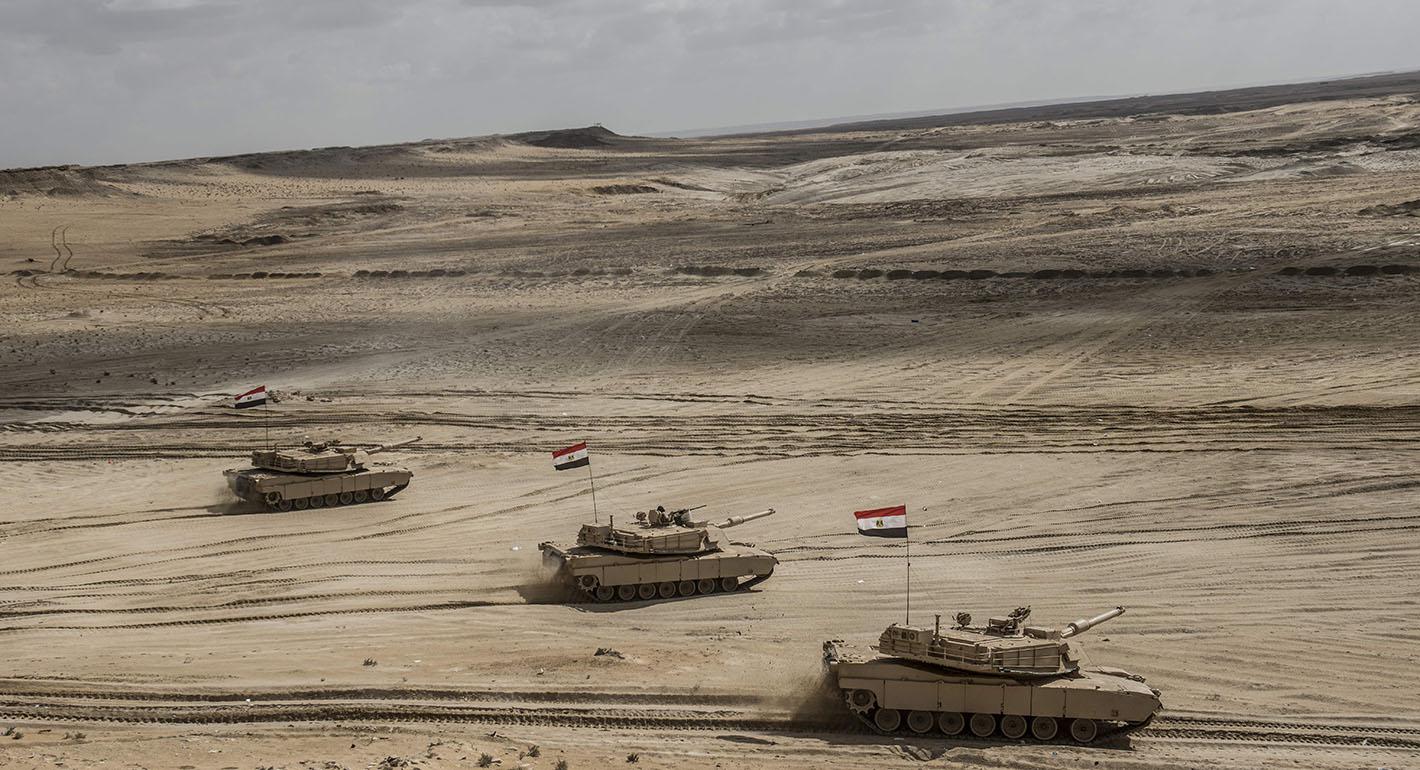
The Egyptian military’s involvement in the economy has come at a high cost, contributing to underperformance in development and auguring a new ruling class of military officers.
The Carnegie report “Owners of the Republic: An Anatomy of Egypt’s Military Economy” details how the involvement of the Egyptian Armed Forces in the economy has undergone a transformation in scope and scale under President Abdel-Fattah el-Sisi, giving rise to a new version of Egyptian state capitalism. The Egyptian military’s involvement in the economy has come at a high cost, contributing to underperformance in development and auguring a new ruling class of military officers. The Egyptian economy relies heavily on the military-led public sector, which has proven unable to provide the long-term, quality growth necessary to pull millions out of poverty. The Sisi administration has expanded its business interests to sideline cronies of the government it overthrew, but its economic activities will make it difficult to implement the reforms necessary to stimulate growth.
Egypt’s Military as the Spearhead of State Capitalism, Yezid Sayigh
The Chronic Underperformance of Egypt’s Military Economy, Bessma Momani
Egypt’s Emerging Ruling Class, Shana Marshall
The Egyptian Economy: In the Clutches of the Deep State, George T. Abed
Armed Forces in Power and in Business, Ishac Diwan

Senior Fellow, Malcolm H. Kerr Carnegie Middle East Center
Yezid Sayigh is a senior fellow at the Malcolm H. Kerr Carnegie Middle East Center in Beirut, where he leads the program on Civil-Military Relations in Arab States (CMRAS). His work focuses on the comparative political and economic roles of Arab armed forces, the impact of war on states and societies, the politics of postconflict reconstruction and security sector transformation in Arab transitions, and authoritarian resurgence.
Recent Work
Yezid Sayigh
Yezid Sayigh
Carnegie does not take institutional positions on public policy issues; the views represented herein are those of the author(s) and do not necessarily reflect the views of Carnegie, its staff, or its trustees.

Europe is facing rising populism internally as well as external pressures from Russia, China, Turkey, and the United States.

Dimitar Bechev

A notable degree of participative democracy has firmly arrived in Europe. But to have more far-reaching impact, democratic deliberation needs to move into a radically new phase.

Richard Youngs

The European Commissioner for Trade is headed to China. But after President Xi’s bridge-building visit to Washington, can a more isolated EU overcome Beijing’s stranglehold on critical raw materials? Who will blink first?

Rym Momtaz, ed.

The domestic impacts of how long it is taking to end the war in Ukraine have pushed the French electorate to the political extremes and compromised the country’s diplomatic capacity.
Rym Momtaz

Before the next wave of EU enlargement takes place, the union needs to grapple with thorny questions of how power is distributed among its members.


Emil Sondaj Hansen, Ditte Brasso Sørensen