

Commentary
Dmitri Trenin
{
  "authors": [
    "Dmitri Trenin"
  ],
  "type": "commentary",
  "centerAffiliationAll": "",
  "centers": [
    "Carnegie Endowment for International Peace",
    "Carnegie Russia Eurasia Center"
  ],
  "collections": [],
  "englishNewsletterAll": "",
  "nonEnglishNewsletterAll": "",
  "primaryCenter": "Carnegie Russia Eurasia Center",
  "programAffiliation": "",
  "programs": [],
  "projects": [],
  "regions": [],
  "topics": [
    "Economy"
  ]
}
Source: Getty
Fresh attempts to expose Russian “red line” deterrence as hollow—whether on the ground, in the air, or at sea—would push Moscow to defend what it cannot give up without losing its self-respect. This would almost inevitably lead to clashes and casualties, which would carry the risk of further escalation.
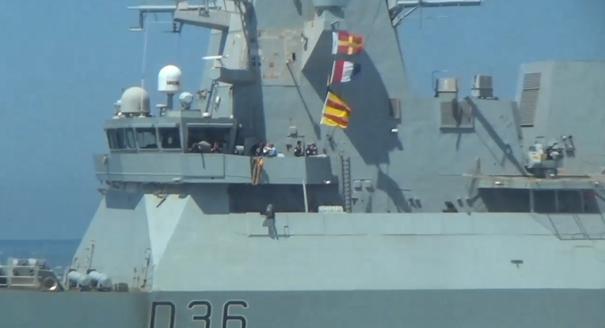
The UK-Russia incident off the Crimea coast highlights Britain’s new role in the international system. It features the newly baptized “Global Britain” as a proactive member of the U.S.-led coalition that seeks to reassert the West’s global leadership against the challenge of China and the actions of Russia. In doing so, London is willing to go to the edge and take non-negligible risks.
Before, as in Afghanistan and Iraq, the United Kingdom was the first responder to U.S. calls for joint action. Now, Britain has demonstrated that in some cases it can lead the way. Until this week, Russia’s sovereignty in Crimea had been directly challenged only in 2018 by Ukrainian navy boats sent by then president Petro Poroshenko from Odessa to the Sea of Azov. Now, the message of non-recognition of Russia’s incorporation of Crimea was delivered by HMS Defender, which sailed into the 12-mile territorial waters not far from Sevastopol. This potentially presages a new, riskier level of confrontation.
The current incident is more serious than the 2018 one not only because of who the challenger is, but also because of when the challenge was made. London’s apparent testing of the Kremlin’s red lines came less than a week after the meeting in Geneva between Russian President Vladimir Putin and U.S. President Joe Biden. In response, Russian forces sailed and flew close to the British ship, fired warning shots, and—according to the Russian defense ministry—dropped bombs to make HMS Defender change course.
A BBC report from aboard the ship indicated that the ship’s crew had been ready from the start for some sort of a physical clash with the Russian forces. The Russian interpretation of this fact is that HMS Defender’s mission was a premeditated provocation, designed to make the Russians use force to dispel the new “spirit of Geneva,” but the motivation for the voyage was probably to dismiss rather than test Russia’s red lines. The situation should become clearer as developments unfold: will this week’s incident remain a one-off event, or will similar attempts be made in the future?
Simply put, fresh attempts to expose Russian “red line” deterrence as hollow—whether on the ground, in the air, or at sea—would push Moscow to defend what it cannot give up without losing its self-respect. This would almost inevitably lead to clashes and casualties, which would carry the risk of further escalation.
Should this happen, Russia-NATO confrontation would deteriorate literally to the point of brinkmanship, a truly bleak scenario. Red lines, of course, are not there to be accepted, merely acknowledged. No one in Moscow expects the West to accept Russia’s sovereignty over Crimea in the foreseeable future. However, dismissing the reality carries a price one should understand before taking the risk of actually having to fight.
Britain has fewer reservations about confronting Russia than some other European NATO member states. The recent UK national security strategy is candid in naming Russia the main security threat to Britain and the West. Thus, UK-Russia relations, in an increasingly deeper freeze for the past decade and a half, are possibly moving to a hot zone.
The location of the incident with HMS Defender—not far from Sevastopol—readily brings back memories of the Crimean War, itself part of the bitter Great Game, a hybrid rivalry between two empires across Eurasia. Those days are gone forever, but the fighting spirit is alive and well on both sides.
In the 2020s, the risks of war between the major powers are higher than they were a half-century ago. Presidents Biden and Putin, by reasserting the maxim that nuclear war can never be won and should never be fought, rightly focused on strategic stability issues. But there is more to stability than strategic nuclear weapons and cybersecurity.
One likely path to war in the 21st century is an inadvertent escalation arising out of an incident, e.g., in the Baltic and the Black Sea, or local conflict, such as in Donbas, that gets out of hand. Even as efforts are made to better manage or even somewhat regulate U.S.-Russian confrontation, preventing dangerous encounters between Russian and NATO countries’ forces should be the absolute top priority for both sides.
This article was published as part of the “Relaunching U.S.-Russia Dialogue on Global Challenges: The Role of the Next Generation” project, implemented in cooperation with the U.S. Embassy to Russia. The opinions, findings, and conclusions stated herein are those of the author and do not necessarily reflect those of the U.S. Embassy to Russia.
Former Director, Carnegie Moscow Center
Trenin was director of the Carnegie Moscow Center from 2008 to early 2022.
Recent Work
Dmitri Trenin
Dmitri Trenin
Carnegie does not take institutional positions on public policy issues; the views represented herein are those of the author(s) and do not necessarily reflect the views of Carnegie, its staff, or its trustees.

As geopolitical rivalry weaponizes global supply chains, the EU’s true vulnerability lies in emerging-risk imports. For these goods, suppliers are growing more concentrated, substitution more difficult, and political risk is looming.

Sinan Ülgen
The EU is putting together a new security strategy to meet today’s myriad challenges. But for any proposal to be effective, the union needs to grapple with its identity and ambitions.

Pierre Vimont
Between the United States’ market-driven approach and China's state-led industrial strategy, Europe is reckoning with how it can remain competitive in the global economy. But is Europe in danger of becoming a U.S. or China colony?


Noah Barkin, Anu Bradford
The U.S.-sponsored TRIPP deal is driving the Armenia-Azerbaijan peace process forward. But foreign and domestic hurdles remain before connectivity and economic interdependence can open up the South Caucasus.



Thomas de Waal, Areg Kochinyan, Zaur Shiriyev

Economic growth is at the heart of a dilemma between planetary and international security.

Olivia Lazard