

Commentary
Judy Dempsey
{
  "authors": [
    "Judy Dempsey"
  ],
  "type": "commentary",
  "centerAffiliationAll": "",
  "centers": [
    "Carnegie Endowment for International Peace",
    "Carnegie Europe"
  ],
  "collections": [
    "EU Integration and Enlargement"
  ],
  "englishNewsletterAll": "",
  "nonEnglishNewsletterAll": "",
  "primaryCenter": "Carnegie Europe",
  "programAffiliation": "",
  "programs": [],
  "projects": [],
  "regions": [
    "Europe",
    "Eastern Europe"
  ],
  "topics": [
    "Democracy"
  ]
}
Source: Getty
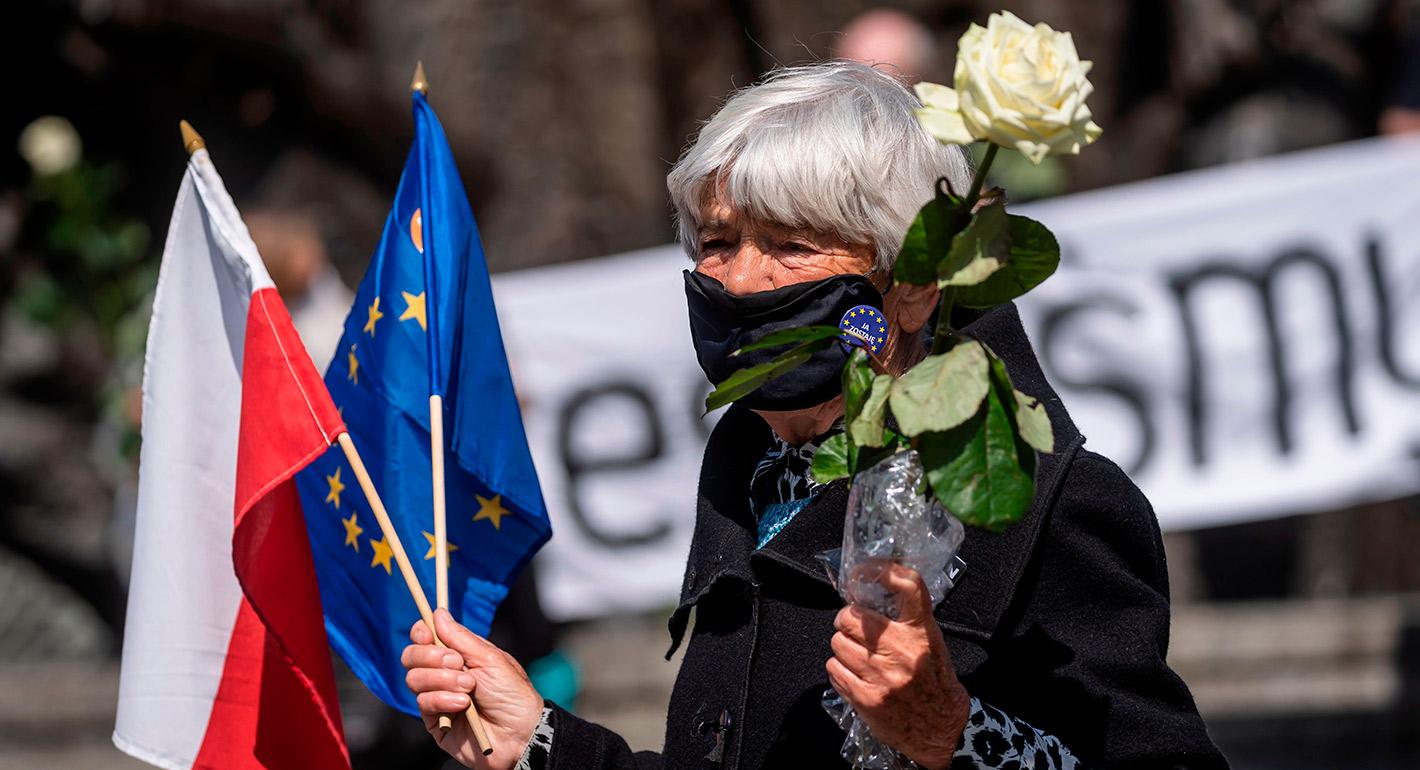
After Poland’s legal challenge, the European Union is struggling to maintain its integration project. The EU needs to assert its legal authority over Poland and other member states that challenge the rule of law and the EU’s treaty itself.
This past week, Poland, whose successive governments since 1989 have been staunch supporters of the EU, turned its back on the EU treaty by rejecting several of its articles.
This decision will make or break the EU’s ability to become more integrated, defend its values, and provide a beacon to other countries that aspire to join the bloc. It is decision time for the EU—and Poland.
The EU is founded on a treaty that is based, among other things, on creating “an ever closer union”; defending the rule of law; solidarity during financial, security and health crises; and upholding human rights. Member states like Poland agree, as a condition of EU membership, to uphold these basic principles.
But Poland—with support from Hungary—is testing the legal and political integrity of the EU by ruling that its own constitution supersedes the EU articles.
Judges in the country’s Constitutional Tribunal decided that four provisions of the EU treaty were not compatible with the Polish constitution. They included Article 1, which introduces a “new stage in the process of creating an ever closer union among the peoples of Europe.”
The judges also challenged Article 2, which contains the union’s main values of respect for human dignity, including the rights of persons belonging to minority groups. They also challenged Article 19 of the treaty, in particular the EU Court of Justice’s responsibility to “ensure that in the interpretation and application of the Treaties, the law is observed.”
Above all, the Polish judges ruled that Articles 1 and 4 of the EU treaty allowed the union to act “beyond the limits of competence transferred by the Republic of Poland in the treaties.” As for other articles of the treaty, especially Articles 2 and 19, the judges said the European Court of Justice illegally overrode the Polish constitution.
Poland’s challenge to the EU, long in the making, has come to a head.
Since 2015, when Poland’s conservative Law and Justice (PiS) party came to power, the government has systematically eroded the independence of the country’s highest court, the Constitutional Tribunal.
PiS has attempted to replace judges. It has violated EU law by forcing judges to retire early. It has given extensive powers to the PiS-run Justice Ministry to appoint judges and prosecutors on the regional level as well.
PiS argued that these changes were about completing the unfinished business of 1989. Back then, during round table negotiations between the ruling Communist Party and the opposition Solidarity movement, both sides agreed to a peaceful transition to democracy.
During this transition, there were no purges of the secret police or top communist officials. There were no reprisals. There was no lustration law banning communists from holding office. The idea was to move to free and independent elections.
Fast forward to 2005, when PiS won the parliamentary elections. Its leader, now Deputy Prime Minister Jaroslaw Kaczynski, challenged the 1989 agreements. He called for a purge of the judiciary, which he claimed was packed with communists, and for a lustration law. For Kaczynski, the judiciary was at the root of Poland’s distorted, incomplete transformation. Precisely because of that, the judiciary had to be controlled and overhauled.
PiS went into the opposition a year later. But in 2015, it re-emerged stronger and more determined.
Since then, it has embarked upon a policy of turning the courts into political entities, weakening the independence of the media, and banning abortion (with very few exceptions). Protection of LGBT rights is not on their radar screen. Essentially, PiS policies challenge what the EU stands for.
The European Commission—the EU’s executive body—at first had been slow to take Warsaw to task over its decision to sack judges and retire them early. There were threats about suspending Poland’s (and Hungary’s) voting rights in the European Council, which represents the member states. But that was a nonstarter from the beginning, because it required unanimity that some EU member states were not likely to give.
After pressure from the European Parliament and some member states, the commission took a stance. Last year, the EU agreed to a coronavirus pandemic recovery fund of over 750 billion euros, consisting of grants and cheap loans to kickstart the economies after the pandemic—but delayed the approval of Poland’s and Hungary’s national recovery plans. The commission is now likely to take a much tougher stance.
Brussels now realizes that Warsaw is challenging the integrity of the EU treaty itself. And if Poland gets away with its challenge, then the future direction of the EU—including a closer union, the rule of law, and the defense of human rights—is in danger. A precedent will have been set.
EU Commission President Ursula von der Leyen has the power to reverse this trend. For one, the commission can ask the Court of Justice to impose daily fines on Poland until the infringements stop.
The alternative option—which could threaten PiS’s future but would show that the EU is serious about defending its principles—is to withhold the money from the EU’s pandemic recovery funds. Poland is due to receive 23 billion euros in grants and 34 billion in low-interest loans. With parliamentary elections in Poland due in 2023, PiS needs these funds to boost its popularity.
Perhaps it has finally come to a showdown between the EU and Poland.
The EU Commission, backed by several member states including France and the Netherlands, has no choice but to defend the treaty. If it doesn’t, it can give up the idea of a stronger and more integrated Europe. Its fragmentation will weaken its ambitions to be a global player.
If the commission and a majority of the member states do not take a stand, other countries, such as Bulgaria, Hungary, and Slovenia, will exploit these weaknesses to prevent Europe from pursuing the path to more integration. For these countries, more integration is seen as undermining national sovereignty. But that is what all EU members signed up for when they joined the bloc.
As for Poland, the country must decide. A member state cannot pick and choose which treaty article it wants to reject or accept. It’s all or nothing.

Nonresident Senior Fellow, Carnegie Europe
Judy Dempsey is a nonresident senior fellow at Carnegie Europe
Recent Work
Judy Dempsey
Judy Dempsey
Carnegie does not take institutional positions on public policy issues; the views represented herein are those of the author(s) and do not necessarily reflect the views of Carnegie, its staff, or its trustees.

The domestic impacts of how long it is taking to end the war in Ukraine have pushed the French electorate to the political extremes and compromised the country’s diplomatic capacity.

Rym Momtaz

Before the next wave of EU enlargement takes place, the union needs to grapple with thorny questions of how power is distributed among its members.


Emil Sondaj Hansen, Ditte Brasso Sørensen

The new U.S.–Denmark–Greenland agreement will help Washington exert political, economic, and financial dominance under the guise of security. Yet, it acknowledged Copenhagen’s and Nuuk’s sovereignty on the island.

Marc Pierini

A summer of escalation in the Black Sea has hurt Ukraine economically and is exacerbating world food security. A truce is needed—as is a broader reframing of Europe’s Ukraine strategy.

Thomas de Waal

Are Germany’s economic, industrial, and political struggles becoming a liability for the EU’s ability to rise to the geopolitical moment?
Rym Momtaz, ed.