

Article
Paul Stronski
{
  "authors": [
    "Paul Stronski"
  ],
  "type": "commentary",
  "centerAffiliationAll": "dc",
  "centers": [
    "Carnegie Endowment for International Peace"
  ],
  "collections": [],
  "englishNewsletterAll": "ctw",
  "nonEnglishNewsletterAll": "",
  "primaryCenter": "Carnegie Endowment for International Peace",
  "programAffiliation": "russia",
  "programs": [
    "Russia and Eurasia"
  ],
  "projects": [],
  "regions": [
    "Central Asia",
    "Kazakhstan",
    "Kyrgyz Republic",
    "Tajikistan",
    "Turkmenistan",
    "Uzbekistan",
    "Russia",
    "Eastern Europe",
    "Ukraine"
  ],
  "topics": [
    "Economy",
    "Security"
  ]
}
Source: Getty
The region is dependent on Russia but wary of endorsing Moscow’s actions.
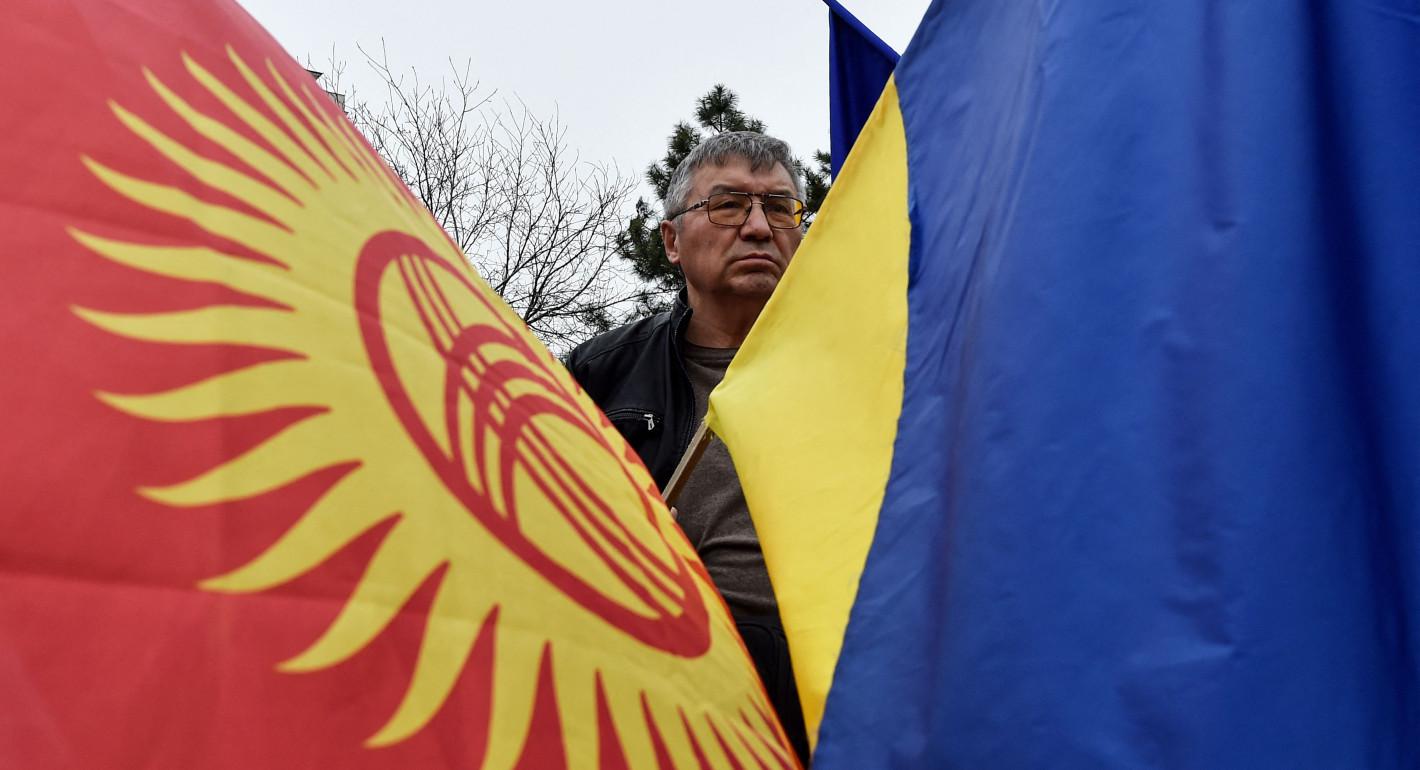
Russia’s war in Ukraine has unnerved the leaders of Central Asia, a region where Moscow enjoys substantial economic, political, and soft-power influence. The five former Soviet states—Kazakhstan, Kyrgyzstan, Tajikistan, Turkmenistan, and Uzbekistan—have been wary of endorsing Russian President Vladimir Putin’s aggression. Their geographic isolation and continued dependence on Russia for export routes, security assistance, and labor markets also make them reluctant to condemn Putin’s actions. Fearful that Moscow might turn on Central Asia next, as some prominent Russians have suggested, the region’s leaders have tried to hedge in ways Moscow may find irritating.
For example, no Central Asian country sided with Moscow on the March 2 or March 24 United Nations General Assembly (UNGA) resolutions condemning the invasion. They either voted formally to abstain or simply did not vote at all. Following the imposition of Western sanctions, Eurasian Economic Union (EAEU) members Kazakhstan and Kyrgyzstan refused to accept customs duties from Russia in rubles. This decision, echoed by Armenia, raises questions over the cohesion of the bloc, which has long been Putin’s pet initiative to integrate the region, although it has not progressed far since its 2014 launch.
Other actions suggest greater resistance to Moscow than initial diplomatic statements indicated. Kyrgyzstan, Tajikistan, and Uzbekistan have disputed Kremlin readouts of bilateral presidential phone calls that suggested greater support for the war than Central Asian leaders were willing to acknowledge. As the Russian military campaign struggled and the extent of human suffering in Ukraine became increasingly evident, the governments of Kazakhstan, Kyrgyzstan, and Uzbekistan moved beyond muted expressions of concern to more open critique. They allowed some anti-war protests, permitted civil society groups to collect humanitarian assistance for Ukraine, and clamped down on local displays of the “Z” sign used by supporters of the war. Those three governments also reiterated their commitment to Ukraine’s territorial integrity.
The overlaps and variations of the shifting Central Asian responses to the war illustrate each nation’s delicate navigation of the crisis.
Many analysts believed President Kassym-Jomart Tokayev would be totally beholden to Moscow after the Russian-backed Collective Security Treaty Organization (CSTO) intervention in January helped him secure his hold on power amid violent, domestic upheaval. Yet Tokayev’s government has shown greater independence from the Kremlin than expected, declaring the country neutral and reportedly rejecting a Russian request for Kazakhstani troops to join the fight.
Instead, Tokayev has fallen back on Kazakhstan’s tried-and-true approach of offering itself up as a mediator of global conflicts, and the foreign ministry declared it will not recognize the independence of the so-called Donetsk and Luhansk People’s Republics. Domestic opinion toward the war is mixed—not surprising given heavy Russian media penetration. Yet Kazakhstan’s government has authorized or tolerated several anti-war protests, and it has expressed displeasure by allowing public discussion in the media of whether the country should remain a CSTO and an EAEU member. Largely in response to Russian-friendly content on social media, Kazakh law enforcement on Monday warned against making “provocative” comments about the conflict, inciting ethnic tension, or questioning the territorial integrity of Kazakhstan. Air Astana, the country’s major airline that’s co-owned by the Kazakh sovereign wealth fund and British partners, stopped all flights to Russia, ostensibly due to insurance difficulties, although reputational risks ahead of an expected initial public offering also may have been a factor.
Like other Central Asian states, the government in Tashkent remains hesitant to assign blame for the war. It has expressed its “deep concern” and urged a diplomatic solution to end the “military activity and aggression” to distance itself from Moscow’s actions. An authoritarian country, Uzbekistan has not sanctioned anti-war rallies and has reined in independent coverage of the war on social media. Yet it has allowed subtle demonstrations of support for Kyiv, including displays of the Ukrainian flag at prominent locations in Tashkent and Samarkand, and tolerated small gatherings outside the Ukrainian embassy. Neither could happen without official sanction. Uzbekistan, along with Kyrgyzstan and Kazakhstan, has sent humanitarian assistance and medical supplies to Ukraine.
The government in Tashkent has warned Uzbek migrants in Russia, subject to being conscripted or recruited to serve in the Russian military, that service in a foreign army could be punished by up to five years in prison—a clear warning to Uzbeks to steer clear of the conflict. Furthermore, as the Russian military has struggled, Tashkent has grown more vocal in its support for Kyiv. During a March 17 address to parliament, Uzbekistan’s long-serving foreign minister, Abdulaziz Komilov, declared that Uzbekistan would not recognize the Russian-controlled portions of eastern Ukraine as independent states and reiterated its commitment to Ukrainian territorial integrity.
Bishkek actively avoids antagonizing Moscow or its own citizens who support the war. Before the invasion, Kyrgyz President Sadyr Japarov mimicked Russian talking points to suggest Moscow’s recognition of Donetsk and Luhansk may have been justified. Reportedly under pressure from Moscow, the Japarov government also banned anti-war protests in Bishkek and levied fines against protesters as of mid-March, although that has not stopped demonstrators from gathering or civil society actors from speaking out.
However, public discussion of Kyrgyzstan’s future in Russian-based regional organizations is ongoing. During a March 20 state television interview, the deputy chair of Kyrgyzstan’s cabinet of ministers underscored that every country has the right to “determine its domestic and foreign policies” under the UN charter. Kyrgyzstan’s foreign minister also reiterated the country’s commitment to the principle of territorial integrity and called for the establishment of stable humanitarian corridors in Ukraine—both implicit criticisms of Moscow.
Except for brief mentions of their citizens caught in Ukraine, neither country has publicly addressed the war—but that is not a sign of support for Russia’s policies. Valentina Matviyenko, chairwoman of the Russian Federation Council, visited Tajikistan on the second day of Russia’s “special military operation” and held public and private discussions on the rationale behind Russia’s invasion. The Tajik government, however, provided no public response to her announcement or any readout of any Ukraine-related discussions she held with senior officials, focusing instead on discussions of Russian-Tajik security cooperation vis-à-vis Afghanistan. Turkmenistan, upholding its long-standing principle of “permanent neutrality,” has avoided all public comment.

Former Senior Fellow, Russia and Eurasia Program
Paul Stronski was a senior fellow in Carnegie’s Russia and Eurasia Program, where his research focuses on the relationship between Russia and neighboring countries in Central Asia and the South Caucasus.
Recent Work
Paul Stronski
Paul Stronski
Carnegie does not take institutional positions on public policy issues; the views represented herein are those of the author(s) and do not necessarily reflect the views of Carnegie, its staff, or its trustees.

Russia is testing the waters of NATO’s mutual defense clause. What do strikes in Romanian territorial waters mean for the alliance’s posture toward Moscow?

Dimitar Bechev

With its public finances in shambles, the far right polling at 35 percent ahead of the 2027 presidential election, and a growing protest movement, is France’s crisis a threat to the EU’s geopolitical awakening?

Rym Momtaz, ed.

Ahead of a tough winter for Ukraine, Donald Trump’s swing back toward Russia bodes ill. But instead of panicking, Kyiv’s European allies are focusing on action.
Rym Momtaz

Funding Ukraine remains a priority for European leaders. As Russia’s war of aggression heads into another winter, two feasible options to mobilize support for Kyiv should be fast-tracked.


Vladyslav Rashkovan, Gregory P. Wilson

Europe is facing rising populism internally as well as external pressures from Russia, China, Turkey, and the United States.
Dimitar Bechev