

Commentary
Andrei Kolesnikov
{
  "authors": [
    "Andrei Kolesnikov"
  ],
  "type": "other",
  "centerAffiliationAll": "dc",
  "centers": [
    "Carnegie Endowment for International Peace",
    "Carnegie Russia Eurasia Center"
  ],
  "collections": [],
  "englishNewsletterAll": "ctw",
  "nonEnglishNewsletterAll": "",
  "primaryCenter": "Carnegie Russia Eurasia Center",
  "programAffiliation": "russia",
  "programs": [
    "Russia and Eurasia"
  ],
  "projects": [],
  "regions": [
    "Russia"
  ],
  "topics": [
    "Political Reform"
  ]
}
Source: Getty
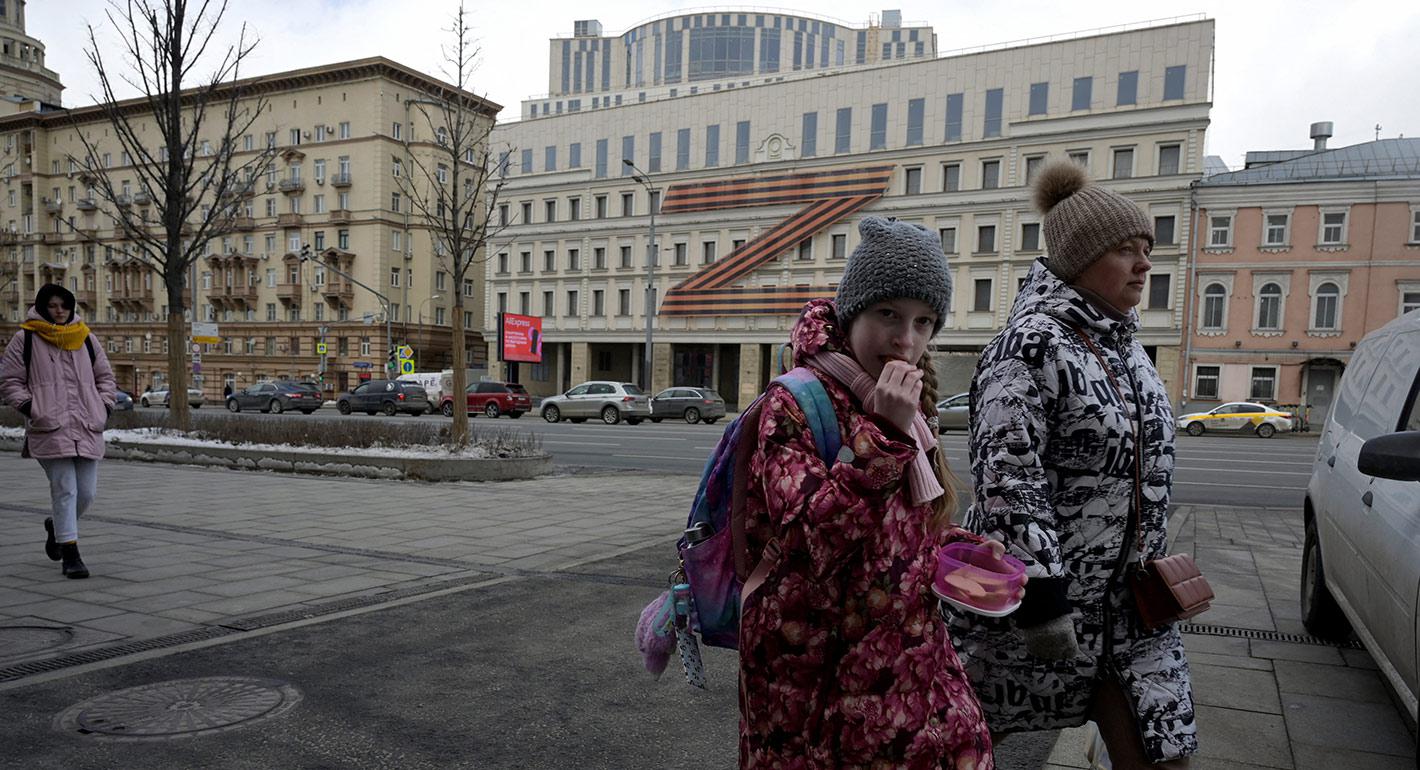
The Russian state is encouraging dehumanization and raising Generation Z: not Zoomers, but disciples of the letter Z, the emblem of Moscow’s war.
This article was originally published in Russian in the New Times.
The start of the second phase of the “special military operation” in Ukraine announced by Russian Foreign Minister Sergei Lavrov, 72, appears to have coincided with the gerontocratic development phase of the post-Soviet model of the Russian state. In 1979, there was a direct link between the increasingly decrepit state of the politburo and the decision to send Soviet troops into Afghanistan. Now the sight of Defense Minister Sergei Shoigu reading haltingly from pieces of paper to a President Vladimir Putin—long dubbed “Granddad”—seemingly frozen to his chair and awkwardly gripping the table cannot help but suggest an indirect link between the moral and mental decrepitation of the current “politburo” and the disastrous decision to begin the “special operation” in Ukraine.
Judging by the actions of these elderly warmongers, who have been in power for decades, they are utterly indifferent to the future of their country. Russian infants are dressed up in military uniforms in preparation for their destiny as cannon fodder. Schoolchildren are indoctrinated with made-up history and decked out in the uniform of the state-sponsored “Young Army” organization. Older Russians are summoned to military recruitment centers or to join a movement patronized by Putin, “Russia — Land of Possibilities.” That last one is, ironically, for once entirely true: in Russia, even a “special military operation” on the territory of a neighboring country is possible.
Now, in a Freudian field day, T-shirts emblazoned with the words “I Am Not Ashamed” are being churned out and marketed aggressively. This cocky, indignant phrase contains a clear challenge to the world: “Take that! I’m not ashamed that cities—Soviet cities, no less—are being destroyed, that thousands of people are being killed, that more than 200 children have been killed, that more than 5 million people have become refugees, and that Russians have become international pariahs, all for the sake of an idea that no one understands and for goals set by an aging KGB officer that haven’t been explained to anyone. I’m not ashamed that I am directly involved, since I support an autocrat and his brutal, archaic, and ineffective political regime.” In fact, proclaiming “I am not ashamed!” only acknowledges that there is something to be ashamed of.
This brings us to the psychology of the “special operation” and the associated problem of the banality of evil. Back in ordinary life and normal circumstances, those who have killed and raped civilians in Ukraine lead ordinary, non-aggressive lives. But war has thrown them into very different circumstances: it dehumanizes them. If any Russian security service officials (siloviki) were to be told that enemies of the people—whether Nazis or detested liberals—were hiding out in apartments right in the center of Moscow, those siloviki would treat Muscovites no better than Russian soldiers treated Ukrainian civilians in the Kyiv suburb of Bucha. This is the psychology of legalized and encouraged violence.
In parallel with the decrepitation of the regime and its politburo, the unwritten social contract between the authorities and what is generally referred to as “the people” has also degraded.
First, that contract was for petrodollar-fueled prosperity in exchange for staying out of the government’s murky dealings. Then, when that prosperity dried up as a result of excessive state interference in the economy, the government offered up the annexation of Crimea, accompanied by much patriotic pomp, as a replacement. This model worked quite well for a while—until real disposable incomes fell and the retirement age was raised. Now the contract is extremely primitive: a “special military operation” in exchange for “patriotic” support for the autocrat.
In the Russian playwright Yevgeny Schwartz’s 1944 play “The Dragon,” a knight sent to slay a dragon finds that the very people terrorized by the dragon have come to accept it and see it as the only way of ruling. And in today’s Russia—during the initial peak of this Armageddon—the primitive social contract scheme is working. But this effect of rallying around the dragon cannot be counted upon to continue at a time of economic crisis—a crisis that has not yet even really begun.
Like Schwartz’s dragon, however, Putin understands crowd mentality and the psychology of submission all too well: “Cut the body in half—and the man croaks. But tear the soul apart—and it only becomes more pliable, that's all… Souls with no hands. Souls with no legs. Mute souls, deaf souls, chained souls, snitch souls, damned souls."
In Putin’s Russia, the tool for subduing the masses is not so much the language of hatred—which has become Russia’s lingua franca both for communicating with the rest of the world and at home on pro-Kremlin talk shows—as the expansion of the discourse itself. Not so long ago, it would have been unthinkable to freely speculate on the possibility of nuclear war, while now it has become shockingly normal.
Acceptable subjects for discussion now include nuclear war, waging war against NATO countries directly once the operation in Ukraine is over (discussed openly by the rabidly bellicose pro-Kremlin TV host Vladimir Solovyov in front of his millions of viewers), extending the “special operation” to Moldova’s breakaway Transnistria region (as hinted at by a very senior military official) and the thinking of many people that the Ukrainians must be “finished off.”
This broadening of what is permissible changes ideas of what is normal: the language of hatred and a free focus on topics that are taboo in a civilized society are becoming the new normal. Dehumanization is encouraged by the state, which is raising Generation Z: not Zoomers, but disciples of the letter Z, the symbol of Russia’s war. This is a generation for which a permanent state of war and denouncing their neighbors will be entirely routine.
The Georgian philosopher Merab Mamardashvili believed it was impossible for a person to remain human without making a concerted effort to do so: that the muscles of humanity will atrophy if they are not used. Regular imbibing of an explosive cocktail of predetermined submission and encouraged dehumanization may lead not only to the dystrophy of critical reflection, but also to losing the ability to think for oneself, without the ready-made formulae from Putin and all his propaganda cheerleaders, such as the aforementioned Solovyov, Foreign Ministry spokeswoman Maria Zakharova, RT head Margarita Simonyan, Defense Ministry spokesman Igor Konashenkov et al.
If that ability is lost, then it will take years and years to restore the soft power Russia once held in the form of science, culture, education, and sport. Now the country can no longer export any of that abroad, or even disseminate it at home. The Russian brand only covers two products now: sweeping, fast-selling threats, and fear—delivered right to your door.
Former Senior Fellow, Carnegie Russia Eurasia Center
Kolesnikov was a senior fellow at the Carnegie Russia Eurasia Center.
Recent Work
Andrei Kolesnikov
Andrei Kolesnikov
Carnegie does not take institutional positions on public policy issues; the views represented herein are those of the author(s) and do not necessarily reflect the views of Carnegie, its staff, or its trustees.

The EU’s responses to two recent incidents expose the gulf between European perceptions and capabilities. Unless the union can bridge that gap, it will never become a real geostrategic power.

Rym Momtaz

European states control several Overseas Countries and Territories around the world that carry strategic, economic, and environmental weight. As great powers challenge the rules-based order, defending them is a geopolitical imperative for Europe.

Marc Pierini

In supporting Europe’s far-right, MAGA and Russia both want the same thing: a weaker EU. Europe must defend itself without abandoning the openness these forces exploit.

Armida van Rij

As we close out another season of Strategic Europe, it is worth taking stock of the deep shifts underway.
Rym Momtaz

The hybrid warfare landscape is evolving rapidly, leaving policymakers without clear strategies. To better inform their work in addressing emerging challenges, governments must dig deeper into the underlying dynamics at play.


Raluca Csernatoni, Alicia Wanless