

Commentary
The EU can impose sanctions but struggles to enforce them without the United States. With Washington increasingly disinterested in backing European interests, the bloc must now fend for itself.
Nicu Popescu, Tiago Antunes
{
  "authors": [
    "Eric Brewer",
    "Toby Dalton"
  ],
  "type": "commentary",
  "centerAffiliationAll": "dc",
  "centers": [
    "Carnegie Endowment for International Peace"
  ],
  "collections": [],
  "englishNewsletterAll": "ctw",
  "nonEnglishNewsletterAll": "",
  "primaryCenter": "Carnegie Endowment for International Peace",
  "programAffiliation": "NPP",
  "programs": [
    "Nuclear Policy"
  ],
  "projects": [],
  "regions": [
    "North America",
    "United States",
    "East Asia",
    "South Korea"
  ],
  "topics": [
    "Nuclear Policy"
  ]
}
Source: Getty
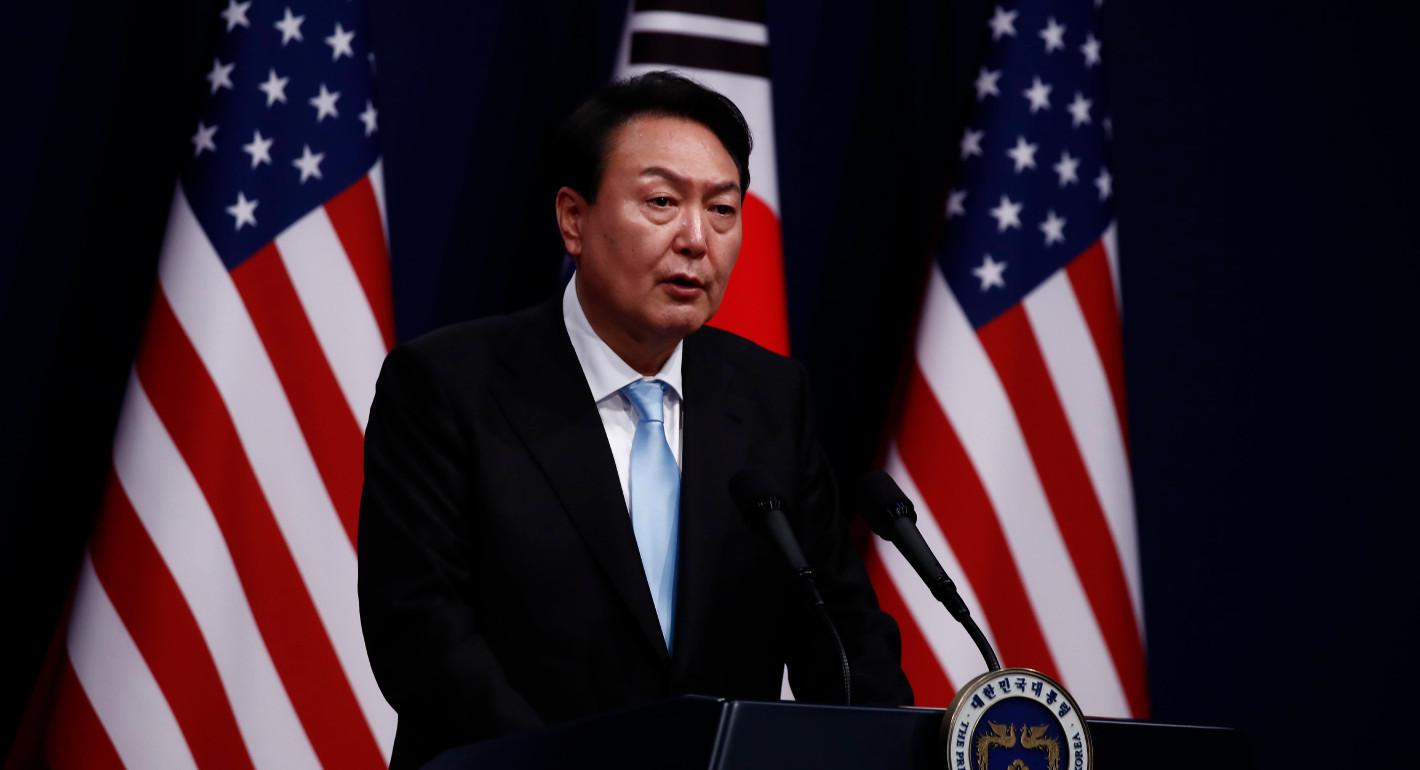
Yoon’s comments have fueled a debate in Washington over how to handle a problem that policymakers cannot wish away.
South Korean President Yoon Suk-yeol’s January comments about his country possibly acquiring nuclear weapons adds to the mounting nuclear dangers in Asia. Though he subsequently walked back his statement, the underlying motives and risks remain that South Korea could one day decide to go nuclear.
Yoon’s nuclear threat also fueled a debate among security experts in Washington about how to respond. Many nonproliferation analysts highlighted the rarity of national leaders making public allusions to acquiring nuclear weapons and argued that the United States needs to remind South Korea of its commitments not to do so. Others highlighted the dangers of a rising tide of “nuclear populism” that is driving South Korea’s nuclear discourse. Conversely, some analysts argued that there is little the United States can do to prevent an inevitable South Korean weapon and that it is better to reduce U.S. extended deterrence commitments in conflicts that exceed vital U.S. interests. A few go even further and suggest that Washington should welcome or even facilitate a nuclear-armed Seoul.
This debate indicates a very unsettled dynamic that American and other policymakers cannot wish away or ignore. Yoon’s comments may simply be the leading edge of a trend in nuclear flirtations by U.S. allies and partners.
Since the dawn of the nuclear age, the United States has sought to stem the spread of nuclear weapons to adversaries and allies alike. This policy aims partly to preserve the U.S. nuclear advantage and to reduce the potential that nuclear weapons are used, which many experts judge increases if more states acquire them. Over the past few decades, the major proliferation fear has been about rogue actors: North Korea, Iraq, Iran, Syria, or potentially terrorist groups. The United States and the international community developed a policy tool kit to address these threats, including sanctions, technology denial, and even cyber and military attacks on nuclear facilities. Today, however, an increasing proliferation risk comes from U.S. allies and partners worried about their security and the credibility of U.S. commitments to their defense.
The last time the United States faced serious allied proliferation risks was roughly forty years ago. In the 1960s and 1970s, South Korea, Japan, Taiwan, West Germany, and other allies and partners considered or pursued nuclear weapons. The United States used several strategies to keep those ambitions in check: pressing for their commitment to the Nuclear Non-proliferation Treaty (NPT) and abstention from ever developing nuclear weapons; providing, and alternatively threatening to withhold, commercial nuclear technology; and, perhaps most importantly, offering security guarantees and other defense commitments. In effect, Washington pledged to use its military might, including nuclear weapons, in defense of many of these allies so they didn’t need to develop their own. These arrangements were part of a clearly conditional bargain. In return for help with civil nuclear power programs and security commitments, allies and partners would eschew nuclear weapons development.
Now, Russia’s invasion of Ukraine, China’s military expansion and aggressive posturing, and North Korea’s nuclear expansion are changing allied threat perceptions, especially in Asia. These come on the heels of the Trump administration’s extortionate approach to alliances, which seriously damaged U.S. credibility, and which allies worry could re-emerge in a future U.S. administration. In the Middle East, Iran’s nuclear progress and its destabilizing activities—combined with fears of U.S. abandonment—are driving similar fears.
South Korea is exhibit A for the effects of these developments. Popular support for nuclear weapons there hovers around 70 percent. Over time, public discussion of developing nuclear weapons has moved from the political fringes to the mainstream, especially among conservative politicians and defense experts. In addition to South Korea’s advanced nuclear energy infrastructure, in recent years Seoul has invested in longer-range and more sophisticated conventional missile capabilities that could also be used for nuclear delivery. These capabilities may be what Yoon had in mind when he said that, if Seoul decided to do so, its “science and technology” would allow South Korea to acquire nuclear weapons “sooner rather than later.”
Until now, no South Korean president has talked about developing nuclear weapons as explicitly as Yoon. His comments—conditional on “problems” from North Korea becoming “more serious”—may have been intended to warn Pyongyang, appease pro-nuclear factions in his political party, or pressure Washington to provide Seoul with a larger role in the nuclear element of extended deterrence. Whatever his intent, they also threaten the very bargain that undergirds U.S. security guarantees.
The United States and South Korea have a shared interest in strengthening the alliance, adapting it to the evolving North Korean threat and broader challenges in the Indo-Pacific. To that end, the Biden administration has been actively working with South Korea, Japan, and other allies and partners to adjust military postures, including U.S. nuclear posture, to address the changing landscape and concerns about U.S. security commitments.
But disagreements about how to accomplish these adjustments—which are inevitable between allies—are best worked out behind the scenes. Yoon’s implicit threat that South Korea will seek nuclear weapons if the United States doesn’t provide what South Korea wants risks undermining the trust that acts as the glue in the alliance. It makes the assurance problem much harder to manage for both the United States and South Korea. It could also inadvertently become a self-fulfilling prophecy: Seoul’s loose proliferation talk may drive more U.S. politicians to believe that South Korea doesn’t need U.S. troops or the alliance.
Even if South Korea opts to withdraw from the NPT and produce nuclear weapons without violating international law, that can’t mitigate a range of other consequences from kicking in—including automatic U.S. sanctions, suspension of international cooperation with Seoul’s nuclear energy program, and a harsh reaction from China most likely in the form of economic sanctions. All of these reactions would further embroil Washington and Seoul and exacerbate strategic anxiety around the world.
Ideally, U.S. policies would both dissuade and reassure allies as a means of preventing further proliferation. “Maximum pressure” tactics aren’t politically realistic, will not work, and could further stimulate pro-nuclear inclinations among allies. Moreover, in an era of strategic competition, it is in the U.S. interest to sustain robust alliances. Yet maintaining the current rules-based system also means continuing efforts to restrain proliferation. To that end, it is time for Washington to update its nonproliferation policies with allies and partners in mind.
Accordingly, the United States must craft new approaches to managing allies’ security in return for their continued promise not to seek nuclear weapons. For instance, Washington and Seoul together should flesh out a military concept of tighter integration between stronger allied conventional military capabilities alongside U.S. conventional and nuclear capabilities to align threat perceptions and better deal with probable escalation scenarios. Forthcoming military tabletop exercises are the perfect opportunity to work out this concept. In addition, it can institute new communications mechanisms that ensure allies have both a better understanding of U.S. deterrence planning and decisionmaking and a means to coordinate during a crisis. The hardest part will be repairing the political damage to U.S. credibility wreaked by the Trump administration. Given the deep polarization in U.S. domestic politics, there are no easy solutions here, apart from time and consistent political messaging toward the publics and policy elites in allied states about U.S. commitments.
As for South Korea, Yoon’s subsequent attempts to reassure the international community that his country doesn’t intend to go nuclear were a positive and necessary step. But the debates about allied nuclear weapons development and how Washington should respond are not going away. U.S. officials should find occasions to publicly and privately remind allies that the assurance bargain is a two-way street: that the United States will do everything within reason to guarantee their security, provided they don’t proliferate.
Eric Brewer
Eric Brewer is deputy vice president at the Nuclear Threat Initiative and has served on the National Security Council and National Intelligence Council.

Senior Fellow and Co-director, Nuclear Policy Program
Toby Dalton is a senior fellow and co-director of the Nuclear Policy Program at the Carnegie Endowment. An expert on nonproliferation and nuclear energy, his work addresses regional security challenges and the evolution of the global nuclear order.
Carnegie does not take institutional positions on public policy issues; the views represented herein are those of the author(s) and do not necessarily reflect the views of Carnegie, its staff, or its trustees.

The EU can impose sanctions but struggles to enforce them without the United States. With Washington increasingly disinterested in backing European interests, the bloc must now fend for itself.


Nicu Popescu, Tiago Antunes

Ahead of a tough winter for Ukraine, Donald Trump’s swing back toward Russia bodes ill. But instead of panicking, Kyiv’s European allies are focusing on action.

Rym Momtaz

While the EU and European governments are embracing the much-lauded middle-power moment, this entails three difficult conundrums.

Richard Youngs

Europe is facing rising populism internally as well as external pressures from Russia, China, Turkey, and the United States.

Dimitar Bechev

European NATO countries are wrestling with the possibility of U.S. disengagement from the alliance. With the continent’s security increasingly uncertain, governments must restore the credibility of their collective defense.



Hans-Dieter Lucas, Adam Thomson, Pierre Vimont