

Commentary
The EU can impose sanctions but struggles to enforce them without the United States. With Washington increasingly disinterested in backing European interests, the bloc must now fend for itself.
Nicu Popescu, Tiago Antunes
{
  "authors": [
    "Joshua Shifrinson"
  ],
  "type": "commentary",
  "centerAffiliationAll": "dc",
  "centers": [
    "Carnegie Endowment for International Peace"
  ],
  "collections": [
    "Debating NATO Enlargement",
    "A More Disciplined American Global Leadership"
  ],
  "englishNewsletterAll": "americanStatecraft",
  "nonEnglishNewsletterAll": "",
  "primaryCenter": "Carnegie Endowment for International Peace",
  "programAffiliation": "ASP",
  "programs": [
    "American Statecraft"
  ],
  "projects": [],
  "regions": [
    "North America",
    "United States",
    "Russia",
    "Eastern Europe",
    "Ukraine"
  ],
  "topics": [
    "Security",
    "Global Governance",
    "NATO",
    "Defense"
  ]
}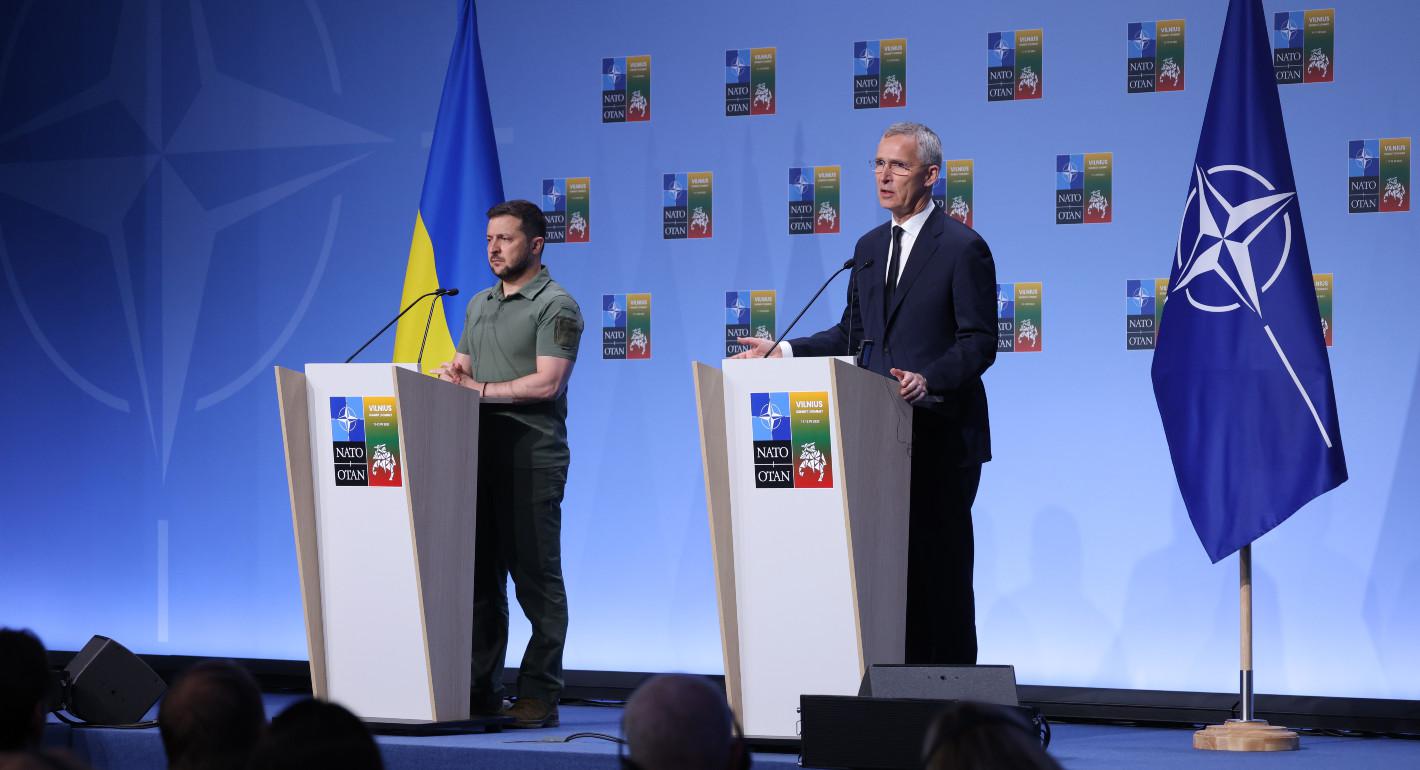
Source: Getty
Members’ interests don’t outweigh the risks.
In this series from the American Statecraft Program, James Goldgeier and Joshua Shifrinson discuss and debate the issues surrounding NATO enlargement in a twenty-first-century exchange of letters. Read the first entry here.
Dear Jim,
You discount the possibility that NATO enlargement—particularly but not exclusively to Ukraine—helped cause the Russia-Ukraine conflict, instead suggesting without quite saying that homegrown Russian “imperialism” is to blame. In turn, you call for the alliance to admit Ukraine once the conflict ends. I don’t think either this diagnosis of the war’s origins or the recommendation for NATO policy going forward is quite right.
For sure, Russian imperialism is a driver of Russian behavior. Still, whereas you present Russia’s imperial impulse as a better explanation for its invasion of Ukraine than NATO enlargement, I see these as complementary. Russian leaders and many Western analysts warned from the 1990s onward that NATO enlargement would inflame Russian nationalism and imperil East-West relations. Correlation is not causation, but it is striking that what former Russian president Boris Yeltsin and others warned about is exactly what has happened. Put another way, Russian nationalism and imperialism did not develop in a vacuum. By providing nationalists such as President Vladimir Putin with a cause and challenging Russian claims to influence in its near abroad, NATO enlargement shaped the thuggish Russian nationalism we see today. Further NATO enlargement to Ukraine promises to reinforce the situation by playing into the basest of Russian identity.
There are additional reasons to think Russian behavior has a lot to do with NATO expansion. For example, the imperialism-based argument can’t explain the timing of Russian aggression. Russian grievances and nationalist claims have been around for decades, but a full-scale Russian invasion of Ukraine occurred only in 2022. Explaining change with a constant is difficult, so we need to look elsewhere for the source of the problem. NATO enlargement provides a more compelling explanation.
After all, Russian elites had warned for decades that Ukrainian membership in NATO was a red line. By 2021, Moscow probably perceived that its window of opportunity to arrest Ukraine’s Westward drift was closing, given developments such as:
Then, when the Kremlin’s initial coercive diplomacy campaign failed, Russia invaded. It’s awful that Russia believes its interests require dominating Ukraine’s geopolitical orientation, but analytically, NATO enlargement is essential to understanding how we’ve ended up in this mess.
NATO may also present more of a challenge to Russian interests today than your letter allows. Claiming that NATO is purely defensive is not 100 percent accurate, for example. Interventions in Libya and Kosovo hardly involved defending NATO territory. Likewise, the U.S. way of war emphasizes striking to disarm and disrupt a target, just as prominent strategic analysts have called for NATO to prepare for deep conventional attacks into Russia itself. For all that NATO thinks it would never pick a fight with Russia, Russia may, tragically, simply not trust the West’s stated intentions.
Nor does the military situation alone pose potential problems. NATO members have spent the past three decades trumpeting the alliance’s role in creating a European “order” uniquely advantageous to the United States and its partners. At the same time, Russia—as we and others conclude—never had a real prospect of entering the core of this order. Since relative power and security matter to states—including the United States—Russia’s fears of the enlargement of a security system from which it is excluded and that (if allied claims are correct) progressively shifts the distribution of power against Moscow shouldn’t be surprising. Meanwhile, recent American policy underlines why Russia may be worried about the consequences of these trends. Although you claim the West would address Russian interests if Russia were content to live within its borders, U.S. policymakers rejected Russian calls to forego NATO enlargement to Ukraine before Moscow invaded, even though Russian leaders were clear that Ukraine was a vital concern. Again, Moscow may doubt NATO whether can ever accommodate Russian interests.
What of NATO’s future with Ukraine and Russia? You argue that Russia is the greatest threat to European security today, requiring the alliance to embrace Ukraine. Moreover, because Moscow has not attacked a NATO member, you imply that protecting Ukraine within NATO would be easily accomplished. On both counts, I wonder.
Russia may be a threat to European security, but its failures in Ukraine demonstrate that it is far from capable of dominating Europe. This is supremely important, insofar as the United States’ primary interest in Europe over the past century or so has involved preventing the emergence of a European hegemon. Given Russia’s revealed weakness, the allies have little reason to take on a NATO-style security commitment to Ukraine: the interests for NATO members don’t outweigh the risks.
And those risks are enormous. Deterrence is not magic. Advocates of Ukrainian membership highlight the alliance’s success in protecting Western Europe from the Soviet Union, but deterrence during the Cold War required the United States deploy more than 300,000 troops and 6,000 nuclear weapons while embracing dangerous politico-military arrangements (including options involving nuclear escalation). Even then, questions over the credibility and viability of this commitment were pervasive. Today meanwhile, NATO is already scrambling to make deterrence along the existing eastern front viable after assuming for years that enlargement would not require military action by the allies. Admitting Ukraine into NATO would impose an exceptionally complex and costly mission at a time when American attention is shifting elsewhere and Europe’s willingness to step up remains uncertain. Even then, deterrence may fail, risking World War III.
NATO enlargement writ large has provided security for some states at the expense of others, just as NATO’s prospective enlargement to Ukraine would expose the American people and current allies to high risks for few gains. Given all this, I am curious: supposing the current war ends and Kyiv joins NATO, how do you rate both the ease and feasibility of deterring Russia?
I remain your obed. servant,
Josh
Read more from Debating NATO Enlargement:
Joshua Shifrinson
Joshua Shifrinson is an associate professor of international policy with the University of Maryland’s School of Public Policy and a nonresident senior fellow with the Cato Institute’s Defense and Foreign Policy program. A graduate of Brandeis University and MIT, he is the author of Rising Titans, Falling Giants: How Great Powers Exploit Power Shifts and co-editor (with Jim Goldgeier) of Evaluating NATO Enlargement: From Cold War Victory to the Russia-Ukraine War.
Carnegie does not take institutional positions on public policy issues; the views represented herein are those of the author(s) and do not necessarily reflect the views of Carnegie, its staff, or its trustees.

The EU can impose sanctions but struggles to enforce them without the United States. With Washington increasingly disinterested in backing European interests, the bloc must now fend for itself.


Nicu Popescu, Tiago Antunes

Russia is testing the waters of NATO’s mutual defense clause. What do strikes in Romanian territorial waters mean for the alliance’s posture toward Moscow?

Dimitar Bechev

With its public finances in shambles, the far right polling at 35 percent ahead of the 2027 presidential election, and a growing protest movement, is France’s crisis a threat to the EU’s geopolitical awakening?

Rym Momtaz, ed.

Ahead of a tough winter for Ukraine, Donald Trump’s swing back toward Russia bodes ill. But instead of panicking, Kyiv’s European allies are focusing on action.
Rym Momtaz

Funding Ukraine remains a priority for European leaders. As Russia’s war of aggression heads into another winter, two feasible options to mobilize support for Kyiv should be fast-tracked.


Vladyslav Rashkovan, Gregory P. Wilson