

In The Media
Michele Dunne, Robert Kagan
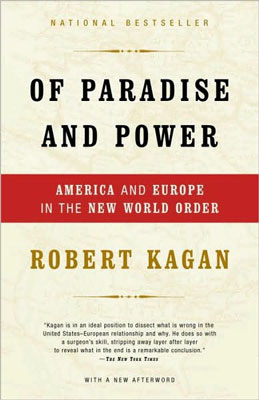
Europe sees the U.S. as high-handed, unilateralist, and unnecessarily belligerent; the U.S. sees Europe as spent, unserious and weak. The anger and mistrust on both sides are hardening into incomprehension.
Source: Knopf Publishers

This past summer in Policy Review, Robert Kagan reached into this impasse to force both sides to see themselves through the eyes of the other. Tracing the widely differing histories of Europe and America since the end of World War II, he makes clear how for one the need to escape a bloody past has led to a new set of transnational beliefs about power and threat, while the other has evolved into the guarantor of the “post-modern paradise” by dint of its might and global reach.
Reviews
“No academic piece in this realm has generated quite as much heat and interest since Samuel Huntington’s ‘Clash of Civilizations’ article in 1993 or Francis Fukuyama’s ‘End of History’ in 1989.”
—François Heisbourg, New York Times
“Cogent and important. This book deserves to be read by all conscientious citizens.”
—Brad Hooper, Booklist
"The best-known and most comprehensive analysis of divisions between the United States and Europe..."
—Orbis, A Journal of World Affairs
—Parameters, US Army War College Quarterly
—Charles A. Kupchan, The Economist
—Business Week
"This brilliant and controversial work belongs in all library collections."
—Library Journal
“Brilliant.”
—Francis Fukuyama
“One of those seminal treatises without which any discussion of European-American relations would be incomplete and which will shape that discussion for years to come.”
—Dr. Henry Kissinger
“Robert Kagan’s small book is a big book…for its brilliant juxtaposition of strategy and philosophy, of the realities of power and the ethics of power, of the American ideal of justice and the European ideal of peace.”
—Leon Wieseltier

Former Senior Associate
Kagan, author of the recent book, The Return of History and the End of Dreams (Knopf 2008), writes a monthly column on world affairs for the Washington Post and is a contributing editor at both the Weekly Standard and the New Republic.
Recent Work

Michele Dunne, Robert Kagan
Robert Kagan, Michele Dunne
Carnegie does not take institutional positions on public policy issues; the views represented herein are those of the author(s) and do not necessarily reflect the views of Carnegie, its staff, or its trustees.

A summer of escalation in the Black Sea has hurt Ukraine economically and is exacerbating world food security. A truce is needed—as is a broader reframing of Europe’s Ukraine strategy.

Thomas de Waal

Are Germany’s economic, industrial, and political struggles becoming a liability for the EU’s ability to rise to the geopolitical moment?

Rym Momtaz, ed.

European Commission President Ursula von der Leyen is about to give her annual address on the state of the EU. Here’s what she won’t—but should—say.
Rym Momtaz

Radical-right parties are expected to do well in upcoming elections in four of the EU's biggest member states. If successful, they could prevent the union from addressing key challenges ahead.

Stefan Lehne

The aftermath of the Ceuta crisis shows Europe has drawn the wrong lessons. Rather than doubling down on failed migration policies, the EU needs to address the underlying roots of such episodes.

Richard Youngs