

Commentary
Are Germany’s economic, industrial, and political struggles becoming a liability for the EU’s ability to rise to the geopolitical moment?
Rym Momtaz, ed.

REQUIRED IMAGE
Western assistance should focus on catalyzing domestic reform, a strategy that has received little attention to date. Matthew J. Spence argues that reform can be successful when two conditions are present: first, a policy entrepreneur who favors reform and enjoys some political space to make efforts reality; and second, a plan to implement reforms already part of the policy debate.
Summary
In the 1990s, the United States sought to promote the rule of law in many parts of the former Soviet Union and beyond, often with little success. Yet in 2001, Russia adopted a liberal new Criminal Procedure Code and introduced jury trials after nearly a decade of U.S. rule-of-law assistance that supported precisely these steps. How did U.S. policy contribute to this reform? Why did these reforms succeed while others failed?
In this new Carnegie Paper, Matthew J. Spence argues that Western assistance should focus on catalyzing domestic reform, a strategy that has received little attention to date. He argues that reform can be successful when two conditions are present: first, a policy entrepreneur who favors reform and enjoys some political space to make efforts reality; and second, a plan to implement reforms already part of the policy debate.
Click on the link above for the full text of this Carnegie Paper.
About the Author
Matthew J. Spence is a director of the Truman National Security Project and Associate World Fellow at Yale University.
A limited number of print copies are available.
Request a copy
Matthew J. Spence
Carnegie does not take institutional positions on public policy issues; the views represented herein are those of the author(s) and do not necessarily reflect the views of Carnegie, its staff, or its trustees.

Are Germany’s economic, industrial, and political struggles becoming a liability for the EU’s ability to rise to the geopolitical moment?

Rym Momtaz, ed.

European Commission President Ursula von der Leyen is about to give her annual address on the state of the EU. Here’s what she won’t—but should—say.
Rym Momtaz

Radical-right parties are expected to do well in upcoming elections in four of the EU's biggest member states. If successful, they could prevent the union from addressing key challenges ahead.

Stefan Lehne

The aftermath of the Ceuta crisis shows Europe has drawn the wrong lessons. Rather than doubling down on failed migration policies, the EU needs to address the underlying roots of such episodes.

Richard Youngs
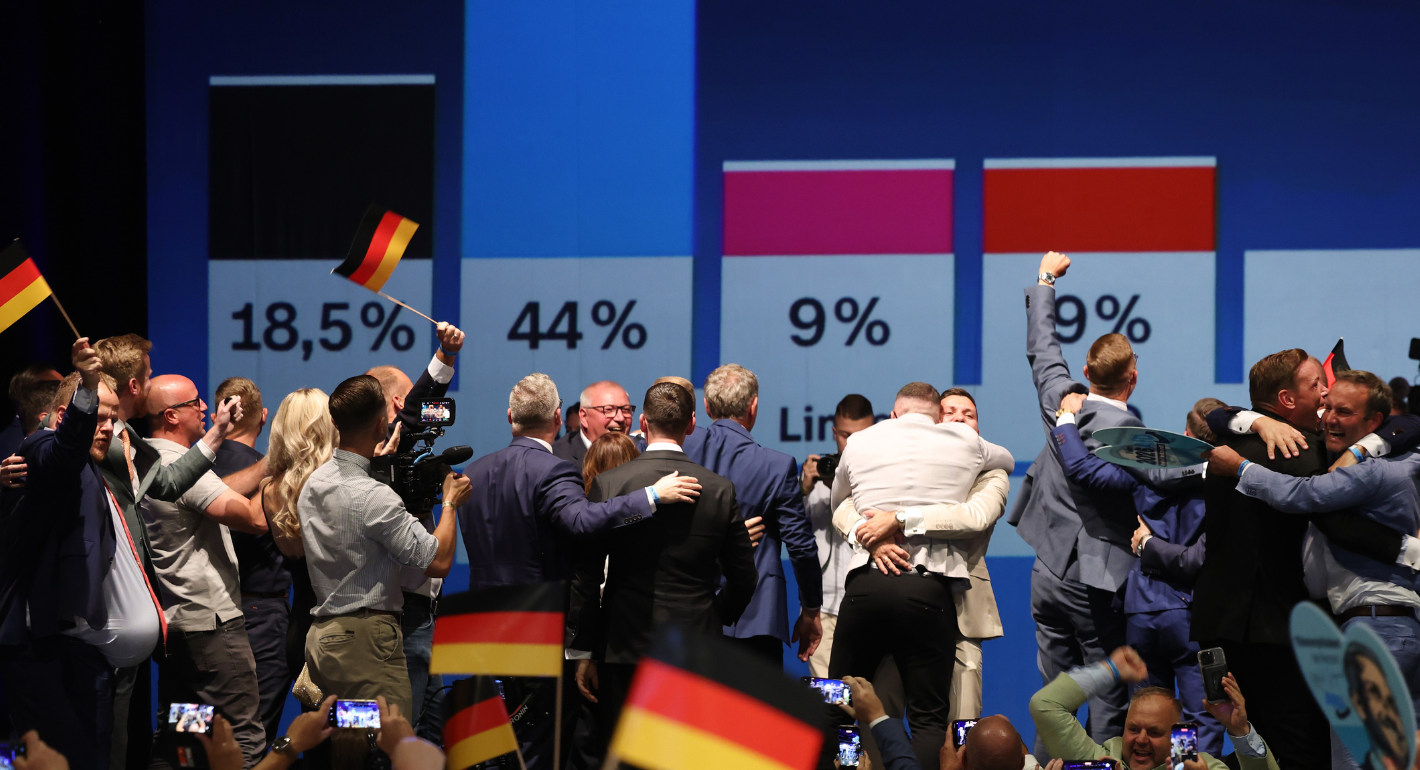
An overwhelming victory by a far-right-wing party in a small state in eastern Germany will have major repercussions for Chancellor Friedrich Merz’s coalition.

Judy Dempsey