

Commentary
The new U.S.–Denmark–Greenland agreement will help Washington exert political, economic, and financial dominance under the guise of security. Yet, it acknowledged Copenhagen’s and Nuuk’s sovereignty on the island.
Marc Pierini
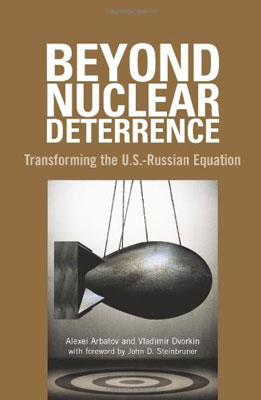
While deterrence as a concept has always been paradoxical, it is poorly equipped to handle today’s most significant nuclear challenges: proliferation and terrorism. Nuclear arms control must move beyond the deadlock of deterrence.
Source: Washington

For nearly fifty years—and the decade and a half since the end of the Cold War—deterrence has remained the central nuclear arms control policy between the United States, Russia, and other principal nuclear powers. The question today is: Has it outlived its usefulness?
In Beyond Nuclear Deterrence, two of Russia’s top nonproliferation and international security experts, Alexei Arbatov and Vladimir Dvorkin, critically assess the history of deterrence as it emerged between the Soviet Union and the U.S. and evolved through the Cold War to include an expanding nuclear club. The authors argue that while deterrence as a concept has always been paradoxical, it is poorly equipped to handle today’s most significant nuclear challenges: proliferation and terrorism. Nuclear arms control must move beyond the deadlock of deterrence. The U.S. and Russia need to take the first bilateral steps to remove mutual nuclear deterrence as the foundation of their strategic relationship and implement changes that can be exported internationally.
Alexei Arbatov is Scholar-in-Residence and Program Co-chair of Nuclear Nonproliferation at the Carnegie Moscow Center and head of the Center for International Security at the Institute for International Economy and International Relationships of the Russian Academy of Sciences.
Vladimir Dvorkin is a senior researcher at the Center for International Security at the Institute for World Economy and International Relations of the Russian Academy of Sciences and former director of the Fourth Central Research Institute in Moscow.
“Beyond Nuclear Deterrence helps us face the fact that we have been marking time in arms control since the signing of the CTBT in 1996 and that nuclear arms control and proliferation issues do not go away if ignored but tend to get more complicated and critical.”
—Jack Mendelsohn, Adjunct Professor, George Washington University and member of U.S. SALT II and START I delegations

Alexey Arbatov
Alexey Arbatov is the head of the Center for International Security at the Primakov National Research Institute of World Economy and International Relations.
Vladimir Dvorkin
Major General Dvorkin (retired) is a chief researcher at the Center for International Security at the Institute of World Economy and International Relations.
Carnegie does not take institutional positions on public policy issues; the views represented herein are those of the author(s) and do not necessarily reflect the views of Carnegie, its staff, or its trustees.

The new U.S.–Denmark–Greenland agreement will help Washington exert political, economic, and financial dominance under the guise of security. Yet, it acknowledged Copenhagen’s and Nuuk’s sovereignty on the island.

Marc Pierini

A summer of escalation in the Black Sea has hurt Ukraine economically and is exacerbating world food security. A truce is needed—as is a broader reframing of Europe’s Ukraine strategy.

Thomas de Waal

Are Germany’s economic, industrial, and political struggles becoming a liability for the EU’s ability to rise to the geopolitical moment?

Rym Momtaz, ed.

European Commission President Ursula von der Leyen is about to give her annual address on the state of the EU. Here’s what she won’t—but should—say.
Rym Momtaz

The aftermath of the Ceuta crisis shows Europe has drawn the wrong lessons. Rather than doubling down on failed migration policies, the EU needs to address the underlying roots of such episodes.

Richard Youngs