

Paper
Ashley J. Tellis
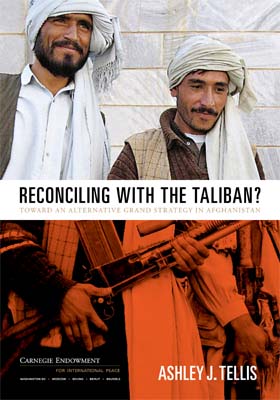
Negotiating with the Taliban is the worst possible approach the U.S. could adopt in its effort to stabilize Afghanistan. Instead, the U.S. must signal long-term commitment to rebuilding the nation.
Negotiating with the Taliban—who are convinced military victory is within sight—is the worst possible approach to stabilizing Afghanistan, and one that would fail. Ashley J. Tellis warns that U.S. signals of impatience and a desire for an early exit could motivate insurgents to maintain a hard line and outlast the international coalition. Though costly, a long-term commitment to building an effective Afghan state is the only way to achieve victory and defend U.S. national security objectives.
Key Conclusions:
Tellis explains:
“Mullah Omar and the Taliban leadership have decisively rejected any reconciliation with the government of Afghanistan. And the tribal chiefs, village elders, and street fighters, who either
support the insurgency or are sitting on the sidelines currently but are susceptible to being reconciled in principle, certainly will not take any steps in that direction so long as the Karzai regime, and its Western supporters, are not seen to be winning in their long-running battle against the Taliban. The coalition, therefore, is confronted by an inescapable paradox: any meaningful accommodation with those reconcilable segments of the rebellion will only come at the tail end of political-military success in Afghanistan and not as a precursor to it; yet, if such success is attained, reconciliation will become possible but, ironically, when it is least necessary.”
Former Senior Fellow
Ashley J. Tellis was a senior fellow at the Carnegie Endowment for International Peace.
Recent Work
Ashley J. Tellis
Ashley J. Tellis
Carnegie does not take institutional positions on public policy issues; the views represented herein are those of the author(s) and do not necessarily reflect the views of Carnegie, its staff, or its trustees.

Ahead of a tough winter for Ukraine, Donald Trump’s swing back toward Russia bodes ill. But instead of panicking, Kyiv’s European allies are focusing on action.

Rym Momtaz

Funding Ukraine remains a priority for European leaders. As Russia’s war of aggression heads into another winter, two feasible options to mobilize support for Kyiv should be fast-tracked.


Vladyslav Rashkovan, Gregory P. Wilson

While the EU and European governments are embracing the much-lauded middle-power moment, this entails three difficult conundrums.

Richard Youngs

Much has been said of the changes Brussels is trying to make to the EU enlargement process. Here’s why gradual integration might—or might not—be the answer.

Dimitar Bechev

The European Commissioner for Trade is headed to China. But after President Xi’s bridge-building visit to Washington, can a more isolated EU overcome Beijing’s stranglehold on critical raw materials? Who will blink first?
Rym Momtaz, ed.