

Commentary
Uri Dadush
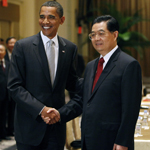
Source: Getty
The recent emphasis on the trade imbalance between the United States and China—which was high on President Obama’s agenda in Asia this week—is largely misplaced and diverts attention from more pressing domestic problems.
Imbalances between the United States and China were high on the agenda during Obama’s visit to China earlier this week. However, the emphasis is misplaced: U.S. and Chinese external imbalances are neither deeply interwoven nor obviously excessive. The focus on bilateral imbalances diverts attention from necessary domestic reforms and risks undermining international collaboration on more pressing issues.
U.S. and Chinese External Imbalances: No Strong Link
There is an urge to establish a causal link between the world’s largest current account surplus—held by China—and its largest deficit—that of the United States. This is especially tempting since the United States runs a large bilateral deficit with China, estimated to be in excess of $200 billion in 2009.
However, three other factors affect the external imbalances of these two countries more than the two could possibly affect each other.
U.S.–China imbalances do not so much “cause” each other as reflect other external factors.
First, current account balances are only the residual of much larger flows of domestic savings and investment, which are driven predominantly by domestic forces. For instance, if U.S. savings decline, but U.S. domestic investment does not, the U.S. current account deficit must increase. Such shifts are predominantly determined in the United States—not in China, or any other country. The same line of argument applies in China.
Second, foreign investment decisions are playing an increasingly important role in total investment. Current account balances must equal outward foreign investment (in the case of a surplus) or inward foreign investment (in the case of a deficit). This means, for instance, that if foreigners decide to invest more in the United States, the U.S. current account deficit must rise, unless something else changes. At the end of 2008, foreigners held U.S. assets equal to about 160 percent of U.S. GDP, but only a tiny fraction of these—5 percent—were held by China. In general, China’s role in these markets, though increasing, remains small.
Third, the United States and China only account for 20 percent of world trade, and they trade with some 200 other countries that account for the remaining 80 percent. Their bilateral trade accounts for just 3 percent of world trade. A 10 percent increase in Chinese imports will, other things equal, result only in a 0.7 percent increase in U.S. exports and less than 0.1 percent increase in U.S. GDP.
Thus, U.S.–China imbalances do not so much “cause” each other as reflect other external factors.
Important External Factors
What factors were at work prior to the crisis? In the United States, household savings as a share of household income declined to near zero as house and stock prices soared, making consumers feel wealthier. National savings also declined as government deficits increased. At the same time, the investment rate remained fairly stable. This combination gave rise to current account deficits of 5–6 percent of GDP.
Reducing external imbalances, if desirable, can only be achieved if domestic policies and household behavior change.
At the same time, in China, national savings rates increased, reaching an astronomical 52 percent of GDP in 2006. This rise reflected high corporate profits and retained earnings, as well as increasing government savings. Yet domestic investment in China moderated as the government tried to rein in extremely rapid growth. As a result, Chinese savings rose more than investment and the current account surplus increased, reaching nearly 11 percent of GDP in 2007.
These developments are connected only in that both countries were responding to an extended period of high global growth. The United States chose to increase its share of spending out of income and China did the opposite. Once the crisis erupted, the reverse occurred, and both U.S. deficits and Chinese surpluses declined.
Reducing external imbalances, if desirable (see below), can only be achieved if domestic policies and household behavior change. Exchange rate changes by themselves are likely to play only a minor role. Although the yuan looms large in the U.S.–China debate, changes in the exchange rate—or any other factor that affects the Chinese surplus—will have only a small effect on the U.S. deficit as China’s surplus represents less than 3 percent of U.S. GDP. In addition, other countries can increase exports to the United States if those from China decline, and increase their exports to China as China’s imports grow.
U.S. and Chinese Imbalances: Not Obviously Excessive
There is also a strong tendency to brand these external imbalances as excessive. However, the evidence for this is mixed at best.
In 2009, the U.S. current account deficit is projected at just 2.6 percent of GDP and China’s surplus at 6 percent of GDP. However, even before the crisis, when the U.S. deficit and China’s surplus were about twice as large as they are now, they were not remarkable compared to those of other countries. Expressed as a share of GDP, China’s surplus ranked 22nd among surplus countries, and the United States was 29th among deficit countries. In the last decade, current account deficits and surpluses have about tripled on average, reflecting increased financial and trade integration.
Rising U.S. government debt and low household savings are both serious problems—much more serious than external imbalances.
Prior to the crisis, a U.S. balance of payments crisis was repeatedly predicted. Yet, even though the financial crisis started there, the United States continued to finance its deficit easily, the dollar even appreciated initially, and Treasury Bill yields declined to record lows.
Bearing in mind that the real riskless borrowing rate in the United States has typically been in the range of 1–2 percent, and that the United States consistently ranks as a top investment destination, current account deficits in the United States may reflect the fact that it is profitable to invest there. Similarly, given that China’s domestic investment rate is already close to 40 percent of GDP—among the highest in the world—and that China typically ranks only in the middle of investment destinations, China’s current account surplus may reflect the profits Chinese residents stand to reap by investing overseas.
Worrying Domestic Imbalances
However, there are major domestic policy challenges that policy makers in the United States and China have to address. These challenges are only indirectly related to external imbalances.
Rising U.S. government debt and low household savings are both serious problems—much more serious than external imbalances. Fixing them once the crisis emergency is over will require measures to encourage household savings, as well as domestic fiscal reforms. To increase revenues, the United States could introduce a Value Added Tax of 15–20 percent, eliminate the mortgage tax credit, or introduce a tax on carbon or gasoline. These are politically thorny options, but considering them will do much more for U.S. macroeconomic imbalances than any conceivable adjustment from China.
The role of international coordination in dealing with these domestic imbalances is inherently limited.
At first glance, the arguments for lowering China’s high national savings rate are not as compelling. In fact, Chinese consumption has been rising at 8 to 9 percent a year for many years now, two and half times faster than in the United States. However, distortions, including very low dividend requirements in state companies and artificially low interest rates on consumer deposits, artificially inflate the high savings rate.
China could look to better social safety nets, financed by reduced government surpluses, to reduce savings. The easiest available step, appreciating the yuan, would—in combination with these measures—boost consumer incomes and encourage spending.
These measures may also help reduce Chinese and U.S. external imbalances, but that is not inevitable. If, as a result of these reforms, the United States becomes a more attractive investment destination, or China a less attractive one, the net result may be domestic rebalancing of consumption and investment with little change in external balances.
International Coordination Needed Elsewhere
Rather than focus on reducing external imbalances, the United States and China should address the tough policy decisions needed at home. The role of international coordination in dealing with these domestic imbalances is inherently limited. Instead, the international community should collaborate in other areas, such as coordinating stimulus policies, reducing trade friction, and, last but not least, developing a common approach to climate change.
Uri Dadush is a senior associate in and the director of Carnegie’s International Economics Program.

Former Senior Associate, International Economics Program
Dadush was a senior associate at the Carnegie Endowment for International Peace. He focuses on trends in the global economy and is currently tracking developments in the eurozone crisis.
Recent Work
Uri Dadush
Uri Dadush
Carnegie does not take institutional positions on public policy issues; the views represented herein are those of the author(s) and do not necessarily reflect the views of Carnegie, its staff, or its trustees.

The aftermath of the Ceuta crisis shows Europe has drawn the wrong lessons. Rather than doubling down on failed migration policies, the EU needs to address the underlying roots of such episodes.

Richard Youngs

Canadian Prime Minister Mark Carney has twice inspired praise for standing up to U.S. President Donald Trump: at the 2026 World Economic Forum in Davos and on Canada-U.S. trade negotiations. Is Carney showing a third way better than the EU has in dealing with the Trump administration?

Rym Momtaz, ed.

The EU’s responses to two recent incidents expose the gulf between European perceptions and capabilities. Unless the union can bridge that gap, it will never become a real geostrategic power.
Rym Momtaz

European states control several Overseas Countries and Territories around the world that carry strategic, economic, and environmental weight. As great powers challenge the rules-based order, defending them is a geopolitical imperative for Europe.

Marc Pierini

In supporting Europe’s far-right, MAGA and Russia both want the same thing: a weaker EU. Europe must defend itself without abandoning the openness these forces exploit.

Armida van Rij