

Commentary
Are Germany’s economic, industrial, and political struggles becoming a liability for the EU’s ability to rise to the geopolitical moment?
Rym Momtaz, ed.
Source: Getty
The U.S. Nuclear Posture Review offers a number of hints on how Washington might influence the future of NATO's nuclear policy.
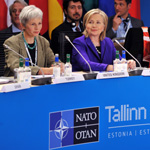
Last week, the foreign ministers of NATO’s 28 member states gathered in Estonia for informal talks. There was one especially controversial issue on the agenda: the future of NATO’s nuclear policy. Included in the discussions was the question of whether NATO should continue to rely on the approximately 200 U.S. B-61 nuclear bombs stored in Europe as part of U.S. extended deterrence.
The message of the meeting does not herald any far-reaching change. The problem will be further discussed until a consensus is found within NATO. In theory, all options are still on the table. But in practice, a compromise seems to be in the making at NATO--one which would seriously disappoint the proponents of an early withdrawal, but is the only solution which would prove acceptable to all of NATO’s member states.
The position of the United States is crucial to chart NATO’s course on this issue. The recently released U.S. Nuclear Posture Review (NPR) offers a number of hints on how Washington might influence the alliance’s nuclear strategy towards a gradual change rather than a revolution.
As a flurry of reports and articles would have it, NATO is deeply divided on the issue of U.S. nuclear weapons deployed in Europe. On the one hand, we have a group of enlightened disarmers who follow President Barack Obama’s call for nuclear disarmament. Germany emerged as the most vocal representative of this group when it requested last year NATO consultations on the removal of nuclear weapons from its territory. On the other hand, there are supposed to be the Cold War warriors of Central and Eastern Europe, quietly backed by Turkey, who perhaps irrationally believe that these weapons would somehow come in handy if they ever get into a conflict with Russia.
The main problem with this description is that it is terribly oversimplified. Of course, there are some in Central Europe who interpret even discussing the withdrawal as a sign that the U.S. is abandoning its European allies, but there is a growing recognition that it is no longer possible to continue with nuclear “business as usual.” Still, many in the region would argue that NATO should not make unilateral decisions based on the recent wave of disarmament enthusiasm, but rather approach the issue of tactical nuclear weapons in Europe in a holistic way. This calls for keeping an eye on the developments in the Middle East, but mainly for making a serious attempt to engage Russia, which stores non-strategic nuclear weapons on the European part of its territory in much greater numbers than the United States.
In short, the question is not if, but how to proceed with reductions and, ultimately, the withdrawal. Poland has recently teamed up with Norway to propose a set of proposals aimed at addressing the issue of the sub-strategic nuclear weapons in a larger framework of European arms control issues. The joint communiqué from the April 9 meeting of the Polish and Norwegian foreign ministers suggests a “step-by-step approach, including transparency and confidence-building measures as well as balanced and mutual arms reductions.” Released after a New York Times op-ed signed by Polish and Swedish foreign ministers, which called nuclear weapons in Europe “dangerous remnants of a dangerous past,” this initiative aims at transforming an internal NATO debate into a subject to be tackled jointly by NATO and Russia.
As for the United States, the 2010 NPR report gives at least some clarity as to where the Obama administration stands on the issue. Even though it repeats the mantra about leaving all options open, the NPR seems to place the U.S. in the group of countries opposed to the unilateral withdrawal of nuclear weapons from Europe.
By highlighting the political value of the weapons deployed in Europe, which “contribute to Alliance cohesion” and “provide reassurance” to some allies, and also by mentioning the “unique” NATO nuclear sharing arrangements, the U.S. NPR signals that the time is not ripe for any radical decisions. Since it does not want to apply pressure on some skeptical allies, it looks like the Obama administration decided to play it safe and not support a German-led charge to fundamentally alter NATO’s nuclear policy.
What does this mean for NATO? It would probably need to start working on an offer to Russia to discuss the ultimate withdrawal of all sub-strategic nuclear weapons from Europe, with some added transparency and confidence-building measures to get Russia’s attention and jumpstart the process. NATO would also need to acknowledge that until meaningful progress with Russia is made, U.S. nuclear weapons would stay in Europe, although the countries which no longer wish to host them could be quietly relieved from this duty. On a parallel track, if NATO wants to gradually phase out the sub-strategic nuclear weapons from its arsenals, it should beef up its non-nuclear deterrence capabilities, including both offensive and defensive systems.
Lukasz Kulesa is an international security analyst and Deputy Head of the Research Office at the Polish Institute of International Affairs (PISM), Warsaw.

Lukasz Kulesa
Director, Proliferation and Nuclear Policy, Royal United Services Institute
Łukasz Kulesa is the deputy head of research at the Polish Institute of International Affairs (PISM).
Carnegie does not take institutional positions on public policy issues; the views represented herein are those of the author(s) and do not necessarily reflect the views of Carnegie, its staff, or its trustees.

Are Germany’s economic, industrial, and political struggles becoming a liability for the EU’s ability to rise to the geopolitical moment?

Rym Momtaz, ed.

European Commission President Ursula von der Leyen is about to give her annual address on the state of the EU. Here’s what she won’t—but should—say.
Rym Momtaz

Radical-right parties are expected to do well in upcoming elections in four of the EU's biggest member states. If successful, they could prevent the union from addressing key challenges ahead.

Stefan Lehne

An overwhelming victory by a far-right-wing party in a small state in eastern Germany will have major repercussions for Chancellor Friedrich Merz’s coalition.

Judy Dempsey

Canadian Prime Minister Mark Carney has twice inspired praise for standing up to U.S. President Donald Trump: at the 2026 World Economic Forum in Davos and on Canada-U.S. trade negotiations. Is Carney showing a third way better than the EU has in dealing with the Trump administration?
Rym Momtaz, ed.