

Commentary
Before the next wave of EU enlargement takes place, the union needs to grapple with thorny questions of how power is distributed among its members.
Emil Sondaj Hansen, Ditte Brasso Sørensen
Source: Getty
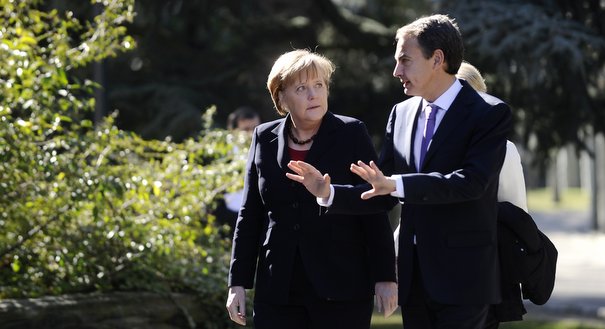
Angela Merkel hopes that the Eurozone crisis will bring about greater economic and political union for Europe, and she is acting to drive public debate to reach the same conclusion.
Angela Merkel likes to tell a story of how, at the age of twelve, she spent a 45-minute swimming lesson shivering at the wrong end of the diving board. Ignoring the cajoling of schoolmates, she weighed the pros and cons of jumping and, just before the bell sounded, leaped into the water below.
Four decades on, the eurozone crisis has the German leader on another springboard. Whether it was bailing out Greece or establishing temporary or permanent bailout funds, the German leader has watched, waited, and, at the last minute, made a political leap.
For her critics, every delayed decision provides further proof that the German leader is reacting rather than acting in the crisis. Ask Merkel why she acts as she does, though, and you get a remarkably frank answer. “I'm the kind of person who waits until a decision is ripe for the making, then decides,” she said recently. After months of watching and waiting, there is a definite sense that the pieces of Merkel's eurozone puzzle are falling into place. Is she about to leap?
Since the start of the eurozone crisis, a plaintive cry has echoed through the European debate: “What does Germany want?” Angela Merkel is not the world's greatest communicator, but her answer is simple, for anyone who cares to listen: in exchange for German financial assistance to its neighbors, she wants to have one final go at completing the European Union. After it was decoupled along the way for reasons of political expediency, the German leader is nudging the EU toward so-called finalité by reattaching the political carriage to the existing monetary union locomotive.
For many in the union this is not an appetizing prospect. And so after complaining that Merkel is doing too little in the crisis—Germany has lost its European vocation—they switch gears and complain that the EU is now subject to a German diktat. So which is it?
After months of watching and waiting, Merkel is readying herself. Minutes after Germany’s highest court in Karlsruhe backed limited EU bailouts earlier this month, Merkel gave her most stirring speech in memory. She made a clear call for greater economic and political union to reverse "decades of false philosophy" of debt-fuelled growth.
“The message was that growth was the main thing, regardless of cost and with debt if need be. Then pay nothing back in the good times—decades of debt is what we are dealing with today.”
In the Merkel world view, debt is the weed choking the eurozone. Austerity and reforms are the weed killer. Economic governance is the best way to keep the garden weed free.
This absolutist thinking annoys many of Germany's neighbors. They accuse Germans of being debt-obsessed austerity absolutists, something that is not the case at all. The German political scene is, economically, a far wider church than many realize. In the same Bundestag debate, the opposition Social Democrat (SPD) leader Sigmar Gabriel, for instance, tore up Merkel's austerity prescription for the eurozone. “We need the famous magic square...balancing price stability, economic growth, a high employment rate, and foreign trade balance—that is the right answer in Europe," he said.
Despite his economic disagreement, however, the SPD leader agrees with the German leader that Berlin should make its bailout support conditional on greater EU fiscal and budgetary oversight in Europe. If anything, the SPD under Gabriel is critical, arguing that Merkel has not gone far enough, fast enough.
“To whom should indebted member states hand over their competences?” asked Gabriel. “To a common, democratically-legitimized EU? Or to anonymous finance markets that, at this stage, bet against anything that promises a quick profit?”
Make no mistake: weeks after Helmut Kohl complained about Germany's “directionless” European politics, Berlin's EU debate has roared back to life. Most interestingly is the revival of a two-speed Europe re-entering the German debate. Finance Minister Wolfgang Schäuble, who proposed the idea fifteen years ago, favors a eurozone core pursuing tighter economic governance but is coy about a feasible timeframe. Former chancellor Gerhard Schröder less so: in Der Spiegel he urged Merkel “not to hang around” any longer but to establish a eurozone core to drive closer political and fiscal union, leaving a noncommittal Britain outside the door. To do that, the EU needs new rules in a new treaty. So on Wednesday, Merkel told the Bundestag she wanted to make economic reforms obligatory and budgetary oversight binding—either for the EU of 27 or, if that is politically impossible, then the eurozone of 17. It is time to “drop the taboo” of treaty change, she said. Then repeating her mantra of the eurozone crisis, she warned: “If the euro fails, Europe fails.”
As Merkel prepares for her political leap, however, clouds are forming on the horizon. The September 29 parliamentary vote to expand the eurozone's temporary bailout fund could be tight; the vote to establish the permanent European Stability Mechanism bailout fund, scheduled for early next year, even tighter.
Angela Merkel has done quite a good job of keeping the eurozone reform debate on track, balancing her European obligations with domestic realities. Polls show that Germany is divided on Europe: while two thirds of Germans oppose concrete measures like EU bailouts, a slim majority still supports closer European integration.
Angela Merkel is walking a narrow line with two dangers looming. The first is a German economic slowdown: promising multi-billion euro solidarity in exchange for greater integration is just about possible in a boom, committing to bailouts in an economic slowdown is a political disaster. The German leader knows that her political leverage for closer EU integration is inextricably linked to the health of the German economy and that the window to act is closing.
The second danger for Merkel is her coalition partner, the Free Democratic Party (FDP). Flatlining in the polls, they appear to have decided that exploiting growing German unhappiness with bailing out Greece is the best way to save their political skin. This could cause serious instability and possibly sink her coalition, so Merkel will have to employ greater skill to keep her ship afloat.
Just because the German leader is not shouting it from the masthead—she’s not much of a shouter—Angela Merkel has a very clear idea of where she wants the eurozone crisis to end: in an EU of intertwined political and monetary union. In the EU backroom, she held a strong enough hand to get things moving in this direction. Now the German leader has to drive the public debate as far as possible in the same direction before the wind changes.
But make no mistake: the EU has joined Merkel on a metaphorical springboard and she is poised for an all-or-nothing political leap.
Derek Scally is Berlin Correspondent for the Irish Times.
Derek Scally
Carnegie does not take institutional positions on public policy issues; the views represented herein are those of the author(s) and do not necessarily reflect the views of Carnegie, its staff, or its trustees.

Before the next wave of EU enlargement takes place, the union needs to grapple with thorny questions of how power is distributed among its members.


Emil Sondaj Hansen, Ditte Brasso Sørensen

The new U.S.–Denmark–Greenland agreement will help Washington exert political, economic, and financial dominance under the guise of security. Yet, it acknowledged Copenhagen’s and Nuuk’s sovereignty on the island.

Marc Pierini

A summer of escalation in the Black Sea has hurt Ukraine economically and is exacerbating world food security. A truce is needed—as is a broader reframing of Europe’s Ukraine strategy.

Thomas de Waal

Are Germany’s economic, industrial, and political struggles becoming a liability for the EU’s ability to rise to the geopolitical moment?

Rym Momtaz, ed.

European Commission President Ursula von der Leyen is about to give her annual address on the state of the EU. Here’s what she won’t—but should—say.
Rym Momtaz