

Commentary
As we close out another season of Strategic Europe, it is worth taking stock of the deep shifts underway.
Rym Momtaz
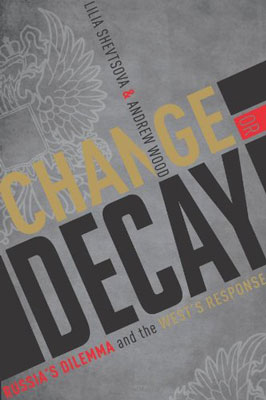
Two decades after the collapse of the Soviet Union, the West has yet to adjust to the post-Soviet reality and Russia has not settled on its relationship with the rest of the world.
Source: Washington
The world is still coping with the consequences of the collapse of the Soviet Union. Two decades later, the West has yet to adjust to the post-Soviet reality and Russia has not settled on its relationship with the rest of the world.
In Change or Decay, two of the most respected scholars on Russia analyze how relations are shifting between Russia and the world. In a series of lively and candid conversations, Lilia Shevtsova and Andrew Wood discuss how the Russia of Putin and Medvedev emerged from the ashes of the Soviet Union and the trajectory of Russia’s relations with the West.
“This book attacks the widely held myths and illusions that have for so long governed both the evolution of Russia and the ideas of Russia held by the outside world. It’s a lively book made still better by flashes of humor. You may agree with it, or dispute it. You may like some of it, and hate the rest. But read it.”
—Mikhail Gorbachev, former president of the Soviet Union, Nobel Peace Prize winner, and president of the Gorbachev Foundation

Former Senior Associate, Russian Domestic Politics and Political Institutions Program, Moscow Center
Shevtsova chaired the Russian Domestic Politics and Political Institutions Program at the Carnegie Moscow Center, dividing her time between Carnegie’s offices in Washington, DC, and Moscow. She had been with Carnegie since 1995.
Andrew Wood
Carnegie does not take institutional positions on public policy issues; the views represented herein are those of the author(s) and do not necessarily reflect the views of Carnegie, its staff, or its trustees.

As we close out another season of Strategic Europe, it is worth taking stock of the deep shifts underway.

Rym Momtaz
The hybrid warfare landscape is evolving rapidly, leaving policymakers without clear strategies. To better inform their work in addressing emerging challenges, governments must dig deeper into the underlying dynamics at play.


Raluca Csernatoni, Alicia Wanless
The EU had to compromise to adopt a twenty-first sanctions package against Russia, exposing growing cracks in the union’s resolve. Is this latest, weaker round worth it to keep pressure on Moscow?
Rym Momtaz, ed.

Trump is distracted and Ukraine wants Europe to step up. The continent’s leaders must find their voice and assert it in talks with Russia.

Alissa de Carbonnel

Mounting economic strain and battlefield losses will not necessarily make the Kremlin less dangerous. They could instead push Moscow toward a more aggressive hybrid campaign designed to test NATO’s Eastern flank, exploit allied hesitation, and fracture European resolve.

Maksym Beznosiuk