• Research
  • Strategic Europe
  • About
  • Experts
Carnegie Europe logoCarnegie lettermark logo
EUUkraine
  • Donate
Tunisia’s Lessons for the Arab World

Source: Getty

Article

Tunisia’s Lessons for the Arab World

By holding largely peaceful elections just ten months after the fall of its long-time dictator, the country credited with sparking the waves of protest that swept the Arab world is serving as an example to the rest of the region.

Link Copied
By Marwan Muasher
Published on Nov 1, 2011
Project hero Image

Project

Eurasia in Transition

Learn More
Project hero Image

Project

Tunisia Monitor

Carnegie’s Tunisia Monitor project tracks the status of the country’s transition in the economic, political, and security spheres. This project provides original analysis and policy recommendations from a network of Tunisian contributors and Carnegie experts to inform decisionmakers in Tunisia, Europe, and the United States. This endeavor is supported by a grant from the Open Society Foundations.

Learn More

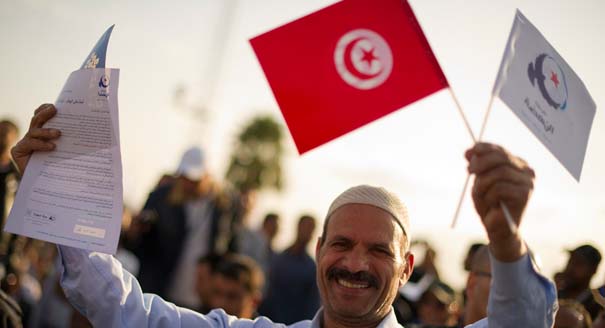
In the first test of the Arab Awakening, a moderate Islamist party received the largest number of votes, secularist parties accepted the results, and discussions began on forming a unity government—all optimistic signs for a new democracy in Tunisia. By holding largely peaceful elections just ten months after the fall of its long-time dictator, the country credited with sparking the waves of protest that swept the Arab world is serving as an example to the rest of the region.

As an international observer in Tunisia during the election, I am optimistic about what the vote means for the future of the country. I saw a politically engaged society with a real sense of responsibility about what the elections will mean, not only for the country, but also for the prospect of democracy in the Arab world. With the eyes of the world upon them, Tunisians showed the world that legitimate elections can take place in a region long constrained by authoritarianism. 
 
Tunisia’s experience points to five important lessons that should be remembered as other countries in the Middle East and North Africa move to fresh elections. 
 
High turnout. Ninety percent of registered voters in Tunisia voted in the October election, a number unheard of in the Arab world. I watched Tunisians patiently stand in long lines in the blazing sun, sometimes for three or four hours, to cast their vote. This directly contradicts arguments that Arab voters are apathetic and shows that when voters know that the process is fair and transparent, they will show up. 
 
Independent commission. Tunisians should be commended for setting up the first truly independent body to monitor an election, from start to finish, in the Arab world. Traditionally this role falls to the ministry of interior, an organization that clearly has bias in the outcome and generally impedes the fairness of elections in a variety of ways. Despite having no previous experience, Tunisia’s commission ran a generally smooth process and was able to gain the trust of the people and the candidates. While the commission did experience some technical problems, there is no doubt about their impartiality and the fairness and effectiveness of the election. This is an important model for the rest of the Arab world to emulate as other elections proceed. In fact, Egypt has already appointed an independent commission of judges—a positive sign. 
 
Neutrality of the army. It’s a telling sign that the names of Tunisia’s leading military officials are not widely known in the West. This points to the army’s role—or lack thereof—in the election. Tunisia’s military played a very important function in protecting polling stations, but did not interfere. In fact, the military did not even vote in the elections. By playing the protector, not the interferer, Tunisia’s military helped safeguard its blooming democracy. 
 
Political consolidation. As we saw in similar post-authoritarian elections like Portugal and Spain in the 1970s, Tunisia had a high number of registered parties. But there were only five or six parties that received significant support. For a democratic culture to emerge, a country needs to consolidate the different points of view into a manageable set of issues. It will be important to see how Tunisia’s political parties progress, but the early signs of government formation are positive.
 
Political Islam. Ennahda, who received about 40 percent of the vote, is a moderate Islamist party that campaigned on a commitment to personal freedom and pluralism. The extent that they are able to enshrine these commitments into the constitution that will be written over the next year will go a long way to showing the rest of the Arab world and the international community that political Islam does not necessarily mean a resort to violence, negation of personal rights, or imposition of cultural values on all of society. It is therefore important to treat political Islam as a legitimate part of the political system that has every right to be included, as long as it does not threaten a commitment to pluralism.  
 
The next major test of the Arab Awakening will be parliamentary elections in Egypt, the Arab world’s most populous country. Based on the experience of Tunisia, there are many reasons to be positive about the prospect for democracy in the Arab world. But Egypt is very different, particularly with the role its military is playing in the transition. The developments there will be watched very closely. The biggest challenge for all of the Arab world is to build pluralistic systems with checks and balances that can truly result in prosperous societies. Tunisia has taken its first step in this direction.  

About the Author

Marwan Muasher

Vice President for Studies

Marwan Muasher is vice president for studies at Carnegie, where he oversees research in Washington and Beirut on the Middle East. Muasher served as foreign minister (2002–2004) and deputy prime minister (2004–2005) of Jordan, and his career has spanned the areas of diplomacy, development, civil society, and communications.

    Recent Work

  • Commentary
    Bombing Campaigns Do Not Bring About Democracy. Nor Does Regime Change Without a Plan.

      Marwan Muasher

  • Other
    Unpacking Trump’s National Security Strategy
      • Cecily Brewer
      • +18

      James M. Acton, Saskia Brechenmacher, Cecily Brewer, …

Marwan Muasher
Vice President for Studies
Marwan Muasher
North AfricaTunisiaMaghrebPolitical ReformDemocracy

Carnegie does not take institutional positions on public policy issues; the views represented herein are those of the author(s) and do not necessarily reflect the views of Carnegie, its staff, or its trustees.
More Work from Carnegie Europe

  • Commentary
    Is the Radical-Right Threat Existential or Overstated?

    Amid increased polarization and the influence of disinformation, radical-right parties are once again gaining traction across Europe. With landmark elections on the horizon in several countries, are the EU’s geostrategic vision and fundamental values under existential threat?

      Catherine Fieschi, Cas Mudde

  • Commentary
    Strategic Europe
    The EU Needs a Third Way in Iran

    European reactions to the war in Iran have lost sight of wider political dynamics. The EU must position itself for the next phase of the crisis without giving up on its principles.

      Richard Youngs

  • Research
    New Approaches to Defending Global Civil Society

    New thinking is needed on how global civil society can be protected. In an era of major-power rivalry, competitive geopolitics, and security primacy, civil society is in danger of getting squeezed – in some countries, almost entirely out of existence.

      Richard Youngs, ed., Elene Panchulidze, ed.

  • Commentary
    Strategic Europe
    How Europe Can Survive the AI Labor Transition

    Integrating AI into the workplace will increase job insecurity, fundamentally reshaping labor markets. To anticipate and manage this transition, the EU must build public trust, provide training infrastructures, and establish social protections.

      Amanda Coakley

  • Commentary
    Strategic Europe
    Can Europe Still Matter in Syria?

    Europe’s interests in Syria extend beyond migration management, yet the EU trails behind other players in the country’s post-Assad reconstruction. To boost its influence in Damascus, the union must upgrade its commitment to ensuring regional stability.

      Bianka Speidl, Hanga Horváth-Sántha

Get more news and analysis from
Carnegie Europe
Carnegie Europe logo, white
Rue du Congrès, 151000 Brussels, Belgium
  • Research
  • Strategic Europe
  • About
  • Experts
  • Projects
  • Events
  • Contact
  • Careers
  • Privacy
  • For Media
  • Gender Equality Plan
Get more news and analysis from
Carnegie Europe
© 2026 Carnegie Endowment for International Peace. All rights reserved.