

Commentary
Trump is distracted and Ukraine wants Europe to step up. The continent’s leaders must find their voice and assert it in talks with Russia.
Alissa de Carbonnel
Source: Getty
Although China has a vital interest in developing Africa’s natural resources, it is not just on a resource hunt in the region. Moreover, the adverse impacts of its rising exports are also limited.

True, China is a large user of commodities and has a vital interest in developing Africa’s natural resources, but it is not just on a resource hunt. Moreover, the adverse impacts on Africa of China’s increased exports, both in internal and external markets, appear to be limited to specific industries such as garments. And despite their differences in priorities and approaches, China and the United States can complement each other in some areas. Africa has much to gain if it uses its leverage wisely.
While the United States and European Union (EU) still remain Africa’s leading trade, investment, and aid partners, over the past decade China has emerged as an influential player in Africa. Starting from a low level, Africa’s goods exports to China increased more than 60-fold between 1998 and 2010, compared to a fivefold and threefold increase to the United States and EU, respectively. As a result, China’s share of Africa’s exports has increased from a mere 1 percent to about 15 percent in just one decade. Though the EU saw its share of Africa’s exports decline from nearly 36 percent to 23 percent, the U.S. share increased slightly.
China’s investments in Africa have also surged, reaching $5.5 billion in 2008, up from just $70 million in 2003. However, since 2005, China has on average accounted for only 5 percent of annual foreign direct investment (FDI) flows to the continent, considerably smaller than investment from the United States and EU, which together accounted for more than 30 percent of annual FDI flows to Africa, the rest includes intra-regional flows. But China’s total investment in Africa is likely higher than what the official figures suggest, as Chinese investment involves state-owned enterprises that use a range of financing instruments, such as export credits, which are not included in FDI figures.1
China has also become a major source of foreign aid to Africa, complementing its trade and investment activities. The volume of Chinese aid is undisclosed, but according to some estimates, its concessional loans to Africa have grown from a cumulative total of $800 million in 2005 to a commitment of $10 billion between 2009 and 2012. By contrast, the World Bank’s annual lending to Africa has averaged $4.5 billion a year since 2006.
China has a vital interest in Africa’s resources, as do many other countries. For example, about one-fourth of China’s total crude oil imports originate in sub-Saharan Africa and more than two-thirds of Africa’s exports to China consist of crude oil.
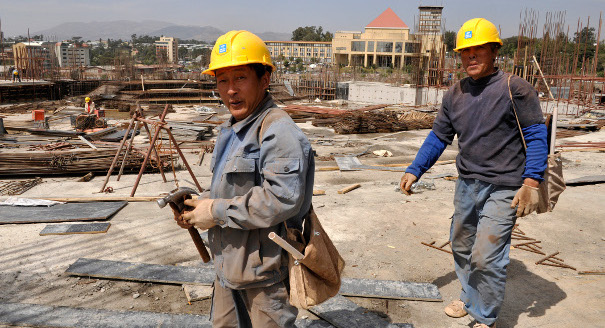
But Chinese investment covers a wide range of sectors including infrastructure, education, and information technology. These investments can benefit Africa and all of its trading partners. For example, in 2009, only 29 percent of Chinese FDI went to the mining sector, while more than half was in the manufacturing, finance, and construction industries. By contrast, the mining sector accounted for nearly 60 percent of U.S. FDI to Africa in 2009. According to the Economist, in Ethiopia, for example, two out of three resident Chinese firms are manufacturers. Chinese non-resource investments are largely market seeking.
China’s investment also reaches nearly all the continent’s countries. Since 2003, resource-rich economies on average have received only 37 percent of Chinese FDI outflows into Africa. In non-resource-rich economies such as Zambia and Tanzania, the Chinese have made significant investments in manufacturing and established industrial zones that produce, for example, pharmaceuticals and tires.
China’s rising low-cost manufacturing exports may well have contributed to lower manufacturing prices in third markets, eroding the competitiveness of Africa’s exports alongside those of many other low-wage developing countries.
But Chinese and African exports overlap in only a few industries such as clothing and textiles, which suggests limited competition in third markets. For example, the export similarity index, a measure of the extent to which exports overlap, is only 7.3 percent between Africa (excluding South Africa) and China (see figure). In addition, manufactures account for only 20 percent of Africa’s exports, as compared to China’s 95 percent, suggesting that China provides little competition to Africa’s exports.

Furthermore, the improvement in Africa’s terms of trade―which have increased by 4.3 percent on average between 2000 and 2008―can be partly attributed to China’s rise as a big commodity importer. Commodity prices are primarily determined by global demand growth, and China has accounted for more than 20 percent of global demand growth since 2000.
China’s low-cost manufacturing exports have undercut local manufacturing firms, especially those engaged in the labor-intensive production of clothing and footwear. For example, in Ethiopia, one study of 96 domestic producers found that Chinese competition forced 28 percent of them into bankruptcy and 32 percent to downsize activity. But, there is also evidence that suggests that most of China’s exports to Africa have substituted for products already being imported by Africa, implying little displacement of domestic manufacturers.
China’s exports to Africa also enable access to inexpensive, if sometimes lower quality, goods, for example, electronics and toys, raising purchasing power and improving the quality of life. The United States and EU, whose comparative advantage is in expensive branded products, typically provide higher priced goods designed for higher income segments. Africa imports Chinese clothes and cars that are typically at half the price of Western ones.
Concerns are sometimes voiced that China is displacing the United States, one of Africa’s traditional partners as a donor, and that this may be harmful to both Africa and the United States. But the idea that China is replacing the need for U.S. assistance is a myth.
In practice, China and the United States have very different approaches to the continent. China’s activities are generally more commercial—most of its aid comes in the form of low-interest loans, for instance—and it adheres to a “noninterference policy” in African politics. U.S. aid is often conditional and the United States is more frequently involved in Africa’s internal political affairs.
The United States also still provides far greater aid than China. In 2009, it gave $8 billion in assistance to Africa, while China gave an estimated $1.4 billion (see figure).

To be sure, comparing Chinese aid with Western aid is difficult, as China’s aid is often part of a larger package of investments and trade deals with African governments. It is important to distinguish between official development assistance and these other state-sponsored loans, which include export buyers’ credits, official loans at commercial rates, and strategic lines of credit to Chinese companies.
But there are some ways in which China’s economic cooperation with Africa clearly supplements the United States. Chinese and American aid flows tend to be directed toward different sectors. U.S. aid to Africa is mainly directed toward supporting public health programs, democratization efforts, counterterrorism cooperation, the development of health infrastructure, and improved regulatory institutions. By contrast, the World Bank reports that over two-thirds of African economies now have a financial agreement with the Chinese that funds infrastructure development.
The Chinese also invest in high-risk and post conflict countries such as Burundi and Sierra Leone that Western investors tend to avoid. While Chinese involvement in countries with conflict is not free from criticism, according to China-Africa scholar Deborah Brautigam, China’s resource-backed infrastructure loans are a good method of finance for countries with weak governance because little cash changes hands and an “agency of restraint” is created.
Africa has much to gain from China’s growing presence on the continent, though it is not without some negative impacts. Increased trade and investment links are particularly promising, as they have the potential to support poverty alleviation and sustain recent economic gains.
However, African countries must exercise their bargaining power more effectively to ensure that they benefit from the growing relationship, including in areas such as modern technology transfer, which is needed to support their move up the production value-chain. It is also the continent’s responsibility to make sure that, as it takes advantage of Chinese investments, competition is preserved and encouraged and regulatory frameworks are improved, including mining codes, by increasing transparency and accountability of contracts.
In addition, large flows of Chinese investment and aid should not be allowed to delay much-needed domestic reforms, such as strengthening economic management and improving the business environment. These are needed to attract FDI from Western countries, which in turn would help to counterbalance potential overdependence on China’s investment.
Given its strong economic growth, resource needs, and financial muscle, China is in Africa to stay. The United States should recognize this and engage China in areas of potential collaboration and complementarity, such as education and agriculture projects. All countries can benefit from increased production capacity and improved infrastructure in Africa.
Shimelse Ali is an economist in Carnegie’s International Economics Program. Nida Jafrani is the program coordinator for Carnegie's International Economics Program.
1. However, China’s FDI should not be confused with China’s engineering contracts (valued at close to $40 billion) in Africa which are financed by African governments and development banks.
Nida Jafrani
Former Program Assistant, South Asia Program
Carnegie does not take institutional positions on public policy issues; the views represented herein are those of the author(s) and do not necessarily reflect the views of Carnegie, its staff, or its trustees.

Trump is distracted and Ukraine wants Europe to step up. The continent’s leaders must find their voice and assert it in talks with Russia.

Alissa de Carbonnel

Mounting economic strain and battlefield losses will not necessarily make the Kremlin less dangerous. They could instead push Moscow toward a more aggressive hybrid campaign designed to test NATO’s Eastern flank, exploit allied hesitation, and fracture European resolve.

Maksym Beznosiuk

Over the past ten years, NATO has held almost as many summits as it did during the entirety of the Cold War. Are they still useful, or is it time to stop holding annual meetings?

Rym Momtaz, ed.
Nearly a year and a half after Europeans leaned into sucking up to Trump, the strategy has produced some benefits when it comes to Ukraine.
Rym Momtaz

As Russia's war on Ukraine drags on, NATO is expanding its footprint in the Black Sea. Turkey, Romania, and Bulgaria are upgrading their fleets and deepening trilateral cooperation.

Dimitar Bechev