

Commentary
The EU can impose sanctions but struggles to enforce them without the United States. With Washington increasingly disinterested in backing European interests, the bloc must now fend for itself.
Nicu Popescu, Tiago Antunes
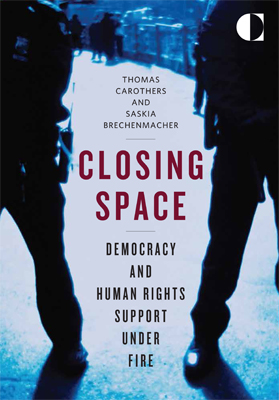
After seeing its reach increase for decades, international support for democracy and human rights now faces a serious challenge.
After seeing its reach increase for decades, international support for democracy and human rights faces a serious challenge: more and more governments are erecting legal and logistical barriers to democracy and rights programs, publicly vilifying international aid groups and their local partners, and harassing such groups or expelling them altogether. Despite the significant implications of the pushback, the roots and full scope of the phenomenon remain poorly understood and responses to it are often weak.
The trend is lasting. Restrictive measures against international support for democracy and rights are not temporary setbacks. Pushback results from fundamental changes in international politics that are likely to persist for the foreseeable future.
The response is inadequate. International reactions to the pushback phenomenon include diplomatic pressure, attempts to strengthen the international normative framework of freedom of association, and new adaptive programming. But competing interests, diverging donor perspectives, and a lack of coordination have weakened responses.
Deepen understanding of the problem. Organizations engaged in democracy support should invest the necessary institutional resources to assess the full scale of the pushback problem and develop clear policy responses. Coordination on responses needs to be strengthened and extended to a wider set of aid actors.
Account for demonstration effects. Given the pattern of copycat actions by hostile actors, aid-providing governments must shape responses based on a full consideration of the wider effects that their stance in any one country can have.
Explore new aid methods in more depth. Aid providers need to go further in investigating how innovative methods—such as support for protective technologies and new forms of distancing—can make aid more effective in less hospitable political environments.
Improve NGO-law diplomacy. Efforts to pressure governments not to adopt restrictive NGO laws have surged as an area of diplomatic engagement. Aid providers should seek to capture learning from these experiences, disseminate best practices, and strengthen such efforts.
Bolster international frameworks and advocacy efforts. Concerned governments and international NGOs should continue their efforts to fortify standards for civil society protection at the United Nations, within regional organizations, and in the post-2015 development agenda.

Harvey V. Fineberg Chair for Democracy Studies; Senior Fellow, Democracy, Conflict, and Governance Program
Thomas Carothers, a senior fellow in the Carnegie Endowment for International Peace’s Democracy, Conflict, and Governance Program, is a leading expert on comparative democratization and international support for democracy.

Senior Fellow, Democracy, Conflict, and Governance Program
Saskia Brechenmacher is a senior fellow in Carnegie’s Democracy, Conflict, and Governance Program, where her research focuses on democratic erosion, gender, and civic activism in the United States and globally. She also serves on the board of the International Center for Not-for-Profit Law.
Carnegie does not take institutional positions on public policy issues; the views represented herein are those of the author(s) and do not necessarily reflect the views of Carnegie, its staff, or its trustees.

The EU can impose sanctions but struggles to enforce them without the United States. With Washington increasingly disinterested in backing European interests, the bloc must now fend for itself.


Nicu Popescu, Tiago Antunes

Russia is testing the waters of NATO’s mutual defense clause. What do strikes in Romanian territorial waters mean for the alliance’s posture toward Moscow?

Dimitar Bechev

With its public finances in shambles, the far right polling at 35 percent ahead of the 2027 presidential election, and a growing protest movement, is France’s crisis a threat to the EU’s geopolitical awakening?

Rym Momtaz, ed.

Ahead of a tough winter for Ukraine, Donald Trump’s swing back toward Russia bodes ill. But instead of panicking, Kyiv’s European allies are focusing on action.
Rym Momtaz

Funding Ukraine remains a priority for European leaders. As Russia’s war of aggression heads into another winter, two feasible options to mobilize support for Kyiv should be fast-tracked.


Vladyslav Rashkovan, Gregory P. Wilson