

Commentary
Thomas de Waal
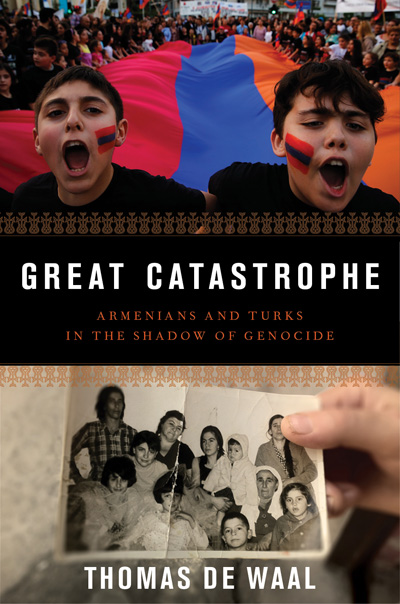
Although it is now a century old, the issue of what most of the world calls the Armenian Genocide of 1915 is still a live and divisive issue that mobilizes Armenians across the world, shapes the identity and politics of modern Turkey, and has consumed the attention of U.S. politicians for years.
Source: Oxford University Press
The destruction of the Armenians of the Ottoman Empire in 1915–1916 was the greatest atrocity of World War I. Around one million Armenians were killed, and the survivors were scattered across the world. Although it is now a century old, the issue of what most of the world calls the Armenian Genocide of 1915 is still a live and divisive issue that mobilizes Armenians across the world, shapes the identity and politics of modern Turkey, and has consumed the attention of U.S. politicians for years.
In Great Catastrophe, the eminent scholar and reporter Thomas de Waal looks at the aftermath and politics of the Armenian Genocide and tells the story of recent efforts by courageous Armenians, Kurds, and Turks to come to terms with the disaster as Turkey enters a new post-Kemalist era. The story of what happened to the Armenians in 1915-16 is well-known. Here we are told the "history of the history" and the lesser-known story of what happened to Armenians, Kurds, and Turks in the century that followed. De Waal relates how different generations tackled the issue of the "Great Catastrophe" from the 1920s until the failure of the Protocols signed by independent Armenia and Turkey in 2010. Quarrels between diaspora Armenians supporting and opposing the Soviet Union broke into violence and culminated with the murder of an archbishop in 1933. The devising of the word "genocide," the growth of modern identity politics, and the 50th anniversary of the massacres re-energized a new generation of Armenians. In Turkey the issue was initially forgotten, only to return to the political agenda in the context of the Cold War and an outbreak of Armenian terrorism. More recently, Turkey has started to confront its taboos. In an astonishing revival of oral history, the descendants of tens of thousands of "Islamized Armenians," who have been in the shadows since 1915, have begun to reemerge and reclaim their identities.Drawing on archival sources, reportage and moving personal stories, de Waal tells the full story of Armenian-Turkish relations since the Genocide in all its extraordinary twists and turns. He looks behind the propaganda to examine the realities of a terrible historical crime and the divisive "politics of genocide" it produced. The book throws light not only on our understanding of Armenian-Turkish relations but also of how mass atrocities and historical tragedies shape contemporary politics.
“This magnificent book is the ideal introduction to a difficult subject. Historically rigorous but also full of compassion, it will educate the expert as well as the curious beginner. Highly recommended for Turks, Armenians, and everyone else.”
—Stephen Kinzer, author of Crescent and Star: Turkey Between Two Worlds
“Finely researched and elegantly written, Tom de Waal’s historical travelogue is an empathetic guide to how Armenians and Turks can ease the century of pain and conflict that succeeded the genocidal Ottoman destruction of the Armenian presence in Anatolia in 1915.”
—Hugh Pope, author of Turkey Unveiled: a History of Modern Turkey
“Great Catastrophe is a frank, honest, humane effort to understand the events surrounding the Armenian Genocide and its aftermath. Thomas de Waal writes with empathy and respect for the various contending narratives while avoiding an equivocating 'balance' that dishonors the events and the victims themselves. Meticulously researched and scrupulously fair, it attempts to comprehend and recount for a broad audience the complexity and pain of the MedZ Yeghern in the hope that average Turks and Armenians might continue the process of recognition, repentance and reconciliation that will allow them both to heal and be redeemed.”
—Michael Lemmon, Former U.S. Ambassador to Armenia
Great Catastrophe: Armenians and Turks in the Shadow of Genocide
—Kirkus Review
Gunning for the G-word
—Economist
Armenia’s Genocide: Death and Denial
—Financial Times

Senior Fellow, Carnegie Europe
Thomas de Waal is a senior fellow at Carnegie Europe, specializing in Eastern Europe and the Caucasus.
Recent Work
Thomas de Waal
Thomas de Waal

The EU can impose sanctions but struggles to enforce them without the United States. With Washington increasingly disinterested in backing European interests, the bloc must now fend for itself.


Nicu Popescu, Tiago Antunes

Russia is testing the waters of NATO’s mutual defense clause. What do strikes in Romanian territorial waters mean for the alliance’s posture toward Moscow?

Dimitar Bechev

With its public finances in shambles, the far right polling at 35 percent ahead of the 2027 presidential election, and a growing protest movement, is France’s crisis a threat to the EU’s geopolitical awakening?

Rym Momtaz, ed.

Europe is facing rising populism internally as well as external pressures from Russia, China, Turkey, and the United States.
Dimitar Bechev

Much has been said of the changes Brussels is trying to make to the EU enlargement process. Here’s why gradual integration might—or might not—be the answer.
Dimitar Bechev