

Paper
Douglas H. Paal
Source: Getty
Despite increasingly strident rhetoric, new developments offer a potential opening for more constructive engagement between China and the Philippines.
China and the United States have been feeding an escalatory security dilemma in the South China Sea, with Beijing jealously protecting its extensive sovereignty claims and Washington resisting being pushed out of its traditional sphere of influence by a rising China. Each claims to be defending against the other’s actions. Their rhetoric is growing increasingly strident.
On July 12, 2016, the arbitration tribunal of the United Nations Convention on the Law of the Sea will issue its judgment (or award) on fifteen issues raised by the Philippines against Chinese claims in the South China Sea. China has refused to participate in the deliberations and has mounted a publicity campaign to dismiss the impending ruling. Beijing would be better off preparing to seize the ruling as a turning point away from increased tensions.
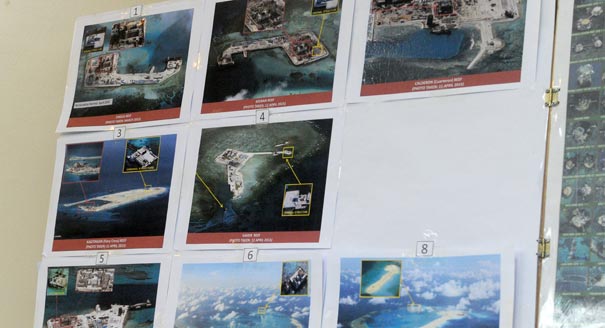
Early in 2015, Beijing touched off the latest round of escalation by using landfill to expand low- tide elevations and rocks it controls in the Spratly Islands in the South China Sea into what are effectively small military air and naval bases, though still only lightly armed. China claims these are for navigational safety, and the country’s leader, President Xi Jinping, said in September 2015 that “China does not intend to pursue militarization.”
For more than a year, U.S. officials have acted as if they fear a credibility deficit in the region, a sense that friendly governments do not believe that Washington has been doing enough to offset rising Chinese power and assertiveness in the sea, evidenced by the new artificial islands. To fill the deficit, last year the U.S. Navy commenced freedom of navigation operations in waters close to recent Chinese landfills, but unlike in most such operations, the United States has publicized these in detail. Moreover, U.S. Secretary of Defense Ashton Carter and senior military commanders have been outspoken on American interests in the area, while civilian officials have seemed almost absent. If this were happening in China, one would speculate that perhaps the military was speaking for itself and not the civilian leadership.
This noise level has had the predictable effect of provoking populist nationalism in China, making hardline policy choices more appealing (or less threatening) to the leadership than more moderate ones. If the United States wants China to show greater flexibility, its tactics are having the opposite effect. If, as some argue, China’s leaders are determined to pursue tough policies in this arena anyway, despite their rhetoric about cooperation with the United States, then a period of American restraint might at least smoke out the truth.
Now, events have created a moment of impending adversity for China that Beijing should turn into an advantage. In May 2016, the Philippines elected a new leader, President Rodrigo Duterte, who has set domestic development as his priority. He is a proud defender of Filipino sovereignty, but he does not own the dispute with China as much as his predecessor did.
Duterte said many things when campaigning, but since taking office he has indicated a willingness not to “taunt or flaunt” the arbitration’s expected findings. He has expressed openness to talking with Beijing, and his foreign secretary plans to send a special envoy to China.
When the arbitration panel’s judgments are released next week, China will have already painted itself into a corner where it will ritually and forcefully denounce the rulings. But Washington and Manila would do well to respond coolly and neither gloat nor fulminate. The two capitals should think about giving China a little space to begin to back down.
Concretely, China should seize the opportunity to talk with the Filipino special envoy to float a de-escalatory trade-off. China can promise to reopen Scarborough Shoal, which it has closed to Filipino fishermen since 2012, and keep it open to legal fishing, while withdrawing military vessels. In exchange, the Philippines can be assured that if it removes its handful of marines from Second Thomas Shoal, where they are just surviving in a derelict and crumbling old landing ship, Beijing will not take advantage and move in its own forces to occupy it. Both can agree to keep the fishing grounds open and free of military ships while their sovereignty remains disputed.
Beyond that potential trade-off, there is scope for greater investment and trade between China and the Philippines that might cool the context of their territorial disputes, which are unlikely to be settled soon and probably would be most effectively addressed bilaterally. If China has wounds to lick after July 12’s arbitration announcement, it can take satisfaction that it has demonstrated its control of some Spratly archipelago features and is in a stronger position to negotiate with its rival claimants. But China needs to get beyond that to reach the point of reconstructing relations with its neighbors.

Distinguished Fellow, Asia Program
Paal previously served as vice chairman of JPMorgan Chase International and as unofficial U.S. representative to Taiwan as director of the American Institute in Taiwan.
Recent Work
Douglas H. Paal


Douglas H. Paal, Tong Zhao, Chen Qi, …
Carnegie does not take institutional positions on public policy issues; the views represented herein are those of the author(s) and do not necessarily reflect the views of Carnegie, its staff, or its trustees.
There is an elephant in the room when it comes to the EU’s upcoming security strategy: Donald Trump. Unless European leaders acknowledge the depth of the transatlantic crisis, true autonomy will remain out of reach.

Stefan Lehne

Europe’s industrial supply chains leave it vulnerable to global shocks. The EU needs a pragmatic green industrial strategy that balances durable partnerships and bolsters homegrown clean tech without sacrificing low-carbon ambition.


Milo McBride, Pauline Gerard
Defense tech innovations will be at the heart of Europe’s new security strategy. But so far, Brussels has been making moves without a broader plan, undermining readiness and credibility.

Raluca Csernatoni

When the U.S.-Iran memorandum of understanding was announced, the UK, France, Germany, and Italy declared their readiness to help demine the Strait of Hormuz and lift nuclear sanctions on Tehran. But does Europe need new tools to recover a diplomatic role?

Rym Momtaz, ed.
The Franco-German relationship is on the rocks again. But unlike previous moments of tension, the epochal changes on the world stage require that both step up investment in their bilateral ties.
Rym Momtaz